
What will it take to stop Antarctic ice shelves from collapsing?
30 Oct 2025
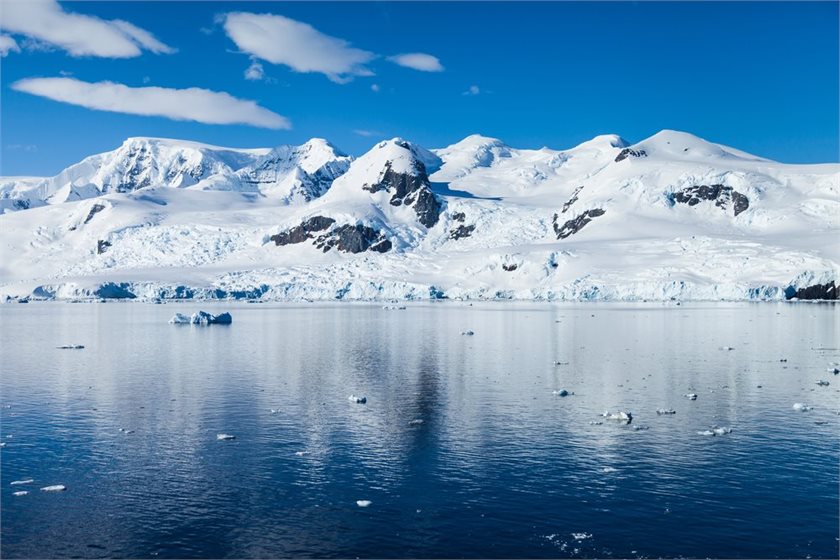
Media release: Springer Nature | Up to 59% of Antarctic ice shelves may be at risk of disappearing under high-emission scenarios by 2300, according to a comprehensive analysis of the effect of ocean warming published in Nature.
This could result in up to 10 m of global sea-level rise. The modelling suggests that ice sheet losses would be much lower under a scenario in which warming remains below 2 °C, which underscores the urgency of pursuing low emissions to safeguard Antarctic ice shelves and coastal regions.
Under warming conditions, Antarctic ice sheets are melting at an accelerated rate, and becoming a major contributor to global sea-level rise. Ice shelves surrounding the sheets act as protective barriers by restraining ice flow into the ocean, but under increasing emissions they face thinning and collapse. Previous studies have assessed future ice shelf stability but often overlook ocean warming as a key driver of decline.
To better understand when and under what conditions ice shelves may lose structural integrity, Clara Burgard and colleagues conducted simulations that accounted for both ocean and atmospheric warming.
The authors found that the point at which ice shelves become non-viable depends on the emissions scenario. Under low emissions, with warming kept below 2 °C by 2300, only 1 of the 64 shelves studied becomes non-viable, with risk increasing after 2250.
By contrast, under a high-emission scenario with warming reaching nearly 12 °C by 2300, 38 (59%) Antarctic ice shelves become non-viable, which will potentially contribute to 10 m of sea-level rise. Most shelf decline would accelerate from 2085 and peak around 2170, with ocean warming identified as the primary driver.
The authors suggest that their estimate for ice shelf disappearance under the high-emission scenario is conservative, as collapse could also be triggered by damage, rifting, fracturing and calving.
To mitigate future sea-level rise and preserve the structural integrity of Antarctic ice shelves and ice sheets, low-emission pathways must be prioritised. Improved data on ocean–ice interactions are also needed to enhance future modelling of Antarctic shelf stability.
print this story

Tauranga secures international funding to support rangatahi climate action
Thu 16 Jul 2026
Media release: Tauranga City Council | Tauranga has been selected as one of 300 cities worldwide to receive funding through the Bloomberg Philanthropies Youth Climate Action Fund, creating new opportunities for local rangatahi to turn their climate action ideas into reality.

University launches worldwide search for nature-focused researchers
Wed 15 Jul 2026
Media release | As governments and businesses around the world grapple with climate change and biodiversity loss, Waipapa Taumata Rau, University of Auckland is launching an international search for ten PhD researchers to help shape a more nature positive economy.

New entrant seeks to expand exploration portfolio
Tue 14 Jul 2026
Media release | Resources Minister Shane Jones has welcomed further investment interest in New Zealand's petroleum sector, with a recent new entrant seeking to expand its exploration interests in the offshore northern Taranaki Basin.

Fifth new petroleum application targets Taranaki
8 Jul 2026
Media release: New Zealand Government | An application targeting frontier deepwater in the Taranaki Basin marks the fifth permit application to prospect or explore for petroleum since the removal of the exploration ban, Resources Minister Shane Jones says.
Government supporting Wairarapa farmers after heavy rain
6 Jul 2026
Media release | The Government is working closely with farmers and rural communities in the Wairarapa to assess the impacts of recent heavy rain, which has damaged local roads and bridges and caused significant erosion on hillside farms.
Tarakihi on verge of extinction: Stock collapse exposes major fisheries management failings
3 Jul 2026
Media release: Environmental Defence Society | Fisheries NZ is consulting on new sustainability measures for the country’s two tarakihi stocks.

New report sounds alarm on risks of unregulated radioactivity from deep-sea mining
3 Jul 2026
Media release | A groundbreaking scientific report released today by the Deep Sea Mining Campaign exposes a critical, unaddressed threat to global ocean health: the mobilisation of naturally occurring radioactive materials by proposed deep sea mining operations.
Next Govt must restart action on plastic pollution
1 Jul 2026
Media release - Zero Waste Aotearoa | Plastic Free July begins with an urgent call to put plastic pollution back on the political agenda. Plastic Free July is a worldwide campaign to reduce plastic waste and eliminate single use plastics.
Fed Farmers back National’s plan to slash solar red tape
30 Jun 2026
Media release | Federated Farmers says the National Party's commitment to make small-scale solar projects a permitted activity is exactly the commonsense farmers need.

What whale poo reveals about survival in warming seas
30 Jun 2026
Media release: University of Auckland | During his morning runs, Rod Keogh had no doubt that the whale poo he saw washed up on the beach had value. Science has finally caught up with him.
