
AI tool predicts wildfire danger faster than current systems
26 Mar 2026
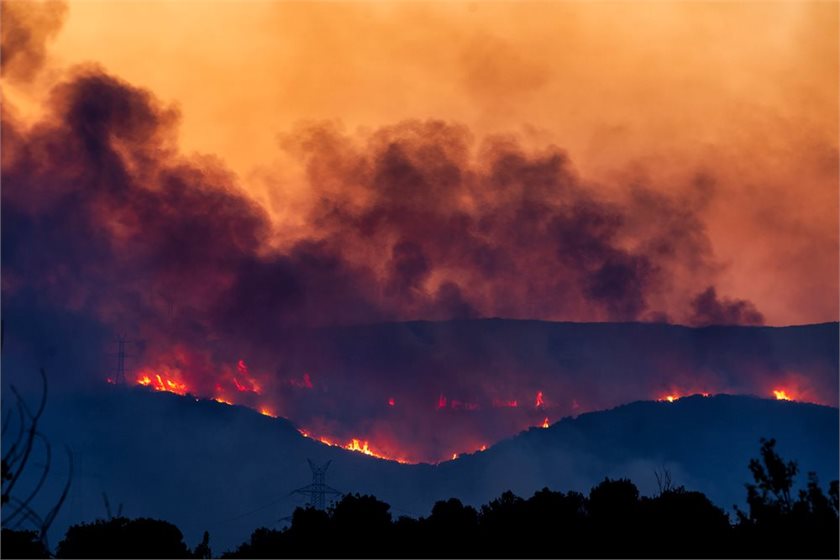
Developed by an international team led by Dr Alberto Ardid, a lecturer in Civil and Environmental Engineering at UC, the system uses machine learning to analyse weather station data and detect patterns that often occur before fires ignite.
Wildfire risk is rising globally as climate change drives hotter, drier conditions. Rapid shifts in weather can cause fire danger to spike within hours, yet many official warning systems currently update only once a day.
The UC-led research aims to address this gap with an AI-based forecasting system that updates every 30 minutes, providing near real-time insight into changing fire risk.
“Wildfires don’t wait for the daily forecast. If fire weather conditions can change within hours, our warning systems need to move just as quickly,” Dr Ardid says.
The latest study builds on earlier research published in 2025 that first demonstrated the concept using data from a single region in Queensland, Australia. The new research expands the analysis to multiple regions with different climates, including the Sunshine Coast, Brisbane and Hobart.
“We originally developed the model as a proof of concept in one region. However, in this new study we tested it across multiple regions to see whether the approach works under different fire weather conditions,” he says.
Across all three locations, the AI model consistently outperformed the standard Fire Behaviour Index, part of Australia’s official fire danger rating system. The machine-learning system improved forecasting performance by 10–30 percent, detecting significantly more fire events in advance.
Researchers evaluated the model using more than 60 years of historical weather and fire data, simulating how it would perform under real-world conditions.
The study also measured the economic value of improved forecasts, which is a new element rarely included in wildfire prediction research.
Wildfires in Australia can be devastating; in the 2019-2020 season, across the country wildfires burnt almost 17 million hectares, destroyed 1.5 billion wildlife animals, caused $1.9b in insurance claims and 33 people lost their lives.
Using a cost–loss framework, the team found the AI system could double the economic savings when compared with existing forecasting tools by reducing missed fires and unnecessary false alarms. Additionally, as the model relies on standard weather station data, it could be deployed widely without requiring new infrastructure.
Dr Ardid says the approach could also be applied in New Zealand, where similar meteorological monitoring networks already exist.
“The models rely on weather station data, which already exists through monitoring networks in New Zealand. That means the system could potentially be implemented without new infrastructure, either at a regional level for fire management agencies, or also at a more local or sector level, for example within the forestry industry.”
Faster, data-driven forecasting could help fire agencies respond earlier, allocate resources more effectively and reduce the environmental and economic impacts of large fires as wildfire risk continues to increase.
print this story

The Reality of Everything: A sold-out symposium at VUW
Thu 25 Jun 2026
Media release: Victoria University of Wellington | What do rising grocery bills, soaring insurance premiums, food producers under pressure, and growing international instability have in common? According to organisers of The Reality of Everything Symposium in Wellington, they are all part of a much bigger story – one that New Zealanders urgently want to understand.

New map highlights mining threat associated with controversial conservation reforms: Greenpeace
Wed 24 Jun 2026
Media release | Greenpeace has launched an interactive online map exposing the overlap between known deposits of minerals the Government has deemed "critical" and the public conservation land that would be easier to sell off and exploit under the Government's Conservation Amendment Bill.

Sustainability profession ‘comes of age’ – but pressure remains beneath the surface
Wed 24 Jun 2026
Media release: Sustainable Business Council | New research shows the sustainability profession in Aotearoa New Zealand has firmly established itself at the centre of business strategy – but ongoing pressures around capability, career pathways and pay are threatening to stall its progress.

Calder Stewart to invest $110m for solar across industrial portfolio
Tue 23 Jun 2026
Media release | NZ’s largest industrial landowner is preparing one of the country’s most significant industrial rooftop solar rollouts, with Calder Stewart set to invest more than $110 million in solar panels and battery storage across its property portfolio.

High Court hearing highlights the 'shrinking pool' for fisheries research and science
22 Jun 2026
Media release: Environmental Law Initiative | At the close of a four-day High Court hearing challenging the government’s under-levying of the fishing industry, the Environmental Law Initiative (ELI) says more science, research and observer coverage is needed to protect marine wildlife and ecosystems from the impacts of fishing.
Forest owners call for wider FENZ review as funding changes considered
22 Jun 2026
Media release - Forest Owners Association | The Government’s review of how Fire and Emergency New Zealand (FENZ) is funded should be accompanied by a wider examination of whether FENZ is delivering for rural communities, forest owners say.
Public conservation land maps show risk of sale
18 Jun 2026
Media release | Forest & Bird has today released new maps highlighting public conservation land across Aotearoa New Zealand that could be more exposed to development or sale.

Coromandel protections could be stripped away for mining through hidden law change
17 Jun 2026
Media release| Forest & Bird is warning that a hidden provision in the Government’s Conservation Amendment Bill could strip away long-standing protections and open up parts of the Coromandel Peninsula to mining.

ANZ confronted with petition and video screening after report exposes fossil fuel ties
15 Jun 2026
Media release: 350 Aotearoa | A petition signed by over 3000 New Zealanders was handed over to ANZ, calling on the bank to cut banking services to coal expansion companies. The petition comes as the annual ‘Banking on Climate Chaos’ report has confirmed that ANZ continues to back fossil fuel expansion.
Communities need to prepare for increased landslide risk
12 Jun 2026
Media release: Te Whare Wānanga o Waitaha University of Canterbury | New UC-led research shows where future Cyclone Gabrielle-like storms could cause more landslides and how communities can reduce the risk.
