
The one-million whale climate solution: 6000-mile voyage launches to audit ocean carbon sinks
28 Apr 2026
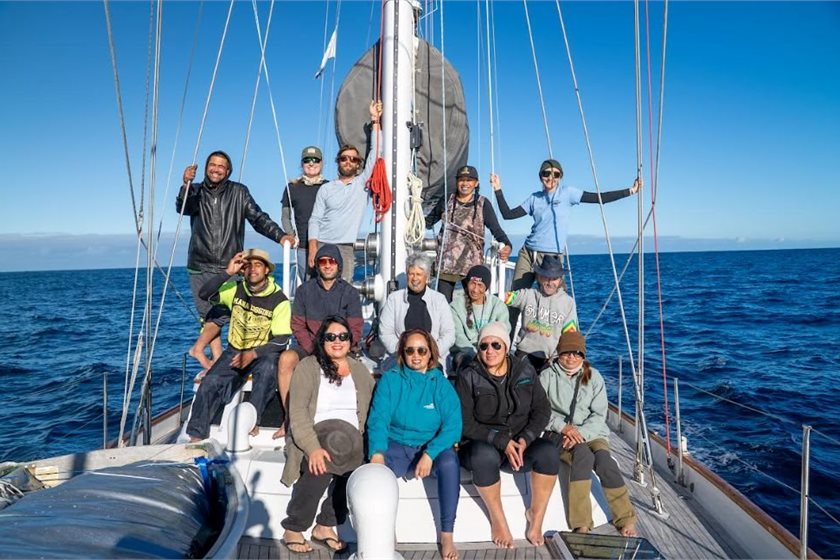
Media release: Pacific Whale Fund | An unprecedented, multi-year ocean expedition launches this week to lay the scientific and legal groundwork for recognising the recovery of whale populations as a vital climate solution across the Pacific.
The initial five-day deployment along the cyclone-prone East Coast of the North Island will use advanced environmental DNA (eDNA) to audit marine health before the mission expands across the Polynesian Triangle.
The expedition is supported by a global coalition of scientific, Indigenous, and legal partners, delivered in partnership with Apparent Winds, which supports the operational deployment of the Moananui Sanctuary's wider ocean restoration framework.
Running from 25–29 April, the East Coast mission marks the operational launch of the two-year Āvei Moana Voyage, a trans-Pacific initiative uniting Indigenous knowledge with cutting-edge science.
The expedition will operate the 75-foot ocean monitoring vessel SV Resilience, joined on the East Coast by the vessel Tangaroa, skippered by local legend and ocean protector Joe McClutchie. A US-based scientific team will conduct eDNA sampling alongside biodiversity monitoring with local hapū (tribes), gathering the rigorous empirical data required to substantiate Customary Marine Title and enforce sovereign Indigenous marine governance.
The voyage serves as the physical activation of He Whakaputanga Moana—a Pacific treaty designed to secure legal personhood for whales. Mandated by the late Māori King and championed by key leaders, including Moananui Sanctuary Chair Rāhui Papa, the Declaration has been signed by Indigenous leaders from throughout the Pacific.
It elevates whales from natural resources to right-bearing entities with the freedom to migrate and thrive. Crucially, the mission aims to establish the baselines needed to recover a population of one million whales, recognising their role as massive biological carbon sinks and vital climate engineers.
Dr. Mere Takoko, author of the Declaration and Executive Trustee of the Moananui Sanctuary, stated the mission will fundamentally shift global ocean governance.
Locally, the high-resolution data gathered will directly support the impending Customary Marine Title applications for 12 Ngāti Porou hapū. This work establishes the genetic and ecological baselines necessary to exercise Indigenous data sovereignty and prove unbroken, active management of the customary marine estate.
“Massive sediment loads from the Waiapu River are actively smothering marine habitats, driving indigenous species of shellfish like hawea and essential seaweeds to the verge of extinction,” Takoko added.
“By blending modern science with hapū-led stewardship, we are proving that our people have never relinquished the capacity or the absolute authority to audit and govern our own marine estates.”
Following the East Coast work, the Āvei Moana Voyage will expand across the Pacific along traditional ara moana (sea roads) of Ngāti Porou, travelling to Tahiti and the Marquesas, returning to Tahiti during the whale breeding season in July, and then continuing to Tonga and Samoa to harmonise legal protections with Indigenous Peoples and Local Communities (IPLCs).
The expedition is supported by a global coalition of scientific, Indigenous, and legal partners, delivered in partnership with Apparent Winds, which supports the operational deployment of the Moananui Sanctuary’s wider ocean restoration framework.
Skipper and Executive Director of Apparent Winds, Prentice “Tripp” Brower, said the Resilience is a floating marae, a place where modern science and traditional knowledge meet.
“The biological and eDNA baselines we establish over these five days will be critical for the long-term survival of these coastlines. By supporting communities to collect their own data, we’re ensuring this knowledge stays with the people protecting these ecosystems. It’s an honour to be part of a coalition that blends traditional knowledge with modern ocean science to support conservation outcomes.”
print this story

Southern Ocean might be best place to fertilise for carbon dioxide removal
Fri 31 Jul 2026
Media release: Springer Nature | The Southern Ocean and parts of the Pacific near the equator may be the best places to fertilise if we want to remove the most carbon dioxide from the atmosphere while minimising the impact on the environment, according to international research.

Greenpeace calls for citizens assembly to reform electoral finance laws
Thu 30 Jul 2026
Media release | Greenpeace is calling on all political parties to support a citizens assembly to reform electoral finance laws in light of the alarming flood of political donations threatening to drown democracy in New Zealand.
Biochar market predicted to reach US$1.6 billion by 2035
Thu 30 Jul 2026
Media release: Transparency Market Research | Strong growth in the global biochar market will be driven by sustainable agriculture and carbon sequestration initiatives.

Culture shapes the meaning of sustainability, NZ study finds
Mon 27 Jul 2026
Media release: Bioeconomy Science Institute | Cultural context changes what sustainability means to people, a new New Zealand study finds.

New funding round opens for Auckland zero waste projects – $500k available
24 Jul 2026
Media release | Auckland Council is inviting applications for the 2026 Waste Minimisation and Innovation Fund (WMIF) with $500,000 available to support projects that reduce waste and increase recycling and reuse to help achieve Auckland’s goal of zero waste by 2040.

Turning waste into climate-resilient soils for communities
24 Jul 2026
Media release: University of Canterbury | Christchurch’s Red Zone is being used as a test bed to see whether biological wastes (biowastes) can help transform contaminated soil into climate-resilient soil.

Dry-year reliability obligation should fall on generators, not major electricity users – MEUG
23 Jul 2026
Media release | The Major Electricity Users' Group (MEUG) is urging the Government to redesign its proposed dry-year reliability obligation so responsibility for securing New Zealand's electricity supply rests with generators rather than major electricity users.

Greenpeace launches legal challenge against US$2.5bn expansion by Premier Beehive parent company JBS
23 Jul 2026
Media release | Greenpeace Netherlands has petitioned a Dutch court seeking to compel the world’s largest meat company JBS, to disclose information, in order to challenge its business policies in court. This includes its planned US$ 6 billion global expansion, of which almost half is earmarked for Nigeria.

Select committee report on resource management guts environmental protections
22 Jul 2026
Media release | Forest & Bird says the Environment Committee report on the biggest overhaul of resource management law in Aotearoa New Zealand in a generation is bad news for nature.

Open Letter: Exercise restraint on LNG import facility decision ahead of the election
21 Jul 2026
The Smart Energy Alliance respectfully urges the Government not to enter into a binding commercial agreement for a liquefied natural gas (LNG) import facility in the period immediately preceding the General Election.
