
Open letter: NZ needs an essential use allocation plan for fuel – now
30 Mar 2026
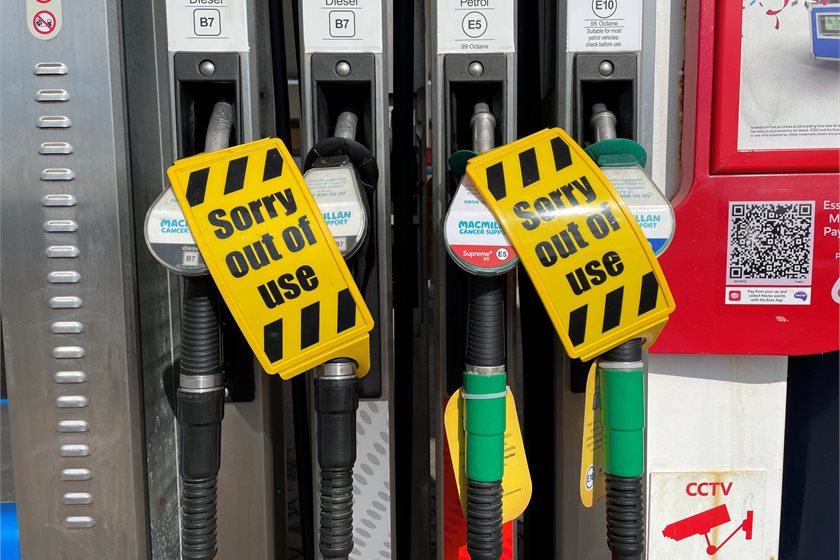
Wise Response Society | We are writing to make one demand: the government must publish a quantified, ranked essential use allocation plan for fuel - with litres-per-day allocations, tied to actual onshore stock levels and realistic resupply assumptions.
The plan announced this week is a framework, not a plan
On 27 March, the government announced a four-phase Fuel Response Plan and five prioritisation bands for fuel allocation. We welcome the fact that a framework now exists. But it has no numbers. The prioritisation bands name categories but assign no volumes. There is no ranking between bands. And the government confirmed it is still consulting on how to implement the phases that actually matter - phases 3 and 4, where fuel is rationed. They are building the lifeboat while the ship is taking on water.
NZ burns roughly 12.3 million litres of diesel per day. The government’s own figures show that only around 18 days of diesel is physically onshore as at March 27th, the rest is on ships that could be diverted, delayed, or cancelled under Force Majeure. If onshore stocks need to last three months, the daily budget drops to under 2.5 million litres, about a fifth of normal consumption. At that level, an unranked list without quantities is functionally no plan at all. As Mike Hodgkinson at Laloli Research has identified: without a pre-agreed quantified framework, allocation defaults to ad hoc decisions under pressure - rationing by political weight, not by need.
The government’s own published criteria for moving to Phase 2 include export restrictions on refineries NZ imports from. South Korea, China, and Thailand have all imposed such restrictions. By the government’s own triggers, Phase 2 should already be active.
The problem goes beyond fuel itself. Ships require bunker fuel to refuel at port. If we cannot supply bunker fuel, shipping lines will bypass New Zealand entirely. That means not just fuel, but all imported goods: medicines, machinery parts, food inputs, and the fertilisers that underpin our agricultural productivity.
The food question is immediate. A large share of what New Zealanders eat is imported. Without a rationing and allocation framework for both fuel and food, people consume what is available in the first days and then there is nothing left. Managed drawdown is the only alternative. Compounding risks - a tropical cyclone, an earthquake, a drought, or further escalation - could hit on top of an already critical fuel situation. The government’s own catastrophic risk research has identified these compound scenarios. That research needs to be acted on now.
What an essential use allocation means
If NZ reaches a point where it has days, not weeks, of usable fuel remaining, every litre must count. Drawing on the essential use allocation framework developed by Mike Hodgkinson (Laloli Research), catastrophic risk research, and independent analysis, we propose the following four-tier framework:
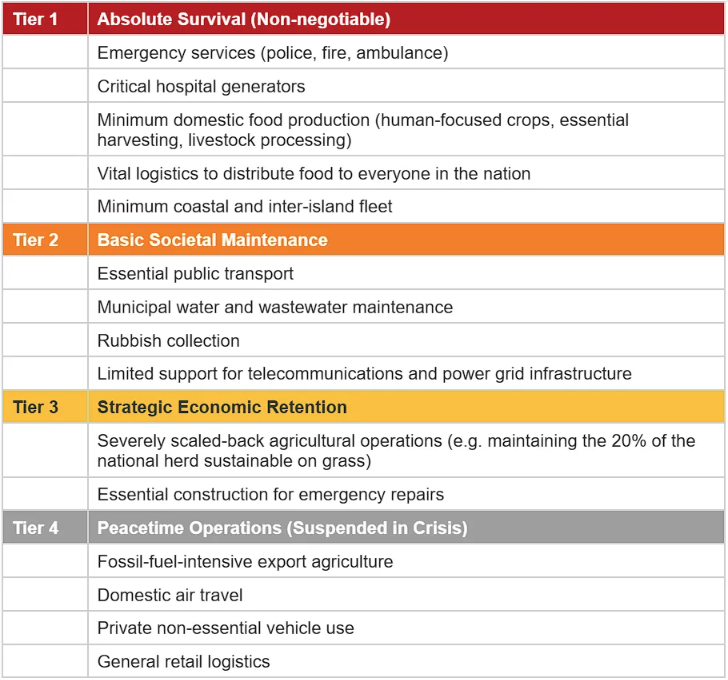
Every diesel use outside these tiers stops.
Wise Response acknowledges the work of Mike Hodgkinson in preparing this hierarchy.
Each tier needs a litres-per-day allocation based on actual stocks, projected resupply timelines, and the duration the stocks need to last. That model does not exist. Building it is urgent and should have started weeks ago.
Why this matters beyond fuel
The problem goes beyond fuel itself. Ships require bunker fuel to refuel at port. If we cannot supply bunker fuel, shipping lines will bypass New Zealand entirely. That means not just fuel, but all imported goods: medicines, machinery parts, food inputs, and the fertilisers that underpin our agricultural productivity.
The food question is immediate. A large share of what New Zealanders eat is imported. Without a rationing and allocation framework for both fuel and food, people consume what is available in the first days and then there is nothing left. Managed drawdown is the only alternative.
Compounding risks make this worse. A tropical cyclone, an earthquake, a drought, a disruption to the Panama Canal, or an escalation involving Taiwan could hit on top of an already critical fuel situation. The government’s own catastrophic risk research has identified these compound scenarios. That research needs to be acted on now.
What we are asking
-
Publish a quantified essential use allocation plan for fuel within the next seven days. Not a discussion paper. A tiered, volumetric plan with litres-per-day allocations for each priority category, based on actual onshore stock levels and projected resupply timelines.
-
Rank the 14 Critical Customer categories in explicit priority order. An unranked list does not work when there is not enough fuel for everyone on it. Someone has to come first. That decision needs to be made transparently, in advance.
-
Establish a rationing framework for food and essential goods that prioritises calories for human consumption and equitable distribution to all communities, including rural and remote areas.
-
Engage with regional councils, civil defence groups, and community organisations to build local implementation capacity. Central government cannot manage this alone. Councils need authority, resources, and clear guidance to act.
-
Be transparent with the public about the severity of the situation. The gap between what the government is saying and what the physical supply data shows is eroding public trust, and people can tell.
-
Convene cross-sector coordination including fuel companies, food producers and distributors, transport operators, health boards, and civil society to align on priorities and logistics.
To civil society, business, and community leaders
If you share these concerns, add your name. This is not a partisan statement. It is a demand for basic quantified planning that should already exist. We need industry bodies, NGOs, local government, health professionals, farmers, transport operators, and concerned citizens to get behind this call.
To show your support: Sign the Open Letter Here
print this story

The Reality of Everything: A sold-out symposium at VUW
Thu 25 Jun 2026
Media release: Victoria University of Wellington | What do rising grocery bills, soaring insurance premiums, food producers under pressure, and growing international instability have in common? According to organisers of The Reality of Everything Symposium in Wellington, they are all part of a much bigger story – one that New Zealanders urgently want to understand.

New map highlights mining threat associated with controversial conservation reforms: Greenpeace
Wed 24 Jun 2026
Media release | Greenpeace has launched an interactive online map exposing the overlap between known deposits of minerals the Government has deemed "critical" and the public conservation land that would be easier to sell off and exploit under the Government's Conservation Amendment Bill.

Sustainability profession ‘comes of age’ – but pressure remains beneath the surface
Wed 24 Jun 2026
Media release: Sustainable Business Council | New research shows the sustainability profession in Aotearoa New Zealand has firmly established itself at the centre of business strategy – but ongoing pressures around capability, career pathways and pay are threatening to stall its progress.

Calder Stewart to invest $110m for solar across industrial portfolio
Tue 23 Jun 2026
Media release | NZ’s largest industrial landowner is preparing one of the country’s most significant industrial rooftop solar rollouts, with Calder Stewart set to invest more than $110 million in solar panels and battery storage across its property portfolio.
High Court hearing highlights the 'shrinking pool' for fisheries research and science
22 Jun 2026
Media release: Environmental Law Initiative | At the close of a four-day High Court hearing challenging the government’s under-levying of the fishing industry, the Environmental Law Initiative (ELI) says more science, research and observer coverage is needed to protect marine wildlife and ecosystems from the impacts of fishing.
Forest owners call for wider FENZ review as funding changes considered
22 Jun 2026
Media release - Forest Owners Association | The Government’s review of how Fire and Emergency New Zealand (FENZ) is funded should be accompanied by a wider examination of whether FENZ is delivering for rural communities, forest owners say.
Public conservation land maps show risk of sale
18 Jun 2026
Media release | Forest & Bird has today released new maps highlighting public conservation land across Aotearoa New Zealand that could be more exposed to development or sale.

Coromandel protections could be stripped away for mining through hidden law change
17 Jun 2026
Media release| Forest & Bird is warning that a hidden provision in the Government’s Conservation Amendment Bill could strip away long-standing protections and open up parts of the Coromandel Peninsula to mining.
ANZ confronted with petition and video screening after report exposes fossil fuel ties
15 Jun 2026
Media release: 350 Aotearoa | A petition signed by over 3000 New Zealanders was handed over to ANZ, calling on the bank to cut banking services to coal expansion companies. The petition comes as the annual ‘Banking on Climate Chaos’ report has confirmed that ANZ continues to back fossil fuel expansion.
Communities need to prepare for increased landslide risk
12 Jun 2026
Media release: Te Whare Wānanga o Waitaha University of Canterbury | New UC-led research shows where future Cyclone Gabrielle-like storms could cause more landslides and how communities can reduce the risk.
