
High-tech flights tackle climate modelling dilemma
2 Mar 2026
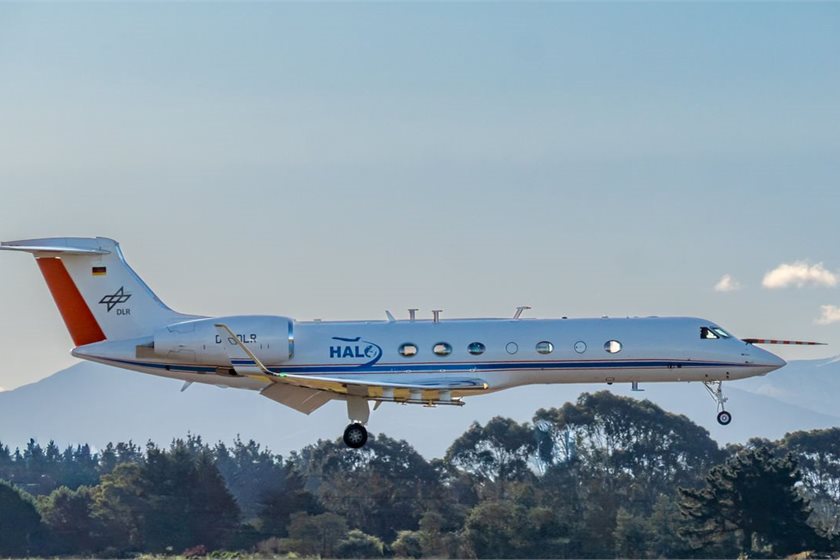
Media release – University of Canterbury | An ongoing challenge in global climate modelling is being addressed by HALO-South a German-Christchurch collaboration.
The High Altitude and Long-Range Observatory (HALO)-South mission brings together researchers from seven German research institutes led by Professor Mira Poehlker (Leibniz Institute of Tropospheric Research), and Carnegie Mellon University (Pittsburgh, USA) with Te Whare Wānanga o Waitaha | University of Canterbury (UC) and the New Zealand MetService to improve the representation of aerosols, clouds and precipitation in climate modelling.
The Intergovernmental Panel on Climate Change, which brings together the world’s most current scientific knowledge, has recognised that climate model accuracy is currently compromised by the challenge of factoring in aerosol and cloud behaviour.
An effective climate change adaptation plan for New Zealand, and for the rest of the world, depends on accurate climate modelling projections.
The German team chose Ōtautahi Christchurch as their research base for several key reasons: it has access to the clear skies of the Southern Ocean and down to the edge of Antarctica; the city has rich logistical experience as an Antarctic Gateway city to support crews; and local climate change experts are available to enhance the project with ground-based research.
Professor Adrian McDonald, UC’s Associate Head of School of Physical and Chemical Sciences and New Zealand’s lead HALO-South researcher says, “the Southern Ocean sits at the crossroads of weather systems that affect New Zealand and much of the Southern Hemisphere, but until now we haven’t had the measurements needed to properly understand what’s happening there.
“By measuring clouds in one of the cleanest atmospheric environments on Earth, we can better understand how these systems behave without human influence,” he says.
“That’s increasingly important as the world moves toward lower-emissions futures.”
HALO is a sophisticated German aircraft carrying some 22 advanced atmospheric instruments, which completed 21 research flights from Christchurch in September and October 2025.
The flights gathered data in the pristine Southern Ocean air, alongside flights measuring polluted air masses travelling towards New Zealand from Australia.
“HALO-South has successfully collected the most comprehensive set of in-situ aerosol and cloud measurements currently available over New Zealand and the Southern Ocean, filling a long-standing gap identified by the global climate modelling community.” Professor McDonald says.
HALO-South promises transformative insights into how clouds and aerosols interact within a low-emission environment. Professor McDonald and his team will use now the data in a UC-led Smart Ideas project to tune a high-resolution regional climate model for New Zealand conditions.
Alongside the research flights, extensive ground-based measurements were carried out at the Tāwhaki National Aerospace Centre, south of Christchurch and in Invercargill. More than 50 weather balloons were launched on HALO flight days, involving students from UC who gained invaluable experience working in the field. The New Zealand MetService has also used the preliminary data to support weather forecasting.
HALO-South is part of the goSouth-2 campaign and runs from 2025 to 2027. Together, these efforts are supported by more than €9 million in international investment from German research agencies, alongside New Zealand Government funding through MBIE, including $415,000 in Catalyst Strategic funding and $876,000 in Smart Ideas funding.
Under the goSouth-2 campaign, which first visited New Zealand in 2022, UC will support ACADIA - ground-based observations at Tāwhaki and Invercargill through 2026 - and will assist with ACAROA - a Southern Ocean research voyage aboard the RV Sonne during 2027 and 2028.
The project brings significant expertise to New Zealand’s shores. A workshop after the field campaign linked researchers from UC, The Air Quality Collective, Earth Sciences New Zealand, Auckland University, MetService and Victoria University of Wellington with visitors from the Leibniz Institute of Tropospheric research, University of Leipzig and University of Hannover to share initial HALO-South findings and discuss future coordinated activities. Outcomes of the project include: UC researchers joined the German U-CARE project, an Antarctica-Insync project, as collaborators and Dr Wenyue Wang has started a two-year collaborative visit at UC (funded by the Swiss National Science Foundation Mobility Award).
With Christchurch hosting major airborne, land-based and future ocean research projects, Professor McDonald says the city is well placed to play a leading role as the Antarctic and Southern Ocean Gateway City for climate science.
“This collaboration shows what’s possible when international expertise, advanced technology and local leadership come together,” he says.
print this story
Tauranga secures international funding to support rangatahi climate action
Thu 16 Jul 2026
Media release: Tauranga City Council | Tauranga has been selected as one of 300 cities worldwide to receive funding through the Bloomberg Philanthropies Youth Climate Action Fund, creating new opportunities for local rangatahi to turn their climate action ideas into reality.

University launches worldwide search for nature-focused researchers
Wed 15 Jul 2026
Media release | As governments and businesses around the world grapple with climate change and biodiversity loss, Waipapa Taumata Rau, University of Auckland is launching an international search for ten PhD researchers to help shape a more nature positive economy.

New entrant seeks to expand exploration portfolio
Tue 14 Jul 2026
Media release | Resources Minister Shane Jones has welcomed further investment interest in New Zealand's petroleum sector, with a recent new entrant seeking to expand its exploration interests in the offshore northern Taranaki Basin.

Fifth new petroleum application targets Taranaki
8 Jul 2026
Media release: New Zealand Government | An application targeting frontier deepwater in the Taranaki Basin marks the fifth permit application to prospect or explore for petroleum since the removal of the exploration ban, Resources Minister Shane Jones says.
Government supporting Wairarapa farmers after heavy rain
6 Jul 2026
Media release | The Government is working closely with farmers and rural communities in the Wairarapa to assess the impacts of recent heavy rain, which has damaged local roads and bridges and caused significant erosion on hillside farms.
Tarakihi on verge of extinction: Stock collapse exposes major fisheries management failings
3 Jul 2026
Media release: Environmental Defence Society | Fisheries NZ is consulting on new sustainability measures for the country’s two tarakihi stocks.

New report sounds alarm on risks of unregulated radioactivity from deep-sea mining
3 Jul 2026
Media release | A groundbreaking scientific report released today by the Deep Sea Mining Campaign exposes a critical, unaddressed threat to global ocean health: the mobilisation of naturally occurring radioactive materials by proposed deep sea mining operations.
Next Govt must restart action on plastic pollution
1 Jul 2026
Media release - Zero Waste Aotearoa | Plastic Free July begins with an urgent call to put plastic pollution back on the political agenda. Plastic Free July is a worldwide campaign to reduce plastic waste and eliminate single use plastics.
Fed Farmers back National’s plan to slash solar red tape
30 Jun 2026
Media release | Federated Farmers says the National Party's commitment to make small-scale solar projects a permitted activity is exactly the commonsense farmers need.
What whale poo reveals about survival in warming seas
30 Jun 2026
Media release: University of Auckland | During his morning runs, Rod Keogh had no doubt that the whale poo he saw washed up on the beach had value. Science has finally caught up with him.
