
Greenpeace's new fuel crisis scorecard: Coalition flunks, Labour offers few commitments
19 May 2026
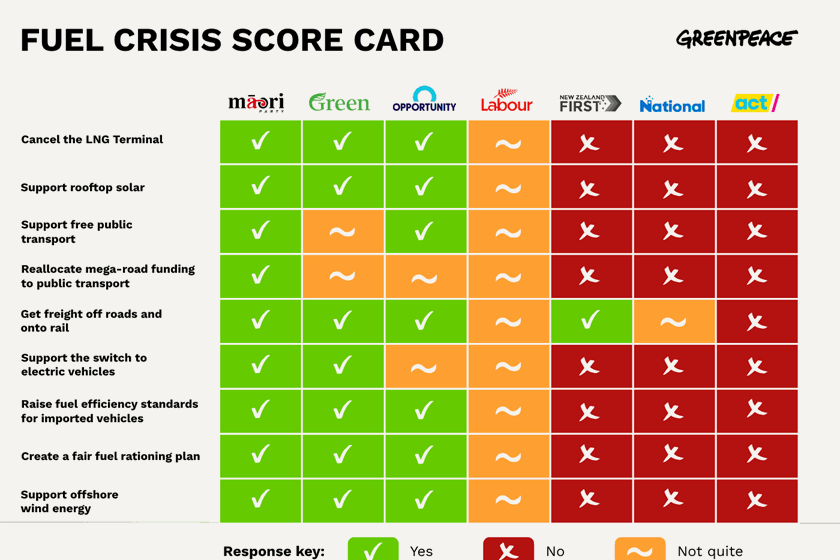
Media release | As fuel prices remain high and the Budget looms closer, Greenpeace Aotearoa has released a scorecard ranking political parties on practical solutions to cut dependence on imported fossil fuels and shield households from oil and gas price shocks.
Parties were asked nine yes-or-no questions about whether they back concrete measures including cancelling the proposed LNG import terminal, financing rooftop solar, shifting freight from roads onto rail, making public transport free, and restoring EV incentives.
The scorecard revealed starkly different policy responses to the fuel crisis. ACT scored 0 points out of 18, National scored just 1 and NZ First scored 2. Labour sat firmly in the middle scoring a 9, while Te Pāti Māori scored 18, and the Greens and Opportunity scored 16.
"We put parties to test to see who has a plan to take decisive and concrete action to cut energy costs and reduce our dependence on imported fossil fuels," says Greenpeace campaigner Gen Toop.
"National, ACT, and NZ First flunked the test, with plans to burn more money on mega-roads, and an LNG import terminal. Their abysmal ranking doesn’t bode well for the upcoming Budget.
"Te Pāti Māori, the Greens, and TOP ranked highly, after giving clear commitments to policies that would deliver homegrown renewables as the cheapest, most secure energy option, alongside electrified public transport and rail.
"Labour sat in the middle of the ranking. While they often supported the intent of the policy in question, they rarely gave a clear unconditional commitment to actually delivering it," says Toop.
One of the most striking findings was that all the current governing parties continue to back the proposed LNG import terminal, despite the soaring imported gas prices and widespread warnings against it from a range of experts including the OECD.
‘"Kiwis are already being hit hard at the pump, the supermarket and on their power bills because of expensive, imported fossil fuels. Those same fuels are driving the climate crisis, and supercharging the storms damaging our communities and environment.
"Building an LNG terminal in the middle of a global gas crisis is like trying to put out a fire with gasoline.
"Instead of wasting billions on an LNG terminal, the Government should be supporting rooftop solar to reduce household bills, cut climate pollution, and stop further obscene profits flowing to the trillion dollar oil and gas industry at the public’s expense," says Toop.
Greenpeace points to Australia as an example of effective Government policy on solar. Supported by $11 billion in government incentives, one in three Australian households now has rooftop solar. The New Zealand Government offers no financial support for household solar and only one in every 35 Kiwi homes have it.
"There are proven solutions to the fuel and climate crises already being rolled out around the world, like rooftop solar and free public transport. Our scorecard shows which political parties plan to ramp up those solutions here and which are choosing to double down on fossil fuels."
National and NZ First were the only two parties that chose not to participate in the scorecard. Their scores were assessed using their public policies and voting records.
Greenpeace has published the scorecard on its website, along with its scoring methodology.
Greenpeace is an independent environmental campaigning organisation and does not take any money from political parties or corporations. It provides independent analysis of political party policies and actions, but does not endorse any political party or tell people how to vote.
print this story
Tarakihi on verge of extinction: Stock collapse exposes major fisheries management failings
Fri 3 Jul 2026
Media release: Environmental Defence Society | Fisheries NZ is consulting on new sustainability measures for the country’s two tarakihi stocks.

New report sounds alarm on risks of unregulated radioactivity from deep-sea mining
Fri 3 Jul 2026
Media release | A groundbreaking scientific report released today by the Deep Sea Mining Campaign exposes a critical, unaddressed threat to global ocean health: the mobilisation of naturally occurring radioactive materials by proposed deep sea mining operations.
Next Govt must restart action on plastic pollution
Wed 1 Jul 2026
Media release - Zero Waste Aotearoa | Plastic Free July begins with an urgent call to put plastic pollution back on the political agenda. Plastic Free July is a worldwide campaign to reduce plastic waste and eliminate single use plastics.
Fed Farmers back National’s plan to slash solar red tape
Tue 30 Jun 2026
Media release | Federated Farmers says the National Party's commitment to make small-scale solar projects a permitted activity is exactly the commonsense farmers need.

What whale poo reveals about survival in warming seas
Tue 30 Jun 2026
Media release: University of Auckland | During his morning runs, Rod Keogh had no doubt that the whale poo he saw washed up on the beach had value. Science has finally caught up with him.

The Reality of Everything: A sold-out symposium at VUW
25 Jun 2026
Media release: Victoria University of Wellington | What do rising grocery bills, soaring insurance premiums, food producers under pressure, and growing international instability have in common? According to organisers of The Reality of Everything Symposium in Wellington, they are all part of a much bigger story – one that New Zealanders urgently want to understand.

New map highlights mining threat associated with controversial conservation reforms: Greenpeace
24 Jun 2026
Media release | Greenpeace has launched an interactive online map exposing the overlap between known deposits of minerals the Government has deemed "critical" and the public conservation land that would be easier to sell off and exploit under the Government's Conservation Amendment Bill.

Sustainability profession ‘comes of age’ – but pressure remains beneath the surface
24 Jun 2026
Media release: Sustainable Business Council | New research shows the sustainability profession in Aotearoa New Zealand has firmly established itself at the centre of business strategy – but ongoing pressures around capability, career pathways and pay are threatening to stall its progress.

Calder Stewart to invest $110m for solar across industrial portfolio
23 Jun 2026
Media release | NZ’s largest industrial landowner is preparing one of the country’s most significant industrial rooftop solar rollouts, with Calder Stewart set to invest more than $110 million in solar panels and battery storage across its property portfolio.

High Court hearing highlights the 'shrinking pool' for fisheries research and science
22 Jun 2026
Media release: Environmental Law Initiative | At the close of a four-day High Court hearing challenging the government’s under-levying of the fishing industry, the Environmental Law Initiative (ELI) says more science, research and observer coverage is needed to protect marine wildlife and ecosystems from the impacts of fishing.
