
What whale poo reveals about survival in warming seas
Today 12:00pm
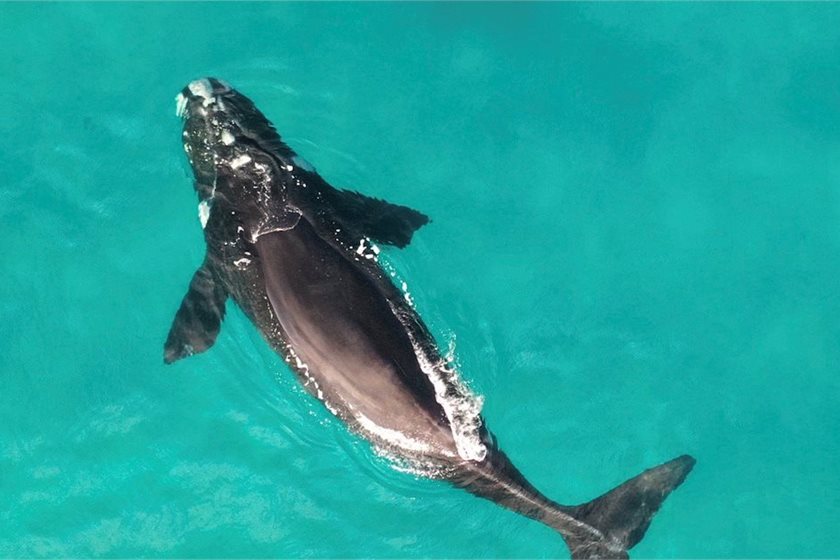
Media release: University of Auckland | During his morning runs, Rod Keogh had no doubt that the whale poo he saw washed up on the beach had value. Science has finally caught up with him.
Samples collected by the South Australian man have contributed to a groundbreaking study of the diets and microbiomes of southern right whales, led by Macquarie University in Sydney and Waipapa Taumata Rau, University of Auckland.
The whales are called tohorā in Aotearoa New Zealand.
After dwindling to as few as 400 individuals early last century because of whaling, tohorā have bounced back to around 15,000.
Distributed across the Southern Hemisphere, the whales are filter feeders who migrate between higher-latitude feeding grounds and lower-latitude socialising and breeding grounds.
The scale of the animals’ recovery has varied widely across regions, and global warming poses fresh challenges because warming waters and declines in Antarctic sea ice are altering the availability of a key food, krill.
The changes have been linked to reduced birth rates and female fitness in some tohorā populations.
Getting a more precise fix on the whales’ diets may help scientists to forecast how the creatures will adapt.
That’s where the samples stashed in Keogh’s freezer come in.
His collection of poo from Fowlers Bay in South Australia was added to samples from two locations in South Africa and from New Zealand’s sub-Antarctic Maungahuka (Auckland) Islands, contributed by the universities of Pretoria, Otago and Auckland, for analysis using molecular tools similar to DNA testing .
“Tohorā are eating a much wider variety of kai moana (seafood) than we knew,” says Associate Professor Emma Carroll of the School of Biological Sciences at the University of Auckland.
She and Dr Richard O'Rorke, also of the University of Auckland, co-supervised the research by PhD student Aashi Parikh, of Macquarie University in Australia.
“While scientists had assumed their diet was mostly krill and small crustaceans called copepods, we found that small and probably young life stages of animals like crabs, shrimp, and lobsters were actually the most commonly detected food across all locations,” says Carroll.
Jellyfish and mantis shrimp also featured.
“The bacteria living inside the whales' guts – their gut microbiome – reflected what they had been eating over a long period of time, not just their most recent meals,” says Parikh.
“Even though krill weren't commonly found in the poo, they appeared to have a lasting influence on the gut bacterial communities, suggesting krill remain an important part of the whales' diet at other times and places.”
Overall, the research offers some hopeful news.
“Tohorā appear to be flexible in what they eat, which may help them adapt as climate change alters the availability of their preferred prey in the Southern Ocean,” says Carroll. “Further research will help us understand whether these alternative food sources are able to support the health and reproductive success of tohorā in the long term.”
Keogh had been trying for years to get scientists interested before he was connected with Parikh, who analysed his collection and the other samples.
“This is the first time we’ve been able to get to the real nitty gritty of exactly what they’re eating,” says Parikh. “It’s exciting because it opens a lot of questions about what alternative prey sources they might be able to survive on if climate change continues to threaten krill and even copepod populations, as it has been over the last several decades.”
The whales’ poos are clay-like and can be grapefruit-sized.
“People expect something six feet long but it’s not like that,” says Keogh, the operator of the Fowlers Bay whale watching business EP Cruises. “By the way, I’m looking for more researchers who want whale poo – it’s hard to find people as interested as me.”
An intriguing fact: In research elsewhere, trained sniffer dogs on boats have helped scientists locate whale poo floating in the ocean.
print this story

Federated Farmers backs National’s plan to slash solar red tape
Today 12:00pm
Media release | Federated Farmers says the National Party's commitment to make small-scale solar projects a permitted activity is exactly the commonsense farmers need.

The Reality of Everything: A sold-out symposium at VUW
Thu 25 Jun 2026
Media release: Victoria University of Wellington | What do rising grocery bills, soaring insurance premiums, food producers under pressure, and growing international instability have in common? According to organisers of The Reality of Everything Symposium in Wellington, they are all part of a much bigger story – one that New Zealanders urgently want to understand.

New map highlights mining threat associated with controversial conservation reforms: Greenpeace
Wed 24 Jun 2026
Media release | Greenpeace has launched an interactive online map exposing the overlap between known deposits of minerals the Government has deemed "critical" and the public conservation land that would be easier to sell off and exploit under the Government's Conservation Amendment Bill.

Sustainability profession ‘comes of age’ – but pressure remains beneath the surface
Wed 24 Jun 2026
Media release: Sustainable Business Council | New research shows the sustainability profession in Aotearoa New Zealand has firmly established itself at the centre of business strategy – but ongoing pressures around capability, career pathways and pay are threatening to stall its progress.

Calder Stewart to invest $110m for solar across industrial portfolio
23 Jun 2026
Media release | NZ’s largest industrial landowner is preparing one of the country’s most significant industrial rooftop solar rollouts, with Calder Stewart set to invest more than $110 million in solar panels and battery storage across its property portfolio.

High Court hearing highlights the 'shrinking pool' for fisheries research and science
22 Jun 2026
Media release: Environmental Law Initiative | At the close of a four-day High Court hearing challenging the government’s under-levying of the fishing industry, the Environmental Law Initiative (ELI) says more science, research and observer coverage is needed to protect marine wildlife and ecosystems from the impacts of fishing.

Forest owners call for wider FENZ review as funding changes considered
22 Jun 2026
Media release - Forest Owners Association | The Government’s review of how Fire and Emergency New Zealand (FENZ) is funded should be accompanied by a wider examination of whether FENZ is delivering for rural communities, forest owners say.
Public conservation land maps show risk of sale
18 Jun 2026
Media release | Forest & Bird has today released new maps highlighting public conservation land across Aotearoa New Zealand that could be more exposed to development or sale.
Coromandel protections could be stripped away for mining through hidden law change
17 Jun 2026
Media release| Forest & Bird is warning that a hidden provision in the Government’s Conservation Amendment Bill could strip away long-standing protections and open up parts of the Coromandel Peninsula to mining.
