
Calder Stewart to invest $110m for solar across industrial portfolio
Today 11:45am
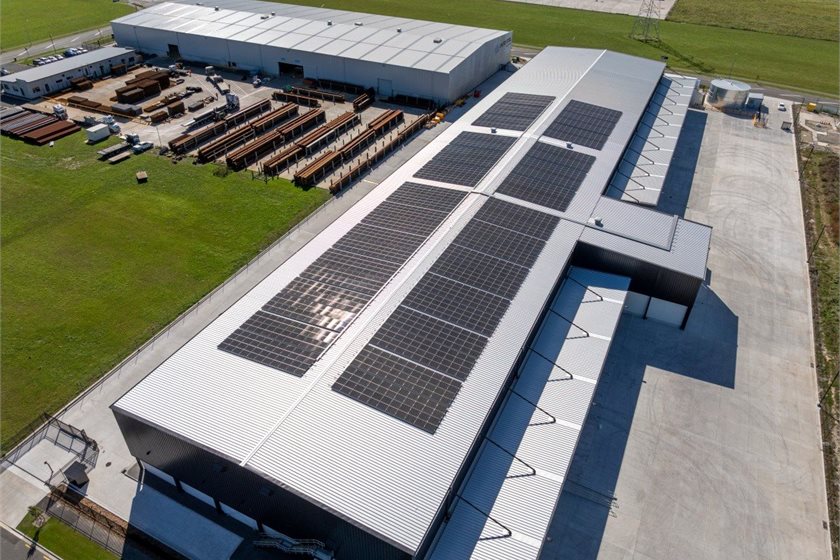
Media release | NZ’s largest industrial landowner is preparing one of the country’s most significant industrial rooftop solar rollouts, with Calder Stewart set to invest more than $110 million in solar panels and battery storage across its property portfolio.
The move will see up to 170,000 solar panels installed across industrial rooftops over the next decade, creating up to 85MW of rooftop solar capacity. The programme is designed to help lower energy costs for local and export businesses while reducing pressure on New Zealand’s electricity grid at peak demand times.
Rooftop Solar New Zealand Investment Targets Industrial Energy Costs
Calder Stewart has more than 900 hectares of zoned industrial land across Auckland, Canterbury, Otago and Southland, giving the company a large platform for distributed energy generation. Its energy arm, Calder Stewart Energy, has already installed solar systems across 17 industrial sites, covering more than 152,000m2 of roof space and capable of generating up to 3.6MW at peak output.
Those systems are expected to generate about 4.2GWh of electricity each year, which is equivalent to the annual power use of more than 500 homes.
For industrial businesses, the wider significance is not just environmental. Energy is a core operating cost for manufacturers, logistics firms and other high-use industrial occupiers. By generating power on the same site where it is used, rooftop solar can reduce the amount of electricity drawn through transmission and distribution networks.
According to the Energy Efficiency and Conservation Authority, commercial solar investment can help New Zealand businesses reduce energy costs, strengthen resilience and build long-term energy security. More information is available from EECA’s commercial-scale solar guidance.
Why Industrial Rooftops Are Becoming Energy Assets
Sam Stewart, Calder Stewart director, says sector-wide adoption of rooftop solar across New Zealand industrial sites could save millions of dollars in avoided transmission and distribution-related costs, while reducing the need for additional grid investment.
He says network losses typically add around 5% to 10% to the amount of electricity users pay for, meaning industrial businesses are effectively paying for more power than they consume onsite.
“If your meter says you have used 100 kilowatt hours, you may actually pay for 105 because of the losses across the network.
“By generating power above where it is used, we can take pressure off the lines network and reduce the cost of moving electricity across the system,” he says.
Stewart says solar will now be integrated as standard into the company’s new industrial developments, while the bulk of existing buildings are expected to be retrofitted within the next 12 months.
He says reducing the delivered cost of power could help lower the cost of producing goods for local and export markets, particularly for manufacturers, logistics firms and other energy-intensive occupiers.
“Every percentage point matters when businesses are operating in competitive markets,” Stewart says.
“If we can help reduce one of the core operating costs for industrial occupiers, that ultimately supports lower-cost production, stronger margins and a more competitive export sector.”
Rooftop Solar New Zealand Rollout Avoids Land-Use Pressure
Stewart says industrial roofs have historically been an underused asset, despite their scale and proximity to large power users. The company’s approach also avoids some of the land-use tension associated with large-scale solar farms by using existing built space rather than productive or developable land.
“We build these buildings and the roof is sitting there unused. The opportunity is to turn that into a productive asset that supports the tenant, supports the grid and creates a long-term return,” he says.
“Our model also avoids some of the land-use tensions associated with large-scale ground-mounted solar by using industrial roof space that would otherwise sit idle.”
Lower-Cost Solar Power Without Tenants Funding the Infrastructure
Ben Krieble, Calder Stewart Energy manager, says the company’s model gives tenants access to cheaper solar power without requiring them to fund or own the infrastructure themselves.
Tenants continue to buy electricity from their normal supplier, but a portion of their power comes from the rooftop solar system at a lower cost.
“Because the generation is on the roof, there are no lines charges, no network transmission losses and no levies attached to that portion of the electricity.
“That allows us to undercut the normal retail power cost because we are generating the power where it is being used.”
Krieble says some tenants are being offered power price arrangements of up to 12 years, creating greater certainty for businesses planning around energy-intensive operations.
“It is like fixing a mortgage for a longer term. On the backdrop of rising electricity prices and lines charges, fixing that operational cost line gives businesses more certainty as they plan ahead.”
Battery Storage Could Turn Industrial Sites Into a Virtual Power Plant
Battery storage is the next phase of the programme. Batteries would allow more solar power generated during the day to be stored and used when demand is higher, including morning and evening peak periods.
Stewart says batteries could also support wider energy resilience by reducing pressure on local lines networks during periods of high demand.
“The two peak periods in New Zealand are first thing in the morning and around six o’clock at night. If power has been stored onsite, or batteries have been topped up overnight when electricity is cheaper, that power can be used instead of drawing from the grid at peak times,” he says.
“That has benefits beyond the individual occupier. It helps reduce stress on the national grid and local networks.”
Krieble says once battery storage is added at scale, the company’s rooftop solar network could become a form of virtual power plant.
“When you have distributed generation and batteries across a portfolio, it is not just a generation asset. It can provide services to the network, reduce demand when the grid is under pressure and keep buildings operating from stored power,” he says.
print this story

High Court hearing highlights the 'shrinking pool' for fisheries research and science
Mon 22 Jun 2026
Media release: Environmental Law Initiative | At the close of a four-day High Court hearing challenging the government’s under-levying of the fishing industry, the Environmental Law Initiative (ELI) says more science, research and observer coverage is needed to protect marine wildlife and ecosystems from the impacts of fishing.

Forest owners call for wider FENZ review as funding changes considered
Mon 22 Jun 2026
Media release - Forest Owners Association | The Government’s review of how Fire and Emergency New Zealand (FENZ) is funded should be accompanied by a wider examination of whether FENZ is delivering for rural communities, forest owners say.
Public conservation land maps show risk of sale
Thu 18 Jun 2026
Media release | Forest & Bird has today released new maps highlighting public conservation land across Aotearoa New Zealand that could be more exposed to development or sale.
Coromandel protections could be stripped away for mining through hidden law change
Wed 17 Jun 2026
Media release| Forest & Bird is warning that a hidden provision in the Government’s Conservation Amendment Bill could strip away long-standing protections and open up parts of the Coromandel Peninsula to mining.

ANZ confronted with petition and video screening after report exposes fossil fuel ties
15 Jun 2026
Media release: 350 Aotearoa | A petition signed by over 3000 New Zealanders was handed over to ANZ, calling on the bank to cut banking services to coal expansion companies. The petition comes as the annual ‘Banking on Climate Chaos’ report has confirmed that ANZ continues to back fossil fuel expansion.
Communities need to prepare for increased landslide risk
12 Jun 2026
Media release: Te Whare Wānanga o Waitaha University of Canterbury | New UC-led research shows where future Cyclone Gabrielle-like storms could cause more landslides and how communities can reduce the risk.

NZ’s largest rooftop solar switched on at Fisher & Paykel Healthcare
11 Jun 2026
Media release | Sunergise, New Zealand’s leading commercial solar company, has switched on the country’s largest-ever rooftop solar installation at Fisher & Paykel Healthcare’s East Tāmaki campus in Auckland.
Antarctic surface melt set to increase dramatically this century, new study finds
10 Jun 2026
Media release – Victoria University | New research shows surface melting across Antarctica is set to intensify and spread dramatically over the 21st century, with melt increasing by 10 times and the area affected growing by more than 10 percent by 2100 if global temperatures continue to rise.

The environment needs fixes now, says new director
5 Jun 2026
Media release: Auckland University | Innovative solutions to environmental problems are urgently needed, because our wellbeing depends on it, says Professor Dan Tompkins, the new director of the Centre for Climate, Biodiversity and Society, Ngā Ara Whetū, at the University of Auckland.
