
Traffic silently killing Aucklanders
20 Mar 2026
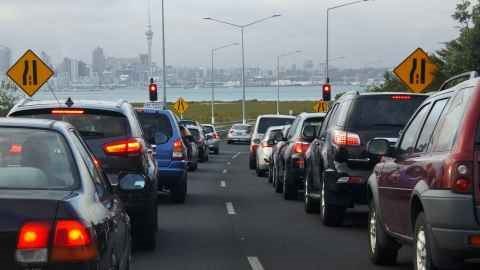
Media release: University of Auckland | Pollution from cars in Auckland is killing around 700 people a year and hospitalising 4,000 more, with health researchers calling for policy changes.
More than 700 Aucklanders die every year from air pollution from traffic, similar to the number who die from smoking cigarettes, with almost 4,000 more ending up in hospital, according to a new report.
Almost all Aucklanders, 90 percent, are exposed to dangerous levels of air pollution higher than international standards.
Nationally, 2,000 people die per year from traffic pollution.
“Because the particles are so small, they are not easy to see, so we often don’t even think about them being there,” says Dr Jamie Hosking, a public health researcher at Waipapa Taumata Rau, University of Auckland.
“Sometimes, when we’re close to traffic, we can smell the exhaust, and that’s when we really notice it. But even when we can’t smell it, it’s still there, putting our health at great risk.”
Petrol and diesel burn to produce noxious gases, chiefly nitrogen dioxide (NO2), and minute particles of soot, smoke, dust and chemicals (PM2.5).
“Because they’re so small, these particles can get right into our lungs and then cross into the bloodstream. They cause health effects through their impact on the lungs, but also on our cardiovascular system – the heart – and can contribute to strokes,” Hosking says.
A report, Our Air, has just been published on Auckland’s air pollution by Healthy Auckland Together a collective of public health researchers and agencies working in the area.
Hosking and fellow public health researcher at the University of Auckland Professor Alistair Woodward will present the report to Auckland Council’s Transport Committee and call for urgent action on Auckland’s air pollution.
Auckland’s air pollution comes partly from household heating but pollution from traffic is by far the biggest cause of illness.
It is estimated traffic pollution causes 6,100 cases and 424 hospitalisations for childhood asthma every year in Auckland.
People in cheaper housing near motorways and busy roads are at extra risk, so there are equity issues.
“It's often people on lower incomes who end up being more exposed to this dirty air and then having the health impacts as a result,” Hosking says.
What Auckland Council needs to do
The report outlines solutions. The 20 agencies comprising Healthy Auckland Together would like to see Auckland Council:
- Invest in affordable, clean and frequent public transport services
- Introduce equitable congestion charges
- Build and maintain attractive footpaths and pedestrian crossings, and protected cycle lanes
- Improve air quality monitoring
- Provide more parks and street trees
What central government needs to do
Nationally, the government needs to:
- Raise vehicle emission standards to ensure cleaner vehicles enter the country
- Update New Zealand’s air quality standards to reflect the latest health evidence
- Set transport charges – such as fuel excise, road user charges and registration fees – so they properly reflect the health and social costs caused by vehicle emissions.
Air pollution in Auckland results in a significant number of deaths and serious illnesses with unacceptable healthcare and social costs – urgent action is needed.
print this story
High Court hearing highlights the 'shrinking pool' for fisheries research and science
Today 11:00am
Media release: Environmental Law Initiative | At the close of a four-day High Court hearing challenging the government’s under-levying of the fishing industry, the Environmental Law Initiative (ELI) says more science, research and observer coverage is needed to protect marine wildlife and ecosystems from the impacts of fishing.

Forest owners call for wider FENZ review as funding changes considered
Today 11:00am
Media release - Forest Owners Association | The Government’s review of how Fire and Emergency New Zealand (FENZ) is funded should be accompanied by a wider examination of whether FENZ is delivering for rural communities, forest owners say.
Public conservation land maps show risk of sale
Thu 18 Jun 2026
Media release | Forest & Bird has today released new maps highlighting public conservation land across Aotearoa New Zealand that could be more exposed to development or sale.

Coromandel protections could be stripped away for mining through hidden law change
Wed 17 Jun 2026
Media release| Forest & Bird is warning that a hidden provision in the Government’s Conservation Amendment Bill could strip away long-standing protections and open up parts of the Coromandel Peninsula to mining.

ANZ confronted with petition and video screening after report exposes fossil fuel ties
15 Jun 2026
Media release: 350 Aotearoa | A petition signed by over 3000 New Zealanders was handed over to ANZ, calling on the bank to cut banking services to coal expansion companies. The petition comes as the annual ‘Banking on Climate Chaos’ report has confirmed that ANZ continues to back fossil fuel expansion.
Communities need to prepare for increased landslide risk
12 Jun 2026
Media release: Te Whare Wānanga o Waitaha University of Canterbury | New UC-led research shows where future Cyclone Gabrielle-like storms could cause more landslides and how communities can reduce the risk.

NZ’s largest rooftop solar switched on at Fisher & Paykel Healthcare
11 Jun 2026
Media release | Sunergise, New Zealand’s leading commercial solar company, has switched on the country’s largest-ever rooftop solar installation at Fisher & Paykel Healthcare’s East Tāmaki campus in Auckland.

Antarctic surface melt set to increase dramatically this century, new study finds
10 Jun 2026
Media release – Victoria University | New research shows surface melting across Antarctica is set to intensify and spread dramatically over the 21st century, with melt increasing by 10 times and the area affected growing by more than 10 percent by 2100 if global temperatures continue to rise.

The environment needs fixes now, says new director
5 Jun 2026
Media release: Auckland University | Innovative solutions to environmental problems are urgently needed, because our wellbeing depends on it, says Professor Dan Tompkins, the new director of the Centre for Climate, Biodiversity and Society, Ngā Ara Whetū, at the University of Auckland.

Entries open for 2026 Sustainable Business Awards
2 Jun 2026
Media release - Sustainable Business Network | Entries are now open for the 2026 Sustainable Business Awards, New Zealand’s pre-eminent sustainability awards. Now in their 24th year, the Awards celebrate outstanding innovation and leadership in sustainability.
