
Waituna Lagoon in better health for World Wetlands Day
3 Feb 2026
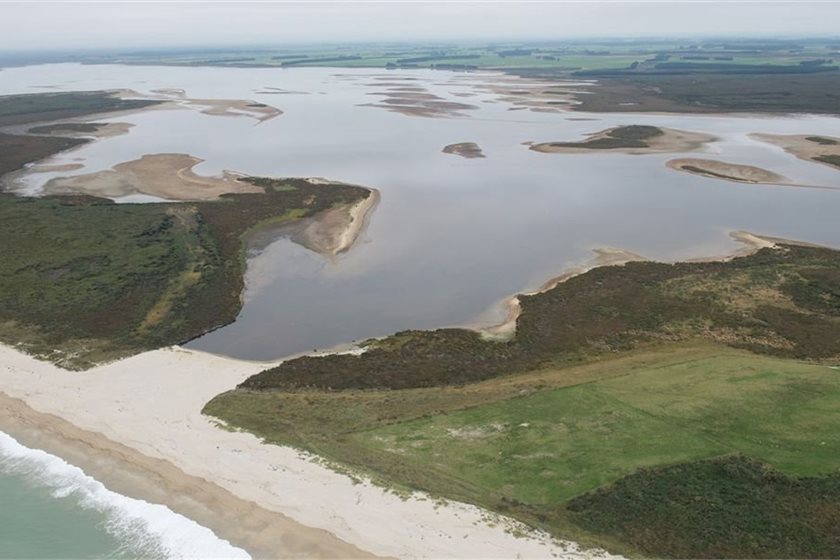
The good news coincides with the celebration of World Wetlands Day (2 February), marking the signing of the Ramsar Convention on Wetlands – a global treaty to conserve and sustainably manage all wetlands, including lakes, rivers and estuaries.
Waituna Lagoon is one of 2,520 wetlands around the world recognised as internationally important for its outstanding biodiversity values. This Ramsar site is one of the best remaining examples of a coastal lagoon in New Zealand and supports many threatened species such as Australasian bitterns and longfin eels.
Department of Conservation (DOC) River Ranger Pat Hoffmann says the results of lagoon's annual survey last summer showed it failed to meet any of the ecological targets.
"The aquatic plants that help stabilise sediment, improve water quality and provide habitat for fish were in low numbers. At that time, the survey was conducted when the lagoon was open to the sea.
"This year, DOC and Earth Sciences New Zealand carried out the survey when the lagoon had been closed for nine months so we were curious to see the results. As it turned out, the results were better than we could have expected.
"Our monitoring across 47 Waituna Lagoon sites showed most parts of the lagoon had very little algae – an indicator of poor water quality. This is terrific given the lagoon experienced an algal bloom in 2024. However, researchers note that algae abundance can increase quickly when there’s high water temperatures and calm conditions, so it's always a risk.
"Most importantly, 80 per cent of monitoring sites had the aquatic plant Ruppia present compared to 36 per cent last year. The presence and abundance of this native species is a sign of good wetland health.
"Another native species that signals a healthy freshwater ecosystem – stonewort – was also thriving. It was found in 54 per cent of sites compared to 7 per cent last year," Pat Hoffman says.
DOC Principal Science Advisor and Chair of the Ramsar Convention's global science panel Hugh Robertson says going forward, the management of both water levels and water quality will remain vital to the long-term conservation of Waituna Lagoon.
"The monitoring helps guide DOC, local iwi and other agencies efforts to look after the sensitive lagoon ecosystem. Many of New Zealand's coastal lakes and lagoons are under pressure, but the survey highlights how nature will respond in favourable conditions."
DOC, Environment Southland and Awarua Rūnaka use this data as part of ongoing efforts to conserve and restore the Waituna Lagoon Ramsar site as a taonga, for its unique biodiversity and as an important naturing site for the local community.
Background information
The Awarua-Waituna Wetlands are New Zealand's first internationally recognised wetland system under the Ramsar Convention on Wetlands, with an exceptional variety of plants and animals and extensive peatlands that store carbon. The wetlands are of great importance to Ngāi Tahu due to their long relationship with the area and wetland taonga species. The area is popular with recreational hunters and fishers.
Waituna Lagoon is a part of the wider Awarua-Waituna Wetlands and is naturally closed by a gravel barrier. An application for resource consent is in progress, to allow it to be mechanically opened to the sea, based on criteria including water level, biosecurity, ecological, water quality, and fish passage.
DOC oversees the monitoring of Ruppia and other aquatic plants and algae to determine the ecological health of the Waituna Lagoon. Six ecological targets are evaluated, such as Ruppia reproductive success.
print this story

The Reality of Everything: A sold-out symposium at VUW
Thu 25 Jun 2026
Media release: Victoria University of Wellington | What do rising grocery bills, soaring insurance premiums, food producers under pressure, and growing international instability have in common? According to organisers of The Reality of Everything Symposium in Wellington, they are all part of a much bigger story – one that New Zealanders urgently want to understand.

New map highlights mining threat associated with controversial conservation reforms: Greenpeace
Wed 24 Jun 2026
Media release | Greenpeace has launched an interactive online map exposing the overlap between known deposits of minerals the Government has deemed "critical" and the public conservation land that would be easier to sell off and exploit under the Government's Conservation Amendment Bill.

Sustainability profession ‘comes of age’ – but pressure remains beneath the surface
Wed 24 Jun 2026
Media release: Sustainable Business Council | New research shows the sustainability profession in Aotearoa New Zealand has firmly established itself at the centre of business strategy – but ongoing pressures around capability, career pathways and pay are threatening to stall its progress.

Calder Stewart to invest $110m for solar across industrial portfolio
Tue 23 Jun 2026
Media release | NZ’s largest industrial landowner is preparing one of the country’s most significant industrial rooftop solar rollouts, with Calder Stewart set to invest more than $110 million in solar panels and battery storage across its property portfolio.

High Court hearing highlights the 'shrinking pool' for fisheries research and science
Mon 22 Jun 2026
Media release: Environmental Law Initiative | At the close of a four-day High Court hearing challenging the government’s under-levying of the fishing industry, the Environmental Law Initiative (ELI) says more science, research and observer coverage is needed to protect marine wildlife and ecosystems from the impacts of fishing.

Forest owners call for wider FENZ review as funding changes considered
Mon 22 Jun 2026
Media release - Forest Owners Association | The Government’s review of how Fire and Emergency New Zealand (FENZ) is funded should be accompanied by a wider examination of whether FENZ is delivering for rural communities, forest owners say.
Public conservation land maps show risk of sale
18 Jun 2026
Media release | Forest & Bird has today released new maps highlighting public conservation land across Aotearoa New Zealand that could be more exposed to development or sale.
Coromandel protections could be stripped away for mining through hidden law change
17 Jun 2026
Media release| Forest & Bird is warning that a hidden provision in the Government’s Conservation Amendment Bill could strip away long-standing protections and open up parts of the Coromandel Peninsula to mining.

ANZ confronted with petition and video screening after report exposes fossil fuel ties
15 Jun 2026
Media release: 350 Aotearoa | A petition signed by over 3000 New Zealanders was handed over to ANZ, calling on the bank to cut banking services to coal expansion companies. The petition comes as the annual ‘Banking on Climate Chaos’ report has confirmed that ANZ continues to back fossil fuel expansion.
Communities need to prepare for increased landslide risk
12 Jun 2026
Media release: Te Whare Wānanga o Waitaha University of Canterbury | New UC-led research shows where future Cyclone Gabrielle-like storms could cause more landslides and how communities can reduce the risk.
