
Mercury powers up new geothermal generator
26 Jan 2026
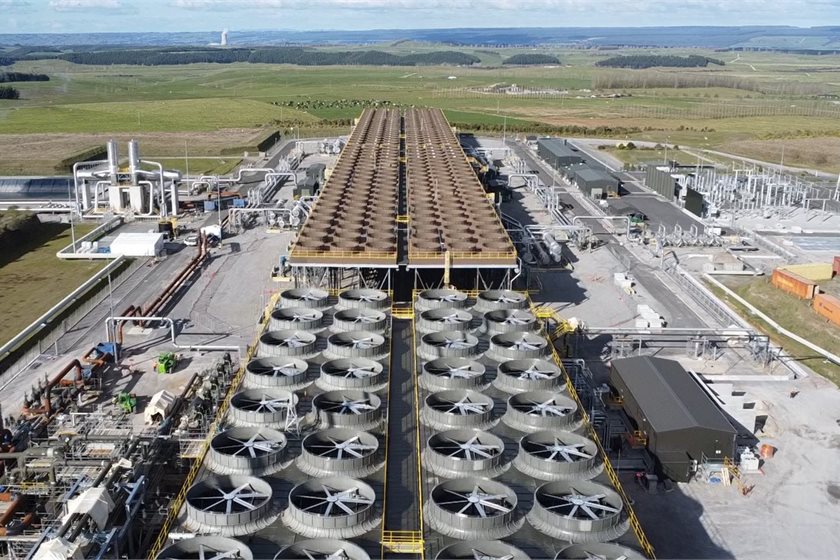
Media release | A new fifth unit at Mercury’s Ngā Tamariki Geothermal Station, near Taupō, has begun delivering generation to the grid.
The $220 million Ngā Tamariki expansion project is on track to be fully commissioned by March, adding another 46MW of renewable energy baseload capacity to the station ahead of winter, taking its installed capacity from 86MW to 132MW.
Mercury Chief Executive Stew Hamilton said bringing the fifth unit online was a significant milestone.
“The unit is currently being put through various tests as it is gradually brought up to 100% output. When it’s generating fully, the station’s annual average generation output will increase by 390GWh, providing the equivalent of enough power for about 55,000 homes - about the same as the number of residential homes in Tauranga city.”
The total annual average generation output for the station, will be about 1120GWh.That’s enough to power the equivalent of 158,000 average homes, greater than all of residential homes in Christchurch.
“The Ngā Tamariki expansion is one of three major renewable generation developments, totalling $1 billion investment, Mercury has underway. These include the Ngā Tamariki expansion, stage 2 of the Kaiwera Downs Wind Farm in Southland and the Kaiwaikawe Wind Farm in Northland,” Mr Hamilton said.
Mercury is currently reinjecting up to around 80% of non-condensable gases (NCGs), which are mostly from carbon dioxide, back into geothermal reservoirs at the first four Ngā Tamariki units. Mercury intends to introduce reinjection to the fifth generation unit, completing the $3.3 million reinjection programme.
Project background:
- The Ngā Tamariki expansion project was developed with support from Mercury's commercial partner Tauhara North #2 Trust and with mana whenua Ngāti Tahu Ngāti Whaoa to ensure the sustainability of the geothermal reservoir and management of the surrounding environment.
- As part of the expansion project, two new geothermal wells have been added. The now nine wells extend to depths of more than 3000 metres, which reach up to 290°C.
- More than 250,000 hours over 600 days have been worked on the project construction phase with no serious harm incidents.
- About 300 people have worked on the project from Mercury, contractors and consultants from Taupō, Rotorua, Hamilton, New Plymouth, Napier and beyond.
print this story

Southern Ocean might be best place to fertilise for carbon dioxide removal
Fri 31 Jul 2026
Media release: Springer Nature | The Southern Ocean and parts of the Pacific near the equator may be the best places to fertilise if we want to remove the most carbon dioxide from the atmosphere while minimising the impact on the environment, according to international research.

Greenpeace calls for citizens assembly to reform electoral finance laws
Thu 30 Jul 2026
Media release | Greenpeace is calling on all political parties to support a citizens assembly to reform electoral finance laws in light of the alarming flood of political donations threatening to drown democracy in New Zealand.
Biochar market predicted to reach US$1.6 billion by 2035
Thu 30 Jul 2026
Media release: Transparency Market Research | Strong growth in the global biochar market will be driven by sustainable agriculture and carbon sequestration initiatives.

Culture shapes the meaning of sustainability, NZ study finds
Mon 27 Jul 2026
Media release: Bioeconomy Science Institute | Cultural context changes what sustainability means to people, a new New Zealand study finds.

New funding round opens for Auckland zero waste projects – $500k available
24 Jul 2026
Media release | Auckland Council is inviting applications for the 2026 Waste Minimisation and Innovation Fund (WMIF) with $500,000 available to support projects that reduce waste and increase recycling and reuse to help achieve Auckland’s goal of zero waste by 2040.

Turning waste into climate-resilient soils for communities
24 Jul 2026
Media release: University of Canterbury | Christchurch’s Red Zone is being used as a test bed to see whether biological wastes (biowastes) can help transform contaminated soil into climate-resilient soil.

Dry-year reliability obligation should fall on generators, not major electricity users – MEUG
23 Jul 2026
Media release | The Major Electricity Users' Group (MEUG) is urging the Government to redesign its proposed dry-year reliability obligation so responsibility for securing New Zealand's electricity supply rests with generators rather than major electricity users.

Greenpeace launches legal challenge against US$2.5bn expansion by Premier Beehive parent company JBS
23 Jul 2026
Media release | Greenpeace Netherlands has petitioned a Dutch court seeking to compel the world’s largest meat company JBS, to disclose information, in order to challenge its business policies in court. This includes its planned US$ 6 billion global expansion, of which almost half is earmarked for Nigeria.
Select committee report on resource management guts environmental protections
22 Jul 2026
Media release | Forest & Bird says the Environment Committee report on the biggest overhaul of resource management law in Aotearoa New Zealand in a generation is bad news for nature.
Open Letter: Exercise restraint on LNG import facility decision ahead of the election
21 Jul 2026
The Smart Energy Alliance respectfully urges the Government not to enter into a binding commercial agreement for a liquefied natural gas (LNG) import facility in the period immediately preceding the General Election.
