
Deforestation and cropland expansion driving stronger heatwaves
29 Jan 2026
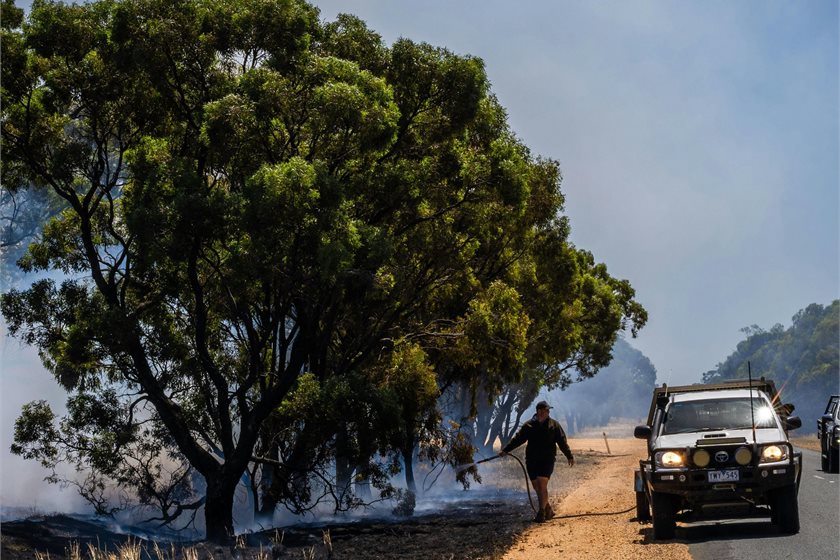
New research has revealed that land clearing and rapid development can sharply intensify heatwaves beyond the impacts of global warming, offering important lessons for many countries already grappling with record-breaking heat.
The study, currently available in press via the Nature journal Communications Earth & Environment, analysed Africa as a case study, but found universal physical mechanisms that apply directly to Australia.
Using AI-assisted climate modelling, the researchers discovered that deforestation and unplanned land-use change act as a “silent amplifier” of heat, often worsening heatwaves beyond what greenhouse-gas emissions alone would produce.
Lead author Dr Oluwafemi Adeyeri, a Research Fellow with the ARC Centre of Excellence for 21st Century Weather based at the Australian National University, says the findings are directly relevant to Australia’s current climate challenges, including recent heatwaves that impacted much of the country in January, coupled with bushfires.
“When vegetation is removed, the land loses its natural cooling system,” he said.
“This amplifies heat locally, and when combined with humidity, it produces more dangerous and longer-lasting heatwaves.”
Although the study focused on Africa, the same processes occur in South-East Queensland, northern NSW, WA’s Wheatbelt, and expanding areas on the urban fringe nationwide, where rapid development and vegetation loss are reshaping local climates. The research shows that in some African regions, heatwaves could become 12 times longer by the end of the century if high emission rates and land degradation continue.
The team also identified the growing role of compound events, where heat interacts with humidity, soil moisture deficits, and storm-forming atmospheric conditions. Queensland’s pattern of oppressive humidity followed by extreme thunderstorms in late 2025 mirrors the compound heat-moisture dynamics highlighted in the study.
Crucially, the research offers a hopeful message – mitigation works. If global emissions follow a moderate pathway rather than a high-emissions trajectory, long-duration ‘mega-heatwaves’ can be broken into shorter, less dangerous events, cutting heatwave duration and intensity by around 30% in many regions.
The authors argue that Australia’s heatwave planning must integrate land-use management with emissions reduction, including urban greening, avoiding unnecessary land clearing, and designing developments that protect, rather than erode, natural cooling processes.
“At a time when Australia is confronting unprecedented heat,” Dr Adeyeri said, “our findings show that smarter land-use choices are one of the most effective tools we have to protect communities.”
print this story
Public conservation land maps show risk of sale
Today 11:30am
Media release | Forest & Bird has today released new maps highlighting public conservation land across Aotearoa New Zealand that could be more exposed to development or sale.

Coromandel protections could be stripped away for mining through hidden law change
Wed 17 Jun 2026
Media release| Forest & Bird is warning that a hidden provision in the Government’s Conservation Amendment Bill could strip away long-standing protections and open up parts of the Coromandel Peninsula to mining.
ANZ confronted with petition and video screening after report exposes fossil fuel ties
Mon 15 Jun 2026
Media release: 350 Aotearoa | A petition signed by over 3000 New Zealanders was handed over to ANZ, calling on the bank to cut banking services to coal expansion companies. The petition comes as the annual ‘Banking on Climate Chaos’ report has confirmed that ANZ continues to back fossil fuel expansion.
Communities need to prepare for increased landslide risk
Fri 12 Jun 2026
Media release: Te Whare Wānanga o Waitaha University of Canterbury | New UC-led research shows where future Cyclone Gabrielle-like storms could cause more landslides and how communities can reduce the risk.

NZ’s largest rooftop solar switched on at Fisher & Paykel Healthcare
11 Jun 2026
Media release | Sunergise, New Zealand’s leading commercial solar company, has switched on the country’s largest-ever rooftop solar installation at Fisher & Paykel Healthcare’s East Tāmaki campus in Auckland.
Antarctic surface melt set to increase dramatically this century, new study finds
10 Jun 2026
Media release – Victoria University | New research shows surface melting across Antarctica is set to intensify and spread dramatically over the 21st century, with melt increasing by 10 times and the area affected growing by more than 10 percent by 2100 if global temperatures continue to rise.

The environment needs fixes now, says new director
5 Jun 2026
Media release: Auckland University | Innovative solutions to environmental problems are urgently needed, because our wellbeing depends on it, says Professor Dan Tompkins, the new director of the Centre for Climate, Biodiversity and Society, Ngā Ara Whetū, at the University of Auckland.

Entries open for 2026 Sustainable Business Awards
2 Jun 2026
Media release - Sustainable Business Network | Entries are now open for the 2026 Sustainable Business Awards, New Zealand’s pre-eminent sustainability awards. Now in their 24th year, the Awards celebrate outstanding innovation and leadership in sustainability.

Science losing the long game
29 May 2026
Media release: New Zealand Association of Scientists | Budget 2026 pushes the science system into a quiet purgatory, with zero announcements from the Minister’s office since 1 April.
New Plymouth residents say “no to LNG”
29 May 2026
Media release: Climate Justice Taranaki | At a public meeting in New Plymouth this Tuesday attended by about 100 local residents, the vast majority signed an ‘Urgent Plea’ to stop the proposed Liquefied Natural Gas import facility, addressed to Prime Minister Christopher Luxon, Energy Minister Simeon Brown, and Cabinet Ministers.
