
Building more sustainably in the wake of cyclones
10 Mar 2026
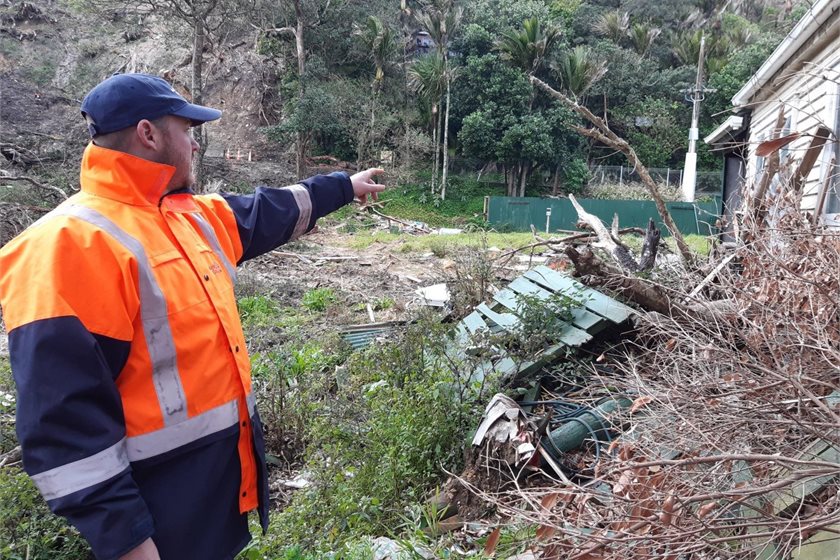
Media release | A new University of Auckland project aims to turn about 1200 Auckland houses destroyed by cyclones into a resource for a more sustainable future.
About 1200 Auckland houses destroyed by cyclones could become a resource for a more sustainable future.
University of Auckland Associate Professor of Architecture Mike Davis has launched a research project identifying reusable materials in houses that have been deemed unsafe, after being hit by Cyclone Gabrielle and floods in 2023.
The aim is to turn cyclone-damaged houses into an “urban mine” that reuses as much as possible, saving the planet from the pressures of endlessly providing brand new materials, says Davis.
“The tragedy of these houses being lost would be deepened if all the reusable materials in them were dumped in landfills.
“We need to look after the land, which is not about putting stuff in landfills, it’s about reusing materials and putting them into a circular economy,” says Davis, who works in the University’s Māori and Pacific Housing Research Centre, MĀPIHI, and Future Cities Research Centre.
Davis is mapping what materials have come out of the red-stickered houses and where these materials have gone.
“Then we can start to predict what might come out of houses that have been red-stickered or that are damaged in storms in the future,” he says.
Hand-held devices and drones are making 3D scans of various types of houses, such as Keith Hay and Universal homes, villas and bungalows, and state houses. This helps identify the quantities of various building materials typically found in each type of house.
“Building a knowledge bank of the reusable materials available from red-stickered houses will help the construction industry know what materials are likely to be available for reuse,” Davis says.
The project also aims to highlight environmentally harmful materials coming out of cyclone-devastated houses. This information will be used to develop more sustainable building practices for the future, he says.
“One example is polystyrene, which doesn’t go away, so when a house comes down after 50 years, it’s a massive problem.
“We want to look for alternatives and ask what we can learn about building better in the future.”
Davis says older houses tend to be richer repositories of valuable materials, such as kauri, matai and rimu timber.
“More than 50 percent of timbers can often be reused from earlier buildings.
“Once you get into houses from the 2000s, lots of materials are glued together and it’s much harder to reuse something that’s been glued.”
The research could have real-world impacts in expanding the quantities of building materials available at recycling centres and demolition yards, Davis says.
About 600 red-stickered houses have already been relocated or deconstructed, but another 600 have yet to be removed from properties.
“The aim is to normalise the idea of buying second-hand materials and seeing that as a positive thing.
“We’re moving away from the idea that everything has to be new, new, new, because that’s resource intensive and not sustainable.”
He aims to develop design principles that will help to future-proof housing, so it is more adaptable, more readily disassembled, and easier to repair.
“We will look at what can we do with relocated houses to make them more affordable and fit for purpose.”
Davis, who has Samoan ancestry, says a fondness for recycling and a hatred of waste is in his DNA.
His great-grandfather built churches and other buildings in the Pacific Islands, where resources are limited and valued.
“New Zealand is also two islands and when you live on an island, what you’ve got is what you’ve got, so you make it last.
“But that’s not going on in the building industry in New Zealand at the moment – there’s a rip, strip and bury mentality,” he says.
Over the past 15 years, his own creative projects have focused on recycled materials.
“We need to see those awesome old timbers as having cultural heritage as well as economic value, because there’s not much kauri coming out of our forests these days,” he says.
Results from the research are expected later this year.
print this story

NZ’s largest rooftop solar switched on at Fisher & Paykel Healthcare
Thu 11 Jun 2026
Media release | Sunergise, New Zealand’s leading commercial solar company, has switched on the country’s largest-ever rooftop solar installation at Fisher & Paykel Healthcare’s East Tāmaki campus in Auckland.

Antarctic surface melt set to increase dramatically this century, new study finds
Wed 10 Jun 2026
Media release – Victoria University | New research shows surface melting across Antarctica is set to intensify and spread dramatically over the 21st century, with melt increasing by 10 times and the area affected growing by more than 10 percent by 2100 if global temperatures continue to rise.

The environment needs fixes now, says new director
5 Jun 2026
Media release: Auckland University | Innovative solutions to environmental problems are urgently needed, because our wellbeing depends on it, says Professor Dan Tompkins, the new director of the Centre for Climate, Biodiversity and Society, Ngā Ara Whetū, at the University of Auckland.

Entries open for 2026 Sustainable Business Awards
2 Jun 2026
Media release - Sustainable Business Network | Entries are now open for the 2026 Sustainable Business Awards, New Zealand’s pre-eminent sustainability awards. Now in their 24th year, the Awards celebrate outstanding innovation and leadership in sustainability.

Science losing the long game
29 May 2026
Media release: New Zealand Association of Scientists | Budget 2026 pushes the science system into a quiet purgatory, with zero announcements from the Minister’s office since 1 April.

New Plymouth residents say “no to LNG”
29 May 2026
Media release: Climate Justice Taranaki | At a public meeting in New Plymouth this Tuesday attended by about 100 local residents, the vast majority signed an ‘Urgent Plea’ to stop the proposed Liquefied Natural Gas import facility, addressed to Prime Minister Christopher Luxon, Energy Minister Simeon Brown, and Cabinet Ministers.

Project linking food waste to cutting methane emissions gets underway
27 May 2026
Media release | Kai Commitment is leading a New Zealand-first project to help understand the connection between food waste and methane emissions and identify effective interventions.

VR tool helps communities plan for a safer, resilient future
27 May 2026
Media release: University of Canterbury | A newly developed virtual reality (VR) tool could help communities understand flood risks, raise public awareness and give decision-makers clearer information for planning.

Climate action key to affordable housing, but buildings decarbonisation stalls
21 May 2026
Media release: United Nations Environment Programme | Decarbonisation of the buildings and construction sector has slowed, leaving it both a major emissions source and increasingly vulnerable to climate impacts and energy price shocks, according to a new report from the UN Environment Programme and the Global Alliance for Buildings and Construction.

Human health appears unaffected by living near wind turbines
21 May 2026
Media release: PNAS | High-resolution data collected across the United States show negligible evidence of adverse health outcomes tied to wind turbine exposure, a study finds.
