
Degraded estuaries feel the heat
16 Dec 2025
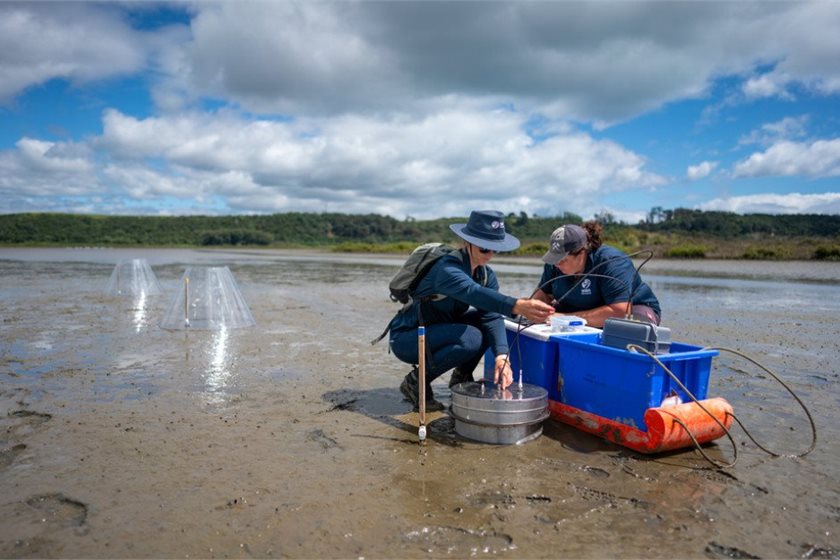
Media release | Degraded estuaries are less resilient to the impacts of heatwaves, new research from Earth Sciences New Zealand shows.
Estuaries are vital to Aotearoa New Zealand’s cultural and economic wellbeing; they also play a crucial role in the carbon cycle and can act as a carbon sinks. However, little is known about carbon cycling in intertidal sand and mudflats or how this will be affected by climate extremes such as heatwaves.
Study lead and marine ecologist Dr Emily Douglas says that these ecosystems are particularly vulnerable environments because of their dynamic nature.
“Estuary intertidal zones naturally experience large temperature changes because of incoming and outgoing tides, meaning they are exposed to both marine and atmospheric heatwaves. Estuaries are also threatened by sediments and nutrients from land, which results in muddy degraded habitats,” said Dr Douglas.
Climate change is increasing the frequency, intensity and duration of heatwaves. Scientists therefore wanted to know how temperature extremes may be impacting these ecosystems and their carbon absorption.
Dr Douglas and her team simulated a multiday atmospheric heatwave at two estuary intertidal flats at low tide – one was sandy, i.e. healthy, and the other muddy, i.e. degraded. They tested how the heatwave impacted biodiversity and shellfish, as well as the uptake and emissions of methane and carbon dioxide.
“We found that muddy sites emit more methane (a potent greenhouse gas) than sandy, healthier habitats. We also found that the sandy site was absorbing more carbon dioxide, and this increased with heatwave duration. These results tell us that climate change may alter the greenhouse gas source/sink status of our estuaries and that effects will be worse in muddy degraded estuaries,” said Dr Douglas.
The researchers also found that heatwaves changed the seafloor community. Again, these effects were greater at the muddy site compared with the sandy site.
“Overall, our findings indicate that healthy biodiverse intertidal habitats will be more resilient to global warming, and this emphasises the importance of preventing further degradation of our estuaries,” said Dr Douglas.
The team are planning another heatwave experiment this summer this time focussing on the impact of heatwaves on shellfish beds.
The research was funded by Earth Sciences New Zealand's Strategic Science Investment Fund.
It was published in Nature Communications.
print this story

High Court hearing highlights the 'shrinking pool' for fisheries research and science
Today 11:00am
Media release: Environmental Law Initiative | At the close of a four-day High Court hearing challenging the government’s under-levying of the fishing industry, the Environmental Law Initiative (ELI) says more science, research and observer coverage is needed to protect marine wildlife and ecosystems from the impacts of fishing.

Forest owners call for wider FENZ review as funding changes considered
Today 11:00am
Media release - Forest Owners Association | The Government’s review of how Fire and Emergency New Zealand (FENZ) is funded should be accompanied by a wider examination of whether FENZ is delivering for rural communities, forest owners say.
Public conservation land maps show risk of sale
Thu 18 Jun 2026
Media release | Forest & Bird has today released new maps highlighting public conservation land across Aotearoa New Zealand that could be more exposed to development or sale.
Coromandel protections could be stripped away for mining through hidden law change
Wed 17 Jun 2026
Media release| Forest & Bird is warning that a hidden provision in the Government’s Conservation Amendment Bill could strip away long-standing protections and open up parts of the Coromandel Peninsula to mining.

ANZ confronted with petition and video screening after report exposes fossil fuel ties
15 Jun 2026
Media release: 350 Aotearoa | A petition signed by over 3000 New Zealanders was handed over to ANZ, calling on the bank to cut banking services to coal expansion companies. The petition comes as the annual ‘Banking on Climate Chaos’ report has confirmed that ANZ continues to back fossil fuel expansion.
Communities need to prepare for increased landslide risk
12 Jun 2026
Media release: Te Whare Wānanga o Waitaha University of Canterbury | New UC-led research shows where future Cyclone Gabrielle-like storms could cause more landslides and how communities can reduce the risk.

NZ’s largest rooftop solar switched on at Fisher & Paykel Healthcare
11 Jun 2026
Media release | Sunergise, New Zealand’s leading commercial solar company, has switched on the country’s largest-ever rooftop solar installation at Fisher & Paykel Healthcare’s East Tāmaki campus in Auckland.

Antarctic surface melt set to increase dramatically this century, new study finds
10 Jun 2026
Media release – Victoria University | New research shows surface melting across Antarctica is set to intensify and spread dramatically over the 21st century, with melt increasing by 10 times and the area affected growing by more than 10 percent by 2100 if global temperatures continue to rise.

The environment needs fixes now, says new director
5 Jun 2026
Media release: Auckland University | Innovative solutions to environmental problems are urgently needed, because our wellbeing depends on it, says Professor Dan Tompkins, the new director of the Centre for Climate, Biodiversity and Society, Ngā Ara Whetū, at the University of Auckland.

Entries open for 2026 Sustainable Business Awards
2 Jun 2026
Media release - Sustainable Business Network | Entries are now open for the 2026 Sustainable Business Awards, New Zealand’s pre-eminent sustainability awards. Now in their 24th year, the Awards celebrate outstanding innovation and leadership in sustainability.
