Carbon News
  • Members
    • Login
      Forgot Password?
    • Not a member? Subscribe
    • Forgot Password
      Back to Login
    • Not a member? Subscribe
  • Home
  • New Zealand
    • Politics
    • Energy
    • Agriculture
    • Carbon emissions
    • Transport
    • Forestry
    • Business
  • Markets
    • Analysis
    • NZ carbon price
  • International
    • Australia
    • United States
    • China
    • Europe
    • United Kingdom
    • Canada
    • Asia
    • Pacific
    • Antarctic/Arctic
    • Africa
    • South America
    • United Nations
  • News Direct
    • Media releases
    • Climate calendar
  • About Carbon News
    • Contact us
    • Advertising
    • Subscribe
    • Service
    • Policies

NZ and US studying "huge unknown" in Antarctic climate science

11 Dec 2025
Earth Sciences New Zealand
Image: Earth Sciences New Zealand

Media release: Earth Sciences New Zealand | Scientists are measuring a huge unknown in climate science: how much heat Antarctica emits into space.

To do this, Earth Sciences New Zealand and the University of Wisconsin Space Science and Engineering Center (USA) are looking at far infrared radiation.


Principal Climate Scientist Dr Sam Dean says far infrared radiation makes up about half of the heat emitted by the Earth’s surface
"Far infrared radiation contributes to global warming via the greenhouse effect, particularly through water vapour, which is increasing in the atmosphere as a response to global warming. The more greenhouse gases and water vapour there are, the more far-infrared radiation is trapped in the atmosphere, and the more the planet warms," said Dr Dean.


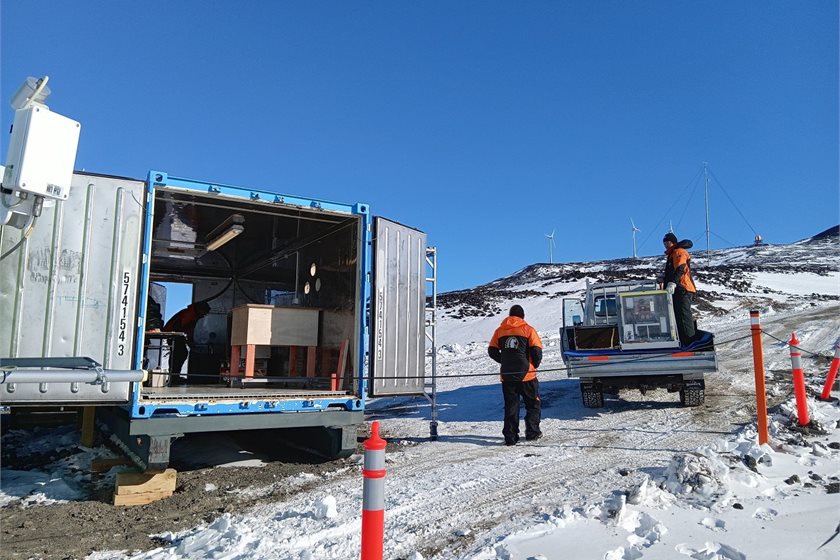
Earth Sciences NZ has just deployed an instrument called an Atmospheric Emitted Radiance Interferometer (AERI) to Antarctica, on loan from the U.S. Department of Energy. It will take novel observations of atmospheric infrared radiation, as well as constituents like greenhouse gases, over the next 12 months.


These ground-based AERI measurements are being made in conjunction with NASA's PREFIRE mission - twin, shoebox-sized satellites that are orbiting the Earth and taking the same measurements of the poles from above. The satellites were launched from Māhia Peninsula by Rocket Lab in May and June 2024.


"AERI will look up as the PREFIRE satellites look down - something that’s never been done in Antarctica before. Warming over Antarctica is a great concern as it may combine with warming oceans to accelerate ice melt, something already being seen in Greenland," said Dr Dean.


Morgan Connaughton, VP - Communications at Rocket Lab, said it’s exciting to see New Zealand scientists contributing to a globally important study leveraging spacecraft launched from right here in Aotearoa.


"Rocket Lab has launched many climate-focused missions, but being part of a mission that sees Kiwi scientists use data from satellites launched from home soil is particularly special. Space has an enormous role to play in how we better understand our planet and our impact on it. With the ability to build and launch spacecraft, and talented scientists and engineers to undertake groundbreaking studies, New Zealand is ideally positioned to be a leader in space science," said Ms Connaughton.


Earth’s poles are pivotal for helping maintain the planet’s temperature. Heating from the Sun mostly occurs in the tropics, where weather systems and oceans act to transport that heat polewards. Over Antarctica, heat is then strongly radiated to space.


"It’s vital we understand more about the greenhouse effect in the atmosphere above Antarctica and whether there are changes in the radiation to space. Our observations will allow for testing of scientific models of the greenhouse effect above Antarctica to make sure they’re correct, helping us to better predict how climate change will affect our polar regions, and vice versa," he said.


Professor Tristan L'Ecuyer of the University of Wisconsin said the lack of far-infrared measurements has limited our knowledge of the Antarctic greenhouse effect that influences ice sheet temperature, melting and refreezing, and, ultimately, global sea level.


"This collaboration between NASA, the U.S. Department of Energy and Earth Sciences New Zealand fills an important need for measurements from the ground to compliment the PREFIRE measurements and support polar climate studies," he said.


This work is part of a larger international collaboration known as SHIRE: The Southern Hemisphere polar Infrared Radiation Experiment. The AERI instrument has been provided by the U.S. Department of Energy’s Atmospheric Radiation Measurement (ARM) User Facility, with Earth Sciences NZ and the University of Canterbury deploying several additional instruments to Antarctica in the coming weeks in support of SHIRE.


With support from Antarctica New Zealand, AERI will be deployed at Scott Base until at least October 2026.

print this story


Related Topics:   Science

More >
Media releases
More >

Offshore windfarms enhance function of coastal waters and diversity of aquatic life

19 Dec 2025

Media release | A study conducted by researchers from Murdoch University in Australia and Dalian Ocean University in China has found that offshore windfarms can improve marine ecosystems and diversify aquatic food chains.

Community removes 2.6 tonnes of litter from across Lower Hutt

18 Dec 2025

Media release: Sustainable Coastlines | More than 300 volunteers came together for Clean Up The Hutt on Saturday, removing 31,493 litres of litter from coastlines, waterways, and underwater sites across nine locations in Te Awa Kairangi ki Tai Lower Hutt.

Three Greenpeace activists removed by police from Fonterra

17 Dec 2025

Media release | Three Greenpeace activists were removed by police from Fonterra’s downtown Auckland offices, following a protest on Monday at the Shareholders’ Fund meeting over the corporation’s role in the contamination of rural communities’ drinking water.

Westpac NZ announces partnership to form Blue Economy hub in Nelson

17 Dec 2025

Media release | Westpac NZ has announced a new three-year partnership with the Nelson Regional Development Agency and Kernohan Engineering to help accelerate the development of a sustainable marine economy – also known as the blue economy.

Degraded estuaries feel the heat

16 Dec 2025

Media release| Degraded estuaries are less resilient to the impacts of heatwaves, new research from Earth Sciences New Zealand shows.

South Island marine reserves get the go ahead

15 Dec 2025

Media release: Environmental Defence Society | A new network of marine reserves off the Otago and south-Canterbury coast is being finalised after years of effort.

Mission for ancient climate clues beneath 500m of antarctic ice gets underway

15 Dec 2025

Media release: Antarctica New Zealand | An international team has set up a remote camp on the ice 700 km from the nearest base (New Zealand’s Scott Base) to attempt to drill for mud and rocks holding critical insights about the fate of the West Antarctic Ice Sheet in our warming world.

High risk of economic losses from Cook Islands nodule extraction and sales – new study

12 Dec 2025

Media release: Greenpeace | The economic potential of seabed polymetallic nodules in the Cook Islands has been overstated, according to a new independent study commissioned by Greenpeace International.

Oil and gas majors would create $78bn more value by stopping exploration

11 Dec 2025

Media release | Ten of the world’s largest oil and gas companies would create significantly more shareholder value by ending exploration and sharply curtailing upstream development, according to new analysis released today by ACCR.

Carbon News

Subscriptions, Advertising & General

[email protected]

Editorial

[email protected]

We welcome comments, news tips and suggestions - please also use this address to submit all media releases for News Direct).

Useful Links
Home About Carbon News Contact us Advertising Subscribe Service Policies
New Zealand
Politics Energy Agriculture Carbon emissions Transport Forestry Business
International
Australia United States China Europe United Kingdom Canada Asia Pacific Antarctic/Arctic Africa South America United Nations
Home
Markets
Analysis NZ carbon price
News Direct
Media releases Climate calendar

© 2008-2026 Carbon News. All Rights Reserved. • Your IP Address: 216.73.216.166 • User account: Sign In

Please wait...
Audit log: