
All Aboard: New electric trains for Lower North Island
8 Sep 2025
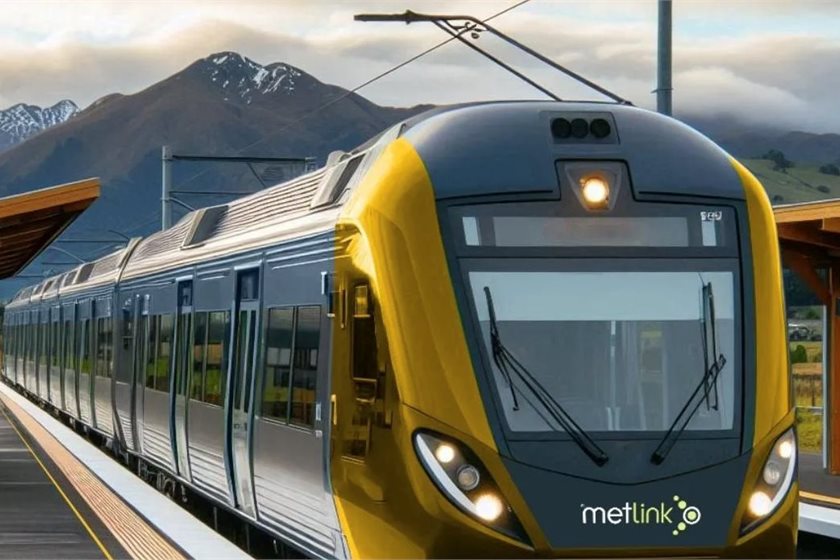
Media release - Minister of Transport | Government’s $802.9 million investment into the Wairarapa and Manawatū rail lines has now reached a major milestone, with Greater Wellington Regional Council today signing a contract for a new fleet of 18 battery electric multiple unit (BEMU) trains, Transport Minister Chris Bishop says.
“French multinational rail transport systems manufacturer, Alstom, has been selected to deliver 18 state-of-the-art battery-electric trains, the first to operate in New Zealand. The new train fleet will significantly improve travel times and passenger experience on the Wairarapa and Manawatū lines,” Mr Bishop says.
“These new trains will replace the ageing diesel locomotive-hauled fleet which dates back to the 1970s and has frustrated commuters for years. They will deliver faster, more frequent and more reliable services for passengers travelling between Wellington, the Wairarapa and the Manawatū.
“This upgrade will enable the doubling of peak services on both lines and additional off-peak services. We expect up to 15-minute travel time savings for commuters between Wellington and Masterton, and increased speeds on the Wairarapa line.
“These modern battery electric trains will deliver real benefits for commuters, increase productivity, support economic growth, and allow Kiwis to get where they need to go quickly and safely.
“Delivering reliable, effective, and efficient public transport is a priority for our Government. We campaigned on delivering the Lower North Island Rail Integrated Mobility Programme (LNIRIM) to improve service reliability, provide more travel choices for commuters, and reduce congestion on our roads – and I’m pleased to see this progress.”
The Government is funding approximately 90% of the costs for the procurement of the trains and infrastructure upgrades on the two lines, with the remainder funded by two regional councils, Greater Wellington Regional Council (GWRC) and Horizons Regional Council (HRC).
Greater Wellington chair Daran Ponter says Alstom was selected through a robust, two-stage global procurement process.
“With a focus on providing passengers with comfortable and accessible rail journeys, we welcome Alstom to the LNIRIM programme to design and build trains for New Zealand conditions and to maintain the fleet for 35 years,” Cr Ponter says.
“Designed for New Zealand conditions, the new trains switch to batteries on tracks without overhead power, using technology proven in countries like Japan and Germany.”
Horizons chair Rachel Keedwell says the new train fleet will be named ‘Tūhono’, meaning ‘to connect or unite’, representing how urban centres and regional communities will be better connected.
“Tūhono trains will help our regions thrive by improving access to work, education and recreation for heartland New Zealand,” Cr Keedwell says.
The new trains are scheduled to enter service from 2030.
print this story
New funding round opens for Auckland zero waste projects – $500k available
Fri 24 Jul 2026
Media release | Auckland Council is inviting applications for the 2026 Waste Minimisation and Innovation Fund (WMIF) with $500,000 available to support projects that reduce waste and increase recycling and reuse to help achieve Auckland’s goal of zero waste by 2040.

Turning waste into climate-resilient soils for communities
Fri 24 Jul 2026
Media release: University of Canterbury | Christchurch’s Red Zone is being used as a test bed to see whether biological wastes (biowastes) can help transform contaminated soil into climate-resilient soil.

Dry-year reliability obligation should fall on generators, not major electricity users – MEUG
Thu 23 Jul 2026
Media release | The Major Electricity Users' Group (MEUG) is urging the Government to redesign its proposed dry-year reliability obligation so responsibility for securing New Zealand's electricity supply rests with generators rather than major electricity users.

Greenpeace launches legal challenge against US$2.5bn expansion by Premier Beehive parent company JBS
Thu 23 Jul 2026
Media release | Greenpeace Netherlands has petitioned a Dutch court seeking to compel the world’s largest meat company JBS, to disclose information, in order to challenge its business policies in court. This includes its planned US$ 6 billion global expansion, of which almost half is earmarked for Nigeria.
Select committee report on resource management guts environmental protections
Wed 22 Jul 2026
Media release | Forest & Bird says the Environment Committee report on the biggest overhaul of resource management law in Aotearoa New Zealand in a generation is bad news for nature.
Open Letter: Exercise restraint on LNG import facility decision ahead of the election
Tue 21 Jul 2026
The Smart Energy Alliance respectfully urges the Government not to enter into a binding commercial agreement for a liquefied natural gas (LNG) import facility in the period immediately preceding the General Election.
Tauranga secures international funding to support rangatahi climate action
16 Jul 2026
Media release: Tauranga City Council | Tauranga has been selected as one of 300 cities worldwide to receive funding through the Bloomberg Philanthropies Youth Climate Action Fund, creating new opportunities for local rangatahi to turn their climate action ideas into reality.

University launches worldwide search for nature-focused researchers
15 Jul 2026
Media release | As governments and businesses around the world grapple with climate change and biodiversity loss, Waipapa Taumata Rau, University of Auckland is launching an international search for ten PhD researchers to help shape a more nature positive economy.

New entrant seeks to expand exploration portfolio
14 Jul 2026
Media release | Resources Minister Shane Jones has welcomed further investment interest in New Zealand's petroleum sector, with a recent new entrant seeking to expand its exploration interests in the offshore northern Taranaki Basin.

Fifth new petroleum application targets Taranaki
8 Jul 2026
Media release: New Zealand Government | An application targeting frontier deepwater in the Taranaki Basin marks the fifth permit application to prospect or explore for petroleum since the removal of the exploration ban, Resources Minister Shane Jones says.
