
Marae resilience research takes global stage
29 Aug 2025
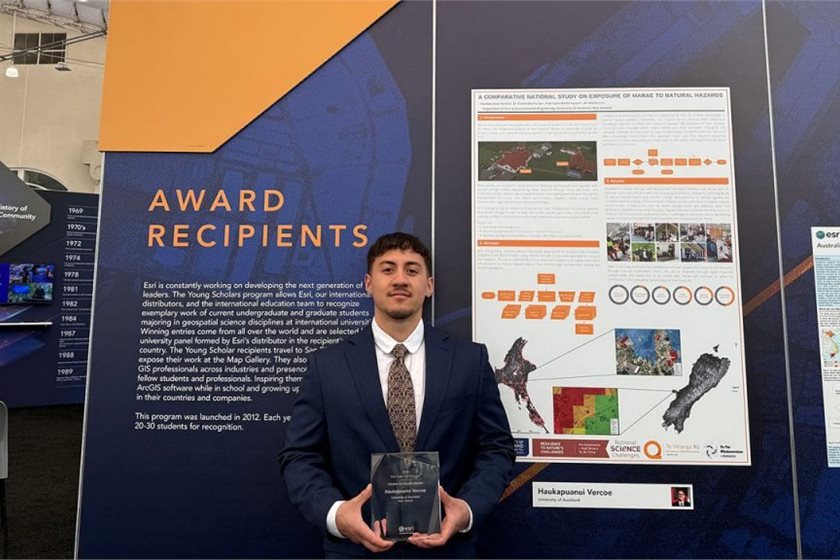
Media release | University of Auckland - Waipapa Taumata Rau | Marae are central hubs for whānau, hapū, and iwi across Aotearoa New Zealand.
But beyond their cultural and social importance, PhD researcher Haukapuanui Vercoe (Te Arawa, Tūwharetoa, Raukawa, Te Āti Haunui-a-Pāpārangi, Ngāti Kahungunu, Ngāti Pāhauwera, Ngāi Tahu) says marae often serve as frontline centres of civil defence during flooding, earthquakes, tsunamis, and other natural hazards.
Vercoe’s groundbreaking research, ‘Adaptations of Marae for Natural Hazards Resilience’, has earned him the prestigious 2025 New Zealand Esri Young Scholar Award, sponsored by Eagle Technology. The award recognises emerging researchers using GIS (or Geographic Information Systems) and spatial science to address real-world challenges.
As part of this recognition, Vercoe represented Aotearoa at the Esri User Conference in San Diego, US.
His research brings together civil engineering, geospatial science, and Mātauranga Māori. By combining spatial analysis with kaupapa Māori methodologies, Vercoe has assessed the exposure of 835 marae to natural hazards and identified strategies to strengthen community resilience.
Key findings show that in a 100-year hazard event:
- Five percent of marae are exposed to coastal flooding and tsunami inundation
- 40 percent would experience a potentially damaging shaking in an earthquake
- 20 percent could be affected by liquefaction
- 45 percent sit within flood zones
Overall, two-thirds (67 percent) of marae are exposed to at least one hazard, while one-third (33 percent) are not.
The most at-risk marae face up to four different hazards – a total of 10 marae across the motu.
“Because GIS and mapping are universal languages, we should be harnessing this technology more in our Māori communities to communicate information,” says Vercoe.
“They say a picture is worth 1,000 words – but a map is worth 10,000.”
My hope is that this research strengthens recognition of marae contributions and leads to greater government support for marae infrastructure and climate resilience.
His research underlines the vital role marae already play in response, recovery and relief efforts during natural disasterssuch as the Canterbury earthquakes and Cyclone Gabrielle.
“Indigenous populations, including Māori, are disproportionately affected by natural hazards and climate change,” he says.“Marae open their doors at their own expense to support not just their people, but the wider community.
“My hope is that this research strengthens recognition of marae contributions and leads to greater government support for marae infrastructure and climate resilience. They already do a tremendous job – imagine what more could be achieved with proper resourcing.”
Sharing Māori solutions with the world
Vercoe says taking this kaupapa to an international audience was “deeply meaningful”.
“Representing our whānau, hapū, iwi and marae on the global stage was a privilege and an opportunity to share the uniqueness of our culture with the world. From my perspective, this award is from and for the people. Ehara taku toa i te toa takitahi, engari he toa takitini.”
At the Esri User Conference, Vercoe presented a poster on his research and connected with Indigenous communities and GIS leaders worldwide. He also explored emerging applications of GIS, including artificial intelligence for faster, more accurate spatial analysis.
Recent milestones in his work include:
- Completion of a national marae multi-hazard exposure assessment
- Publication of a journal article on culturally grounded engagement with Te Arawa marae
- Research cited in the Waitangi Tribunal Climate Change Inquiry (Wai 3325)
- Continued advancement of community-led, culturally informed resilience research
Vercoe attributes his research approach to his upbringing.
“My time in kōhanga reo and kura kaupapa Māori taught me simple but powerful lessons – like mihi to the hau kāinga, doing karakia, taking kai and koha to hui, and understanding tikanga around when to talk, when to listen, and even the importance of ‘tea-towel-tanga’,” he says.
“Being a pā kid has shaped my ability to engage meaningfully with marae, which has been central to the success of this project.”
print this story
Government biodiversity credit scheme welcomed as opportunity for restoration
Tue 12 May 2026
Media release | Forest & Bird says today’s Government announcement supporting the development of voluntary biodiversity credit schemes has potential to bring about much needed investment into nature restoration.

Stripy wind turbines could save some birds
Fri 8 May 2026
Media release: Royal Society Interface | Preventing birds from colliding with wind turbine blades could be as simple as a few paint stripes, according to international researchers, who say this could help protect wildlife as renewable energy expands.

More red lights for cars might mean more green lights for sustainable transport
7 May 2026
Media release: Royal Society Open Science | Reducing the amount of green light time for cars at traffic lights could encourage commuters to switch to more sustainable transport.

Stormwater conference to tackle growing flood risks and climate challenges
6 May 2026
Media release: Water New Zealand | More than 600 stormwater professionals will gather at the Water New Zealand Stormwater Conference and Expo to address one of our most pressing infrastructure challenges – how to manage stormwater in an era of more frequent and intense rainfall.
EDS urges MPs to scrap the Fisheries Amendment Bill
5 May 2026
Media release | The Environmental Defence Society today lodged a substantive submission on the Fisheries Amendment Bill.

Christchurch youth to lead local climate action through global fund
5 May 2026
Media release: Christchurch City Council | Christchurch has been announced as one of 300 cities selected to take part in the Bloomberg Philanthropies Youth Climate Action Fund, a global initiative empowering young people to design and deliver practical climate solutions in their own communities.

Community feedback sought on plan to reduce emissions in the Kāpiti Coast
4 May 2026
Media release | Kāpiti Coast District Council is seeking feedback on its draft Emissions Reduction Plan that aims to cut the district’s greenhouse gas emissions as part of Council’s goal of a ‘net zero’ emissions by 2040.

Health-framed messages are twice as effective at shifting people's attitudes and policy support on climate change
4 May 2026
Media release: Global Climate and Health Alliance | Major study in Brazil, India, Japan and South Africa finds that evidence of climate risks to health increases public support for climate action twice as often as other climate-related messages.

The one-million whale climate solution: 6000-mile voyage launches to audit ocean carbon sinks
28 Apr 2026
Media release: Pacific Whale Fund | An unprecedented, multi-year ocean expedition launches this week to lay the scientific and legal groundwork for recognising the recovery of whale populations as a vital climate solution across the Pacific.

UC researcher shortlisted for $1m global planet prize
23 Apr 2026
Media release | Te Whare Wānanga o Waitaha University of Canterbury PhD candidate and research associate Daniel Hernández-Carrasco is one of 25 scientists worldwide recognised in the 2026 Frontiers Planet Prize for research helping humanity stay within Earth’s environmental limits.
