
Methanexit? New report reveals risk of subsidising gas price hikes
16 Dec 2024
 |
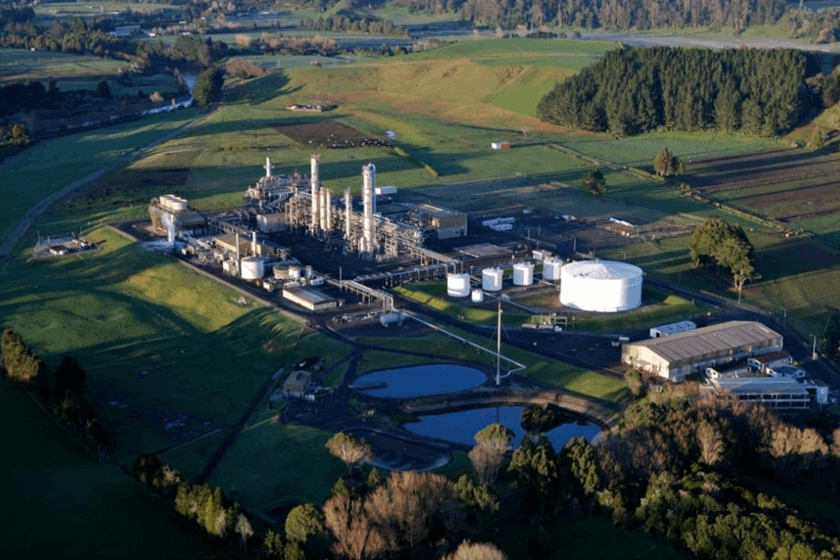
| Methanex's Waitara Valley methanol plant. PHOTO: Methanex |
Media release | A dry winter in 2025 or beyond could enable our largest gas user – Canadian company Methanex – to push up gas and electricity prices, according to a new report, titled “Methanexit: should NZ be subsidising our largest gas user?”
The report – released by 350 Aotearoa, Common Grace Aotearoa and the Centre for International Corporate Tax Accountability and Research (CICTAR) – argues that tightening gas supplies and declining production margins are increasingly shifting Methanex’s business model from methanol production to on-selling gas, at a significant mark-up.
“Methanex’s revenue is down 58 percent in the last decade, it’s generated losses in four of the past five years. We believe Methanex will exit the market at or before the 2029 conclusion of its current gas contracts”, said report author Edward Miller.
“In the meantime as supply contracts, we are concerned the company’s large gas contracts could enable it to influence gas and electricity prices, contributing to another wave of closures and redundancies across the manufacturing sector. Existing analyses suggest that Methanex may have achieved a 400 percent markup on gas sales to electricity generators during the 2024 dry winter,” said Miller.
The report argues that subsidies from our climate and tax rules may have helped sustain the company in this position.
“In the last decade Methanex has received an estimated $301 million in free carbon credits, at the same time that firm profitability has declined. If Methanex has stockpiled units, they could be worth substantially more. Current reporting requirements around company stockpiles are inadequate”, said Miller.
“In addition, interest payments on related party loans also appear to have reduced the company’s taxable earnings by $257.4 million over the decade, which could have in turn reduced income tax expense by $46.3 million.”
“MBIE has told us that the main plank of this government’s energy security strategy – reversing the offshore ban – will take more than a decade to bear fruit. Increasing renewable generating and storage capacity is a cheaper and more reliable option, but that will still take years. In the short-term, the government may need to rely on demand-side measures, particularly around largest gas user Methanex, to safeguard energy security and prevent price hikes.”
Miller said the government must carefully consider how it is subsidising Methanex, and engage directly with the company to ensure it doesn't use its market power to influence prices.
Alex Johnston, Common Grace Aotearoa Co-Director, and coordinator for the "Don’t Subsidise Pollution" campaign said the report revealed that Methanex’s New Zealand operations were 34% more emissions-intensive than the company’s global average.
“We’re concerned that the outdated industrial allocation system could be propping an inefficient, emissions-intensive company that may have to rely on gas price speculation and profit-shifting to deliver future returns to shareholders,” said Johnston.
“The Minister has levers available under the Climate Change Response Act to remove Methanex’s free carbon credits, or otherwise bring them to the table about a fairer use of their remaining gas for the public interest, in a way that won't line shareholder pockets at taxpayers’ expense.”
Lisa McLaren, Co-Director of 350 Aotearoa, said “This Methanexit report follows our "Generating Scarcity" reports, which argued that gentailers are incentivised to keep fossil fuels in the grid to hike power prices and generate windfall dividends, all while slowing the development of renewable energy infrastructure, delaying action to lower carbon emissions, and increasing electricity bills for households.”
“It is outrageous that our government has given over $300 million to Methanex to continue their polluting industry, when many New Zealanders are struggling to keep the lights on. With the right leadership, we could be powering our homes and industries on 100% renewable energy. We’re well overdue a rapid and just transition for our workers, communities, and the planet.”
Media release: 350 Aotearoa, Common Grace Aotearoa and the Centre for International Corporate Tax Accountability and Research (CICTAR)
print this story

Fifth new petroleum application targets Taranaki
Wed 8 Jul 2026
Media release: New Zealand Government | An application targeting frontier deepwater in the Taranaki Basin marks the fifth permit application to prospect or explore for petroleum since the removal of the exploration ban, Resources Minister Shane Jones says.
Government supporting Wairarapa farmers after heavy rain
Mon 6 Jul 2026
Media release | The Government is working closely with farmers and rural communities in the Wairarapa to assess the impacts of recent heavy rain, which has damaged local roads and bridges and caused significant erosion on hillside farms.

Tarakihi on verge of extinction: Stock collapse exposes major fisheries management failings
Fri 3 Jul 2026
Media release: Environmental Defence Society | Fisheries NZ is consulting on new sustainability measures for the country’s two tarakihi stocks.

New report sounds alarm on risks of unregulated radioactivity from deep-sea mining
Fri 3 Jul 2026
Media release | A groundbreaking scientific report released today by the Deep Sea Mining Campaign exposes a critical, unaddressed threat to global ocean health: the mobilisation of naturally occurring radioactive materials by proposed deep sea mining operations.

Next Govt must restart action on plastic pollution
1 Jul 2026
Media release - Zero Waste Aotearoa | Plastic Free July begins with an urgent call to put plastic pollution back on the political agenda. Plastic Free July is a worldwide campaign to reduce plastic waste and eliminate single use plastics.

Fed Farmers back National’s plan to slash solar red tape
30 Jun 2026
Media release | Federated Farmers says the National Party's commitment to make small-scale solar projects a permitted activity is exactly the commonsense farmers need.

What whale poo reveals about survival in warming seas
30 Jun 2026
Media release: University of Auckland | During his morning runs, Rod Keogh had no doubt that the whale poo he saw washed up on the beach had value. Science has finally caught up with him.

The Reality of Everything: A sold-out symposium at VUW
25 Jun 2026
Media release: Victoria University of Wellington | What do rising grocery bills, soaring insurance premiums, food producers under pressure, and growing international instability have in common? According to organisers of The Reality of Everything Symposium in Wellington, they are all part of a much bigger story – one that New Zealanders urgently want to understand.

New map highlights mining threat associated with controversial conservation reforms: Greenpeace
24 Jun 2026
Media release | Greenpeace has launched an interactive online map exposing the overlap between known deposits of minerals the Government has deemed "critical" and the public conservation land that would be easier to sell off and exploit under the Government's Conservation Amendment Bill.

Sustainability profession ‘comes of age’ – but pressure remains beneath the surface
24 Jun 2026
Media release: Sustainable Business Council | New research shows the sustainability profession in Aotearoa New Zealand has firmly established itself at the centre of business strategy – but ongoing pressures around capability, career pathways and pay are threatening to stall its progress.
