
What’s next for Sams Creek after failed mining bid?
Today 12:30pm
By Max Frethey, Local Democracy Reporter
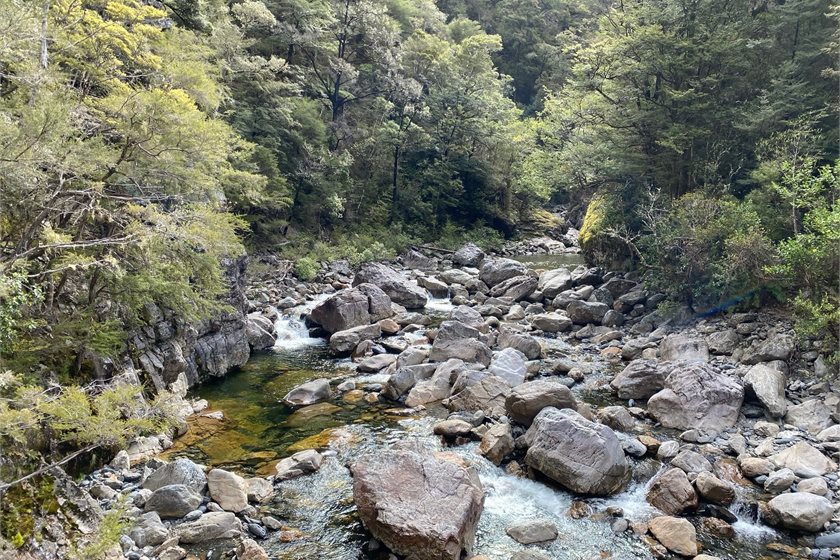
A controversial gold mining application at Sams Creek has been declined, leaving question marks hanging over the future of the land.
The site in Tasman’s Golden Bay was the centre of a fierce debate around the potential impacts of a gold mine on the local environment, particularly on freshwater and the nearby Te Waikoropupū Springs.
Australian mining company Siren Gold, through its subsidiary Sams Creek Gold, had sought to upgrade its exploration permit for the area to a mining permit.
In May, New Zealand Petroleum and Minerals (NZP&M) declined the application, saying that it had failed to meet the legislative tests under the Crown Minerals Act.
The exploration permit expired during that time, so Sams Creek currently has no active mining permits granted for its land and subsequently faces a land status decision.
Land status decisions are typically made within 60 working days, which would be mid-August for Sams Creek, by a decision-maker at NZP&M.
Could the land receive other mining applications?
In short, yes.
As part of the country’s conservation estate, Sams Creek is not perpetually available for mining activities.
The Crown Minerals Act allows mining on conservation land, with limitations that effectively prohibit surface mining, and limit prospecting and exploration to minimum-impact activities.
Access agreements, usually with the Minister of Conservation, and resource consents are also required.
Sams Creek’s availability will be reconsidered afresh under the current legal and policy frameworks.
The Crown retains full discretion, and may re-offer the land for new applications, restrict or remove it from future allocations, or change the policy settings.
If the land was made available for applications again, it would be under one of two processes: the Acceptable Work Programme Offer (AWPO) or the Newly Available Acreage (NAA).
Under an Acceptable Work Programme Offer process, the first applicant with an acceptable work programme that meets legislative requirements may be granted a permit.
However, a Newly Available Acreage process would see a 40-working-day competitive application round, with the highest-ranked applicant progressing through the rest of the assessment process.
The decision on which process to use is based primarily on the expected level of competition, the prospectivity of the land, and the available data quality.
AWPO is often used for areas with modest resource potential where the interest level is limited, while NAA may be used for areas with significant resource potential where competition was expected to deliver stronger work programmes and better outcomes for the Crown.
Sams Creek Gold would be able to make applications if the land became available once again.
John Buick-Constable, NZP&M’s national manager for petroleum, minerals, and offshore renewable energy, said all new applications are independently assessed on their merits, “regardless of previous permitting decisions”.
Through either process, applications could be for prospecting, exploring, or mining.
However, mining applications faced a “significantly higher threshold” to demonstrate that sufficient technical work had been completed to determine the resource, establish its economic vitality, and support a detailed mining programme.
Could Sams Creek be protected?
One advocacy group was trying.
While NZP&M considers the future of the land, Save Our Springs is campaigning to get Sams Creek incorporated into the adjacent Kahurangi National Park.
Save Our Springs was one of the community organisations opposing mining activities in the area.
The group launched its petition earlier this month and described the land’s incorporation into the national park as a step towards meeting community expectations.
More than 6550 people have signed the petition on the Greenpeace website.
National park boundary changes are made by the Governor-General on the recommendation of the Minister for Conservation, following a recommendation from the New Zealand Conservation Authority (NZCA).
The NZCA is the independent body that provides strategic policy advice to the Minister and the Department of Conservation.
The authority would only make a recommendation after consulting with the relevant Conservation Board, tangata whenua, and other relevant local stakeholders.
Land acquired for national park purposes or with well-documented values might simply be recommended for addition, but more complex proposals could require further investigation.
Those would see the NZCA assess if the land met national park criteria, and consider natural, historical, and cultural values, ecosystems, land management, and access, as well as the impacts on tangata whenua, neighbouring communities, and adjoining land use.
David Griffin, land regulatory manager at DOC, said the process ensured any boundary changes were “carefully considered, evidence-based, and aligned with national park objectives”.
Could the land be sold?
It does not appear likely.
Sams Creek was one of many parcels of land identified by Forest & Bird that could be sold under the Government’s proposed Conservation Amendment Bill.
The Bill has come under fire for enabling the sale of conservation land.
Originally intended to enable the sale of superfluous “bits and bobs”, Conservation Minister Tama Potaka has since said the Bill would be changed to include better safeguards around land sales.
What is Siren Gold doing?
Siren Gold chief executive Zane Padman said the company was still considering all of its options regarding the declined mining permit for Sams Creek.
However, he said that the company decided to relinquish the Waitui and Barrons Flat tenements last week.
Sams Creek Gold held an exploration permit for Barrons Flat and a prospecting permit for Waitui. Both tenements adjoined the Sams Creek site.
Padman added that the rehabilitation of its drilling sites was complete and the company was waiting on “the tick of approval” from DOC once it had reviewed the sites.
LDR is local body journalism co-funded by RNZ and NZ On Air.

print this story

Climate law introduced requiring adaptation plans and reducing Commission's role
Today 12:30pm
By Oli Lewis | The Government has introduced legislation to amend the Climate Change Response Act (CCRA), which includes stripping the Climate Change Commission of one of its core roles, adds a new requirement for councils to produce adaptation plans for higher-risk areas, and updates ETS settings.

Clock ticks on Gas Security Fund as Tariki developer reports ongoing losses
Today 12:30pm
By Oli Lewis | A Canadian company advancing a major gas storage project in New Zealand continues to report ongoing losses.

Planetary Facts dashboard aims to make environmental costs visible
Today 12:30pm
By Shannon Morris-Williams | Consumers can now compare the environmental impacts of everyday products with a new online dashboard designed to do for sustainability what nutrition labels have long done for food.
Climate change is here and we’re all paying for it
Today 12:30pm
By Raewyn Peart | COMMENT: Another week, another storm. Just days ago, Kaikōura saw two months of rain fall within 48 hours, the most recent in a long line of adverse weather events.

Quarry land swap gains habitats, loses area for rare native trees
Today 12:30pm
By Justin Wong, Local Democracy Reporter | A proposed land swap could add better-quality natural habitats to the public conservation estate but at the expense of handing over parts of Belmont Regional Park that features rare native trees to expand Lower Hutt’s Belmont Quarry, according to a Department of Conservation (DOC) report.

Climate remains top priority for Pacific leaders
Tue 14 Jul 2026
By Shannon Morris-Williams | Major regional events in Vanuatu and Fiji this month have underscored the Pacific's continued focus on climate action, with locally led innovation and sustainable farming highlighted as critical tools for tackling the region's environmental challenges.

$3m Govt boost for Tauranga geothermal energy
Tue 14 Jul 2026
By Liz Kivi | Resources Minister Shane Jones has announced a $3 million grant for the Gas to Geoheat Tauranga Geothermal System Project as part of the Government's plan to double geothermal energy by 2040.
Batteries and full lakes flatten winter power peaks
Tue 14 Jul 2026
Large batteries and more strategic use of hydro generation are starting to flatten winter electricity price peaks, reducing reliance on expensive thermal generation.

NZ lagging in energy storage investment – report
Tue 14 Jul 2026
Investment in energy storage is maturing globally, with the need for resilient and flexible power driving demand for storage, but New Zealand has some catching up to do, according to a new report.
