
Biomass sector asks: where did the love go?
18 May 2026
By Pattrick Smellie
New Zealand has sufficient biomass in its plantation forests to replace natural gas for industrial process heat at lower costs than electrification, but is failing to get the attention it deserves, sector leaders say.
“It’s so cheap, why is wood energy progressing so slowly?” said Rob Mallinson, the convenor of the Bioenergy Association’s Wood Energy Interest Group in a May 6 briefing to the incoming Minister of Energy, Simeon Brown.
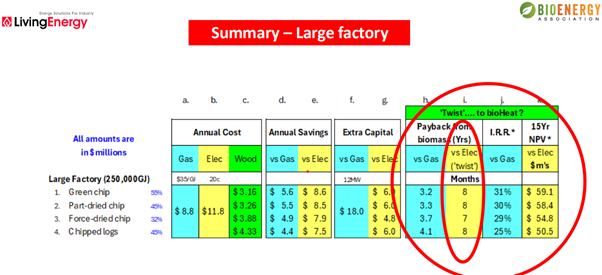
The association argues that not only is there plentiful supply of woody biomass, but that operating costs for a wood-fired boiler are between 20% and 35% of the cost of an electric boiler and 30% to 50% of the cost of a gas-fired boiler at gas prices that are currently as high as $35 per Gigajoule.
The barrier to uptake, as with electrification of gas-fired heat production, is the capital cost of replacing existing equipment, particularly since the current government’s decision to end the Government Investment in Decarbonising Industry (GIDI) fund.
To rapidly increase uptake, the Bioenergy Association advocates “100% accelerated depreciation, 50% co-funding and low-cost green finance”.
“Payback would come from avoid de-industrialisation and the multiplier effect.”
Energy industry participants have become increasingly enamoured of the GIDI fund as de-industrialisation has accelerated, particularly in industries facing steeply rising gas costs.
Prime Minister Christopher Luxon also last week identified energy security as one of three key types of security, alongside financial and national security, in a major pre-Budget speech.
Finance Minister Nicola Willis has indicated the capital expenditure allowance in the May 28 Budget has expanded by $2.2 billion to $5.7b, even as she announced that the operating spending allowance would be underspent by $300m at $2.1b in the year ahead.
She has said that capex spend would be “jobs-rich”. However, no indications have emerged yet as to whether and how that spend might be applied to the energy security priority.
In the letter to Brown, Mallinson argued there was a case for government intervention and that failure to do so “would be even more cost to New Zealand”.
Its thinking is broadly backed by the newly formed Crown agency, the Bio-Economy Science Institute, which argues that currently unproductive agricultural land could be converted to woody biomass production without displacing either food production or existing forestry operations.
“There is plenty of biomass to replace the coal burnt in New Zealand to start on the journey of aviation and marine fuels from wood,” the Bio-Economy Institute’s lead scientist on bioenergy, Paul Bennett, told DairyNews last week.
However, the BioEnergy Association’s case does not address transport fuels, where solutions are as yet very high-cost compared to fossil fuel alternatives.
Its focus is existing industrial heat processes where gas can be replaced by other heat sources, with Mallinson publishing eight scenarios for various sizes of factory.
In the case of a large factory, using 250,000GJ of gas annually, logs that would otherwise be exported are calculated to produce fuel at a cost of $17 per GJ versus an assumed $35 per GJ for gas and an equivalent electricity cost of $56 per GJ, based on an electricity price of 20 cents per kilowatt hour.
Along with high capital costs, barriers to uptake of biomass heat included the potential for a larger and/or messier industrial footprint, more difficult resource consenting, perceptions about the speed at which biomass boilers could respond, and perceptions about biomass supply.
However, the association believes all but the capital cost issue are either surmountable or misplaced.
As well as being “carbon neutral” by using a renewable biomass resource, bioheat could help the increasingly urgent need to transition away from gas “to help avoid deindustrialisation by quickly freeing up scarce natural gas for large users who can’t easily transition”.
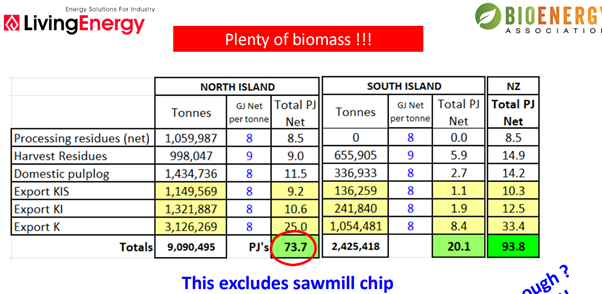
With annual gas demand amounting to about 38.3 Petajoules, excluding Methanex and fertiliser production by Ballance, the association argues that there is more than enough woody biomass to replace gas.
Excluding sawmill chips, it says the Energy Efficiency and Conservation Authority calculates there is some 93.8PJs of processing and harvest residues, domestic and export logs from which demand for gas replacement could be met.
print this story
Story copyright © Carbon News 2026
Offshore renewable energy bill passes, opening path for developers
Today 11:45am
By Oli Lewis | Feasibility permits for offshore wind developments could be issued within months after the Government passed a long-awaited law to establish a regulatory regime.

A tale of two electricity systems as NZ and Australia roll out new cost-saving measures
Wed 1 Jul 2026
By Oli Lewis | New rules requiring electricity retailers to offer time-of-use pricing plans, where consumers can access lower-cost electricity at off-peak times, have come into effect.

Savings gap doubles: all-electric households stand to save $3000 a year, report finds
Mon 29 Jun 2026
By Oli Lewis | The economic incentive for households to electrify has become more compelling, although overcoming upfront installation costs remains a barrier.

Lake Onslow pumped hydro consortium secures funding for consent push
Fri 26 Jun 2026
By Oli Lewis | The consortium behind Lake Onslow pumped hydro has secured funding to finalise its resource consent application, aiming to lodge it under the fast-track process before 2027.

National promises low-cost solar loans for households
25 Jun 2026
By Oli Lewis | The National Party is promising a Home Energy Fund to accelerate the roll-out of household solar, batteries, insulation and other energy resilience measures if it is re-elected this year.

Energy resilience conference axed due to Ara Ake closure
25 Jun 2026
By Shannon Morris-Williams | A national conference focused on energy affordability, resilience and hardship has been cancelled because of the Government's decision to end Crown funding for energy innovation centre Ara Ake.

'Stored solar': Bioenergy Association touts cost benefits of biomass boilers over gas
24 Jun 2026
By Oli Lewis | Businesses across New Zealand are warming to bioenergy, but advocates believe woody biomass could play a far greater role as a replacement for more expensive natural gas and electric heat options.

Gas transition loan scheme nears launch as savings modelled
23 Jun 2026
By Oli Lewis | Commercial gas users could potentially save thousands of dollars a year by using Crown-backed loans to fund fuel-switching and energy efficiency projects, new modelling indicates.

EECA head steps down
22 Jun 2026
By Shannon Morris-Williams | Chief executive Marcos Pelenur will step down after three years at the Energy Efficiency and Conservation Authority, leaving the organisation looking for a new CEO as it becomes the sole remaining government agency offering support for businesses looking to transition away from fossil fuels.

Canadian firm seeks Crown co-investment for Genesis-supported gas storage project
19 Jun 2026
By Oli Lewis | A proposed gas storage project supported by Genesis Energy has sought Crown co-investment through the $200 million Gas Security Fund.
