Lake Onslow pumped hydro consortium secures funding for consent push
26 Jun 2026
By Oli Lewis
The consortium behind Lake Onslow pumped hydro has secured funding to finalise its resource consent application, aiming to lodge it under the fast-track process before 2027.
Speaking to Carbon News, Clutha Pumped Hydro chair Dr Keith Turner acknowledged the filing timeframe was ambitious, as the consortium still had to carry out design work and address gaps in the evidence base.
“We’ve got enough money to do the resource consent application and some of the value engineering,” Turner said, although he wouldn’t disclose the names of the funders or the amount required to advance the consent.
“We’ve got a number of parties who are keen to be part of the project and are willing to bring funds to become part of the project,” he said.
The consortium had also pitched the idea to global firms with the scale to potentially own, build, fund, and operate the Central Otago scheme, Turner said.
“Big investors want big projects. They won’t come here for $1 billion. They’ll come here for $5b.”
An enormous battery
The previous Labour Government provided funding for the Ministry of Business, Innovation, and Employment (MBIE) to investigate the feasibility of a pumped hydro scheme at Lake Onslow as part of the NZ Battery Project.
The Coalition Government accused the Onslow investigation of chilling investor confidence in new renewable generation projects by creating market uncertainty. It discontinued all work on the scheme.
Last year, the private consortium - which includes Turner as well as former Labour minister David Parker - applied to have the project referred into the streamlined consenting pathway established by the Fast-track Approvals Act.
In March, Infrastructure Minister Chris Bishop accepted the referral application, opening the door for the consortium to finalise and lodge a substantive application for consideration by a panel of experts.
The large-scale pumped hydro scheme met the criteria of providing significant regional or national benefits, officials said in a briefing to the minister, as it would materially increase New Zealand’s electricity storage and generation capacity.
“In particular, the enlarged Lake Onslow would be capable of storing sufficient water to enable generation of up to 1,000 megawatts (MW) for approximately six months, producing around 4,000 gigawatt-hours of electricity, and would represent New Zealand’s largest hydro development.”
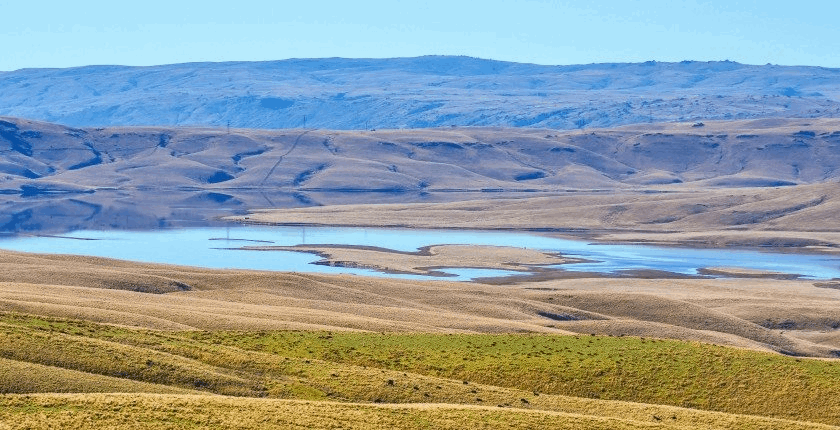
Expanding the lake to create the upper reservoir would require inundating around 7,100 hectares of land, creating a storage basin that works like an enormous battery. When electricity prices are low, water is pumped up to fill the reservoir. When prices are high, water can be released down a tunnel to the Clutha River to generate and sell electricity into the market.
Lake Onslow pitched as a Huntly replacement
Turner, the founding chief executive of Meridian Energy and former chair of Transpower, was in Auckland for the Beyond the election conference hosted by the Environmental Defence Society.
During his presentation on the importance of energy sovereignty, Turner said New Zealand once had the second lowest electricity prices in the OECD.
“That was an enormous competitive advantage for our economy in those days.”
Since the energy crunch of 2024, by contrast, several large manufacturing and industrial firms have closed or temporarily paused their operations, citing the impact of high gas and electricity prices.
Turner said secure, reliable, and competitively priced energy was linked with economic and social welfare. He made the point that previous economic shocks in New Zealand had often been caused by energy shortages.
As well as international examples of countries moving to reduce their dependence on imported fossil fuels, Turner referred to a wind farm installed on the Chatham Islands last year, which he said had helped to protect the island from the price shock caused by the Iran War.
“They used to be entirely diesel based. These last six months they’ve had 85% of their energy from renewable wind.”
Turner also warned that Huntly Power Station, which provides firming capacity to support intermittent generation from renewable sources, was ageing. By 2035, he said, it would be 50-years-old and approaching the end of its operational life.
“So, there is a looming dry year challenge coming.”
Turner pitched Lake Onslow pumped hydro as a solution to replace Huntly. It would lead to lower and less volatile wholesale electricity prices, he said, and help to foster greater competition in the electricity market.
“If the Government isn’t going to do it, someone else better do it,” he said.
“Because we are going to be in deep trouble if Huntly catastrophically fails.”
Turner also pushed back on public cost estimates putting the scheme at between $15b and $20b. This was the lifecycle cost, he said, whereas MBIE had estimated the upfront capital cost to be around $8b.
“My view is that we could do Onslow for somewhere between $6.5b and $7.5b - not much more than Benmore,” Turner said, comparing the project to the estimated present day build cost of the South Island hydro lake.
LNG: not a fan
During a later panel discussion, Turner was asked about importing liquified natural gas (LNG) as a solution to dry year security of supply issues.
“I think New Zealand is making a really big strategic mistake with LNG,” he said.
“Believe it or not, it would be of benefit to Onslow, because the price of LNG is going to be so high it will increase the value of hydro storage.”
MBIE, meanwhile, maintains that imported LNG would provide important insurance for the electricity system. It would cap spot prices at the marginal cost of LNG, officials said in an explanatory note attached to recently released modelling, and it would encourage greater use of low-cost hydro generation.
LNG reduced spot prices for 2028 and 2035 in most modelled scenarios for both normal and dry years, the note said.
Turner had a different view.
“The idea that New Zealand can buy bits of LNG when we’re having a dry sequence and get those quantities reasonably quickly at the ordinary market price is a fallacy,” he said.
“If you’re an LNG producer and you know that New Zealand is having a dry sequence and it must buy 10 petajoules of gas, you know that you’ve got the country over a barrel.”
print this story
Story copyright © Carbon News 2026