
Dairy farmers' lack of climate action 'even bleaker' than water inaction – Upton
1 Apr 2026
By Shannon Morris-Williams
Government projections for cutting agricultural emissions are being undermined by low farmer uptake, with the Parliamentary Commissioner for the Environment warning the country is relying on “heroic” assumptions to meet its methane targets.
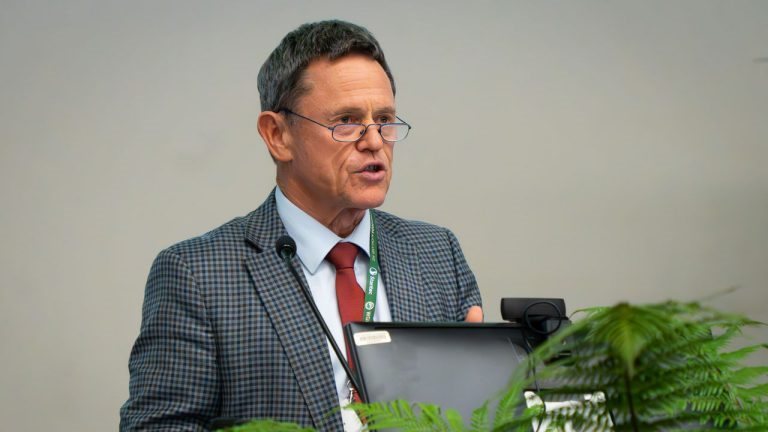
In a March address to the DairyNZ Dairy Environment Leaders Forum, Parliamentary Commissioner for the Environment Simon Upton said that dairy farmers' inaction on reducing emissions was “even bleaker” than their inaction on improving water quality – and put the Government’s methane target to 2030 at risk.
He pointed to the long-running Survey of Rural Decisionmakers by the Bioeconomy Science Institute, conducted every two years since 2013, which examines farmer attitudes to the environment. Just 5% of dairy farmers responding to the survey said reducing GHG emissions had been a major focus over the past two years, while 7% said it would be a major focus over the next two years.
"That means that for 95% of dairy farmers, reducing GHG emissions has not been a major focus over the past two years, and will still not be going forward for 93%!" Upton exclaimed in his speech.
The survey found that just 40% of respondents said they would be likely to adopt a vaccine for reducing methane emissions.
Upton said questions should be asked about whether hundreds of millions of public money should be poured into developing a methane vaccine when 60% of dairy farmers are not planning to use it.
The Government’s latest baseline emissions projections assume that by 2030, 37% of dairy cattle will be vaccinated with a methane vaccine that reduces enteric methane emissions by 10%.
"I personally find this assumption heroic. Remember this is the baseline projection! Not only do we not yet have such a vaccine, but the Government’s decision to abandon a price on methane removes the incentive to use one should it materialise," he said.
"Government projections appear to be relying on farmers acting out of the goodness of their hearts or whatever persuasion processors can come up with."
Agricultural emissions pricing needed
Upton wanted to ask processors such as Fonterra, who have committed to reducing emissions intensity, how they are planning to meet those targets without a price on methane.
"What incentives will there be to take up new technologies? Considerable public subsidy, hundreds of millions, has gone – and is still going – into developing these mitigation technologies, especially methane vaccines.
"This is taxpayers’ money and taxpayers are entitled to ask why this outlay should continue if the vaccines are not going to be adopted. If farmers are lukewarm about using technologies to reduce methane and improve water quality, there certainly is no longer a compelling case for spending taxpayer money to develop them."
Progress needs more than goodwill
The survey showed concern about climate and emissions regulation fell from 62% of farmers in 2023 to 49% in 2025, while concern about freshwater and other environmental rules rose to 68%.
“So, while concerns about regulation on climate change and greenhouse gas emissions have decreased somewhat – no doubt helped by the decision to discard any methane pricing – other environmental regulation is still a major source of concern.
“And while some may be happy to plant trees to achieve an accounting triumph on emissions (although not hill country farmers!), our freshwater issues are not going away.”
He said farmers are not climate change denialists.
“Seventy per cent of survey respondents believe climate change is real and predominantly acknowledge that it is anthropogenic. But not many are planning on doing much about their emissions.
“I find this surprising, especially considering the link between climate change and our changing weather conditions.”
Upton said some farmers are beginning to prioritise adapting to changing weather conditions.
For the past two years, 16% said that “adjusting to changing weather conditions” was a major focus, and 18% said that would be the case over the next two years.
Upton said meaningful environmental progress would require more than goodwill, arguing that voluntary action alone was unlikely to deliver results without stronger incentives, regulatory backstops and hard decisions about who would pay for change.
Voluntary targets rarely work
“I’ll cut to the chase: I am sceptical about voluntarism. Purely voluntary targets rarely work if there is no stick. By contrast, people tend to like carrots – particularly if someone else is paying for them.”
He also warned that funding environmental improvements would require difficult decisions about who pays.
“There is no magic money tree. The people of Tairāwhiti were recently reminded of that when the Government declined to subsidise a long-term land use change programme designed to help future-proof the region’s primary sector, and also prepare it for adverse weather and a changing climate.
“If taxpayers won’t pay, who will? Because if no one is prepared to accept responsibility for land use change, then it is the environment that will pay.”
Move the middle
The commissioner said farmers must deliver measurable, verified progress and bring the wider sector with them if meaningful environmental gains are to be achieved.
He said progress will require action beyond a small group of environmental leaders, and the focus must shift to lifting performance across the wider farming sector.
“Critically, we need more than a few environmental leaders. We need to ‘move the middle’ of New Zealand farming and reserve a real threat of regulation to hurry along the laggards.
“This is not only important for the environment, but also crucial to your customers here and overseas, as well as your neighbours and your social licence to operate.
“New Zealanders, like overseas consumers, want the contents to match the label on the tin: clean green New Zealand. Not greenwashing.”
Upton said achieving outcomes has to be about making measurable progress.
“Verified incremental progress, even if unspectacular, is preferable to aspirational directions of travel – or whatever other verbal lozenge you want us to swallow. Farmers have to be prepared to sign up to action that will make a difference.”
He warned that despite leadership from some farmers, overall progress remains insufficient to reverse worsening environmental trends.
“The question is whether the level of action to date is going to head off a continuing deterioration in a number of environmental indicators – most notably, but not exclusively, water quality.
“While voluntary actions are no doubt holding the line or even turning it in the right direction in some localities, in other places there are serious environmental issues that will take time – and action by all farmers – to shift the dial.”
Constant policy change
Upton said repeated policy changes and regulatory uncertainty have made it harder for farmers to take long-term action, saying upheavals from central government haven’t helped to move things forward.
“Since 2011, we have had four separate National Policy Statements on freshwater. These in turn have spawned a plethora of regional plan changes and court cases. Few have actually been implemented before the national goalposts have been shifted.
“Further changes are on the cards with an entirely new resource management framework based on stronger national direction – which could well mean stronger pendulum swings.
“We’ve also had three attempts at pricing agricultural emissions. The current Government, which had agreed that a price on biogenic methane emissions was a sensible way forward, has now given up on that entirely.”
Upton said he could understand farmers sitting on their hands when any policy seems unlikely to survive the next election.
“Some farmers may be happy to have seen the regulatory tide recede since the last election. But farming, like environmental action, needs a long-term perspective that goes beyond election cycles. And until environmental concerns like water quality are comprehensively addressed, these regulatory risks remain live.”
He said the sector risks the pendulum swinging back harder if public trust continues to erode.
“Farming embraces a broad church. The public perception, right now, seems to be that farmers are pushing – successfully – for weaker regulation and watered-down environmental limits. This carries the risk that the pendulum will swing back harder at a future point.
“You can’t ignore the political context. But my advice would be to chart a pragmatic course that is practical and implementable on the ground, and one that can demonstrate measurable, incremental environmental progress.
"This is, I hope, a goal that everyone in the room shares. The question is how do we do it?".
print this story
Story copyright © Carbon News 2026

Fed Farmers' election wish-list includes stopping whole-farm conversions to carbon forestry
9 Jun 2026
Federated Farmers has launched a five-point plan for the next government, setting out what it says should be a major focus for political parties heading into the November election.

Farmers welcome Nats’ pledge to double QEII funding
9 Jun 2026
By Liz Kivi | Federated Farmers has welcomed the National Party’s promise to double funding to the Queen Elizabeth II National Trust to $8.5 million if re-elected.

Greens condemn planned coal mine next to protected wetland
4 May 2026
By Liz Kivi | The Green Party says a new plan for a coal mine and fertiliser plant next to an internationally significant wetland is “ecological vandalism and climate denial.”

Fonterra ‘spins’ greenwashing research for favourable press
1 May 2026
By Liz Kivi | Dairy co-operative Fonterra has managed to ‘spin’ international research intended to highlight greenwashing, instead using it to generate unwarranted positive press, according to researchers behind the recent study into ag industry greenwashing.
New funding for low methane farming uptake
29 Apr 2026
By Pattrick Smellie | The government will co-fund projects under an Early Adoption Accelerator scheme announced today to accelerate the uptake of low emissions farming technologies emerging from the AgriZero public-private partnership.

Coal-to-urea plan ‘extremely unlikely’ to be zero carbon
28 Apr 2026
By Liz Kivi | A plan to turn Southland coal into nitrogen fertiliser is extremely unlikely “if not impossible” to be net zero, despite the claims of the Australian company applying to fast-track it, says sustainable energy expert Ralph Sims.
Fonterra admits ‘100% grass-fed’ claim breached law in greenwashing row
2 Apr 2026
By Shannon Morris-Williams | Fonterra has admitted its “100% New Zealand grass-fed” claims on Anchor butter were misleading and breached the law, settling a case brought by Greenpeace Aotearoa over packaging used between December 2023 and April 2025.
NZ–Ireland farm emissions deal labelled 'Greenwash Alliance'
20 Mar 2026
By Shannon Morris-Williams | A renewed research partnership between New Zealand and Ireland to tackle agricultural emissions is being promoted as a step forward for climate innovation – but Greenpeace says it risks becoming a distraction from meaningful cuts.
Govt's solar on farms initiative to cut costs, boost resilience
17 Feb 2026
Farms across Aotearoa will begin installing solar panels and battery systems as part of a government-backed demonstration programme designed to test whether on-farm renewable energy can reduce electricity costs and improve energy security for the food and fibre sector.
