
Ōtara homeowner lays bare cost of flood-proofing as council confirms no private funding
30 Jan 2026
By Taelegalolo'u Mary Afemata, Local Democracy Reporter
A lifelong Ōtara resident is using her family home as a real-world example of what flood resilience looks like in practice.
This comes as Auckland Council confirms homeowners must shoulder the full cost of flood mitigation work on private land.
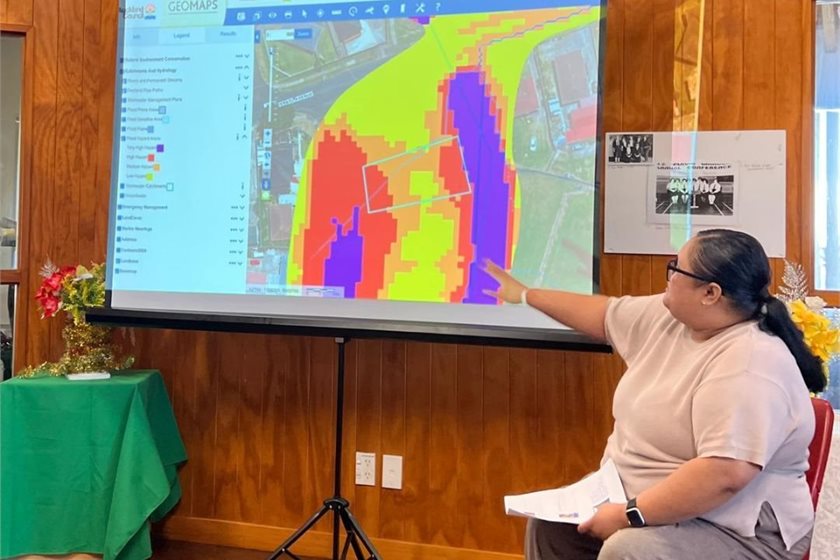
Margaret Faletagoai shared her experience at a community flood resilience event held last week at the Tūrehou Māori Wardens Hub in Ōtara. She encouraged residents to better understand flood risk and what it can mean for their homes.
The event was organised by the Ōtara Waterways and Lake Trust as part of its work to improve community preparedness in the face of climate and increasing flood risk.
Vasemaca Tavola, the trust’s flood resilience coordinator, said Faletagoai was invited to speak as a local case study, using lived experience to make flood risk more tangible for families.
“Flooding is increasing because of climate change,” Tavola said. “Margaret is amazing, and her story is just a local Ōtara story.”
She said much of Auckland Council’s Healthy Waters information is aimed at homeowners, despite Ōtara having one of the lowest rates of homeownership in the city.
“When I heard Margaret’s story, I knew we had to share it,” Tavola said.
Faletagoai, who was born and raised in Ōtara, said her family has lived in their home for more than 30 years. “The house was built in 1984, and my parents bought it in 1990 for a whopping total of $80,000,” she said.
She said the family initially planned a modest expansion to accommodate a growing household, including a sleepout with bathroom facilities for her parents.
But Faletagoai said the project quickly became more complex and costly once plumbing and flood risk came to play.
“We had no drainage whatsoever. No pipes, no nothing. Everything was just sitting on top, and the water would just sit there and flood,” she said.
Using Auckland Council’s online flood mapping tools, Faletagoai showed attendees that her property sits within a medium-to-high flood hazard zone, including an overland flow path.
“These blue lines represent what we call an overland flow path, it’s just a natural way that the water flows, above ground, on land, and you can’t block it.”
Because of that classification, any development on the site required a resource consent and major drainage upgrades, including raising floor levels to reduce the risk of floodwaters entering the home.
Despite her professional background as a senior environmental monitoring officer, Faletagoai said she still needed to hire external specialists to complete engineering and compliance requirements.
She “was not allowed to be part of this process” and “we had to hire somebody else to do it. Our project was little, and then it became bigger because we were in a flood risk area,” she said.
In written responses to Local Democracy Reporting, Auckland Council said responsibility for flood mitigation work on private land sits with property owners, with no public funding currently available for private stormwater maintenance or upgrades.
John Duguid, the council’s General Manager of Planning and Resource Consents, said a dedicated consenting team was temporarily established after the 2023 Auckland Anniversary floods to fast-track mitigation applications, with reduced charges in exceptional cases.
He said the team has since been disbanded. “Any decision to introduce this would sit with Auckland’s mayor and councillors.”
Craig McIlroy, Council’s General Manager of Healthy Waters and Flood Resilience, said funding is focused on maintaining the public stormwater network, while private infrastructure remains the responsibility of homeowners.
Manukau ward councillor Lotu Fuli said climate resilience had become a central issue since the 2023 floods. But Fuli acknowledged South Auckland communities were often the least resourced.
“Many of our community are renters as well, and when something happens to a rental property and the landlord can’t fix the house, a lot of our families don’t have other options,” Fuli said. “That’s why community-led flood resilience work is so important.”
Faletagoai said sharing her experience was about helping others understand the risks they may be living with.
“People don’t know what they don’t know,” she said. “I wanted to use our whare as an example of why we’re having this talk.”
Flood resilience work delivered by Ōtara Waterways and Lake Trust is supported by Auckland Council’s Healthy Waters programme.
LDR is local body journalism co-funded by RNZ and NZ On Air.

print this story

Carbon capture and the need for ‘net zero oil’
Today 12:15pm
By Pattrick Smellie | The answer to making carbon capture and storage work is to make fossil fuel producers responsible for making it happen rather than consumers, says Oxford University climate change policy expert, Professor Myles Allen.

Climate change minister tight-lipped on ACT climate policy
Today 12:15pm
By Liz Kivi | Climate Change Minister Simon Watts is keeping his cards close to his chest about the ACT Party’s election campaign pledge last week that it would resubmit New Zealand’s Paris Agreement target.

Ballance secures gas for 2026 as it progresses energy transition plan
Today 12:15pm
By Oli Lewis | One of the largest industrial gas users in New Zealand is working on an energy transition plan to futureproof domestic fertiliser manufacturing, while continuing to secure ongoing gas supply contracts.

ACT climate policy ‘disingenuous,’ says former top climate diplomat
Mon 15 Jun 2026
By Liz Kivi | ACT’s election campaign pledge to submit a new international climate target to the United Nations is “totally disingenuous", according to New Zealand’s former climate ambassador Kay Harrison.

New Zealand faces $26b energy infrastructure challenge, report warns
Mon 15 Jun 2026
By Shannon Morris-Williams | New Zealand will need an additional $26 billion of investment in energy infrastructure over the next 30 years to meet its decarbonisation goals, with a new report warning that policy certainty is critical to unlocking the renewable generation needed to power a low-carbon economy.

Bid to review Kāpiti Coast climate emergency declaration fails
Mon 15 Jun 2026
By Justin Wong, Local Democracy Reporter | Kāpiti Coast councillors have rejected a motion to review the local district council’s climate emergency declaration.

EU climate policy ‘won’t survive’ its clash with EU farmer politics
Fri 12 Jun 2026
By Pattrick Smellie | European Union climate change policy is on a collision course with European farmer politics, exacerbated by the rise of populist right-wing parties in the UK and the Continent, says Oxford University professor of geosystem science, Myles Allen.

Lack of finance stalling sustainable innovation – report
Fri 12 Jun 2026
By Shannon Morris-Williams | A lack of access to suitable finance is threatening growth in New Zealand's sustainable innovation sector, despite strong confidence and ambitious expansion plans among purpose-driven businesses, according to a new report.

Lower Hutt among five cities in global climate risk initiative
Fri 12 Jun 2026
By Justin Wong, Local Democracy Reporter | Lower Hutt is one of five cities around the world picked for a global climate project to help vulnerable people respond to extreme climate risks.
Coastal inundation enquiries increase on the West Coast
Fri 12 Jun 2026
By Vihan Dalal, Local Democracy Reporter | The West Coast Regional Council is seeing more inquiries about coastal inundation. A report tabled at the Environmental Management Committee meeting last week showed coastal inundation was the second-most common inquiry received by the council after flooding.
