
Rod Carr is ‘over’ climate change defeatism
13 Mar 2026
By Pattrick Smellie
If there’s one thing former Climate Change Commission chair Rod Carr is “over”, it’s people saying there’s nothing they can personally do to address climate change.
That attitude was wrong and had to change, he said in a spirited speech to round out Wednesday’s launch at Parliament of ‘Kiwis in Climate’, a newly published book of thinking from New Zealanders living both here and offshore about tackling climate change.
The book has 23 chapters by different authors under sections including community, business, and government.
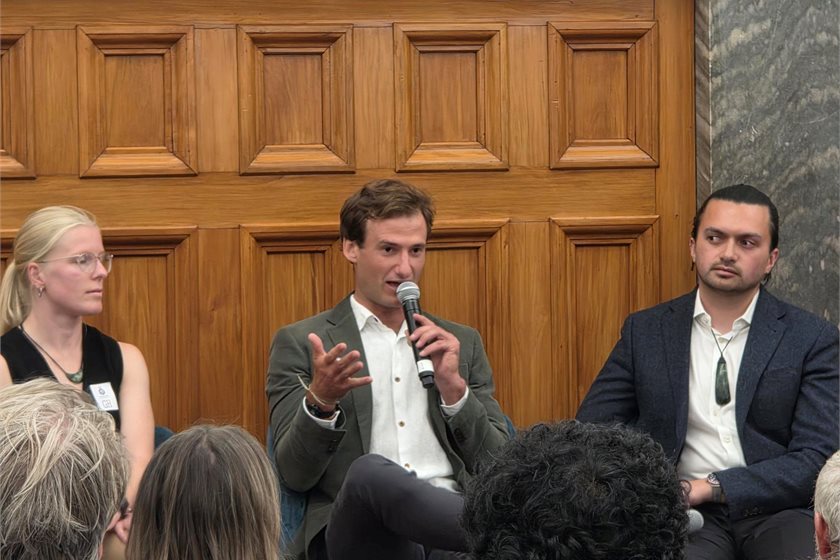
Carr’s comments came after speeches from the book’s co-ordinator, lawyer Tessa Vincent, and Climate and Energy Minister Simon Watts, as well as a panel discussion involving former climate change minister Tim Groser, School Strike for Climate founder Sophie Handford, climate change and indigenous rights advocate Kaeden Watts, and Sam Hogg, a dairy farmer whose use of ecologically focused farming methods has made a struggling family farm profitable.
In perhaps the most compelling comments of the evening, Hogg described how changing from “a really high inputs system” on his farm meant “we are consistently 200% more profitable”.
However, what surprised him was that so few farmers were taking up these available technologies.
“When I got into this, I thought, this is a no-brainer,” he said. “We’re just a little bit ahead of the game. Everyone’s going to figure this out.”
But so far, they hadn’t.
He put that down to large-scale commercial farms being wedded to existing farming methods.
However, smaller scale farmers were sometimes forced to adopt new technologies to survive.
His own experience had been that using conventional modern farming techniques had been “disastrous for us” and that when “things went south really, really quickly” in the 2010s, decisions had to be made in a state of “desperation”.
“This is the story of a lot of the farmers that I know,” said Hogg. They’re desperate and they’re brave and it’s gotta work, basically.”
Hogg, a vegetarian who returned to the family farm with a law degree and a belief that dairying should be replaced with vegetable crops, said that by staying “curious and open-minded”, he’d found new ways to farm that were more profitable and lessened climate change impacts.
“Since then, I’ve been living in a place of hope and optimism” rather than “working and living in doom and gloom”.
Groser made a case for a “centrist” approach to climate change action and policy, saying that making renewable energy and green technology more affordable was key.
“That is happening,” he said.
He argued that it was “not sustainable only to focus on climate change” when tackling the issue.
“This will never work, end of story, because people out there don’t come to meetings like this.”
As climate change minister in the John Key government, he had helped establish the global greenhouse gas research alliance, but “we were never going to destroy the export base of our economy”.
“We were trying to find technologically sophisticated solutions in a temperate climate agricultural country.”
Former commission chair wants more action
In his chapter in the Kiwis in Climate book, former Climate Change Commission Chair Rod Carr said all of us should take action on climate. “To assert we have no choices, that we can't make a difference, that we are helpless and therefore hopeless is a failure of not only leadership but of intellect, a fatalism left behind in the Dark Ages.”
The Government is changing the law to strip the commission of its power to advise the Government on emissions reduction plans – formerly a key role, with some experts predicting the commission will eventually be disestablished.
But rather than weakening it, Carr thinks the Government should strengthen it, give it additional powers and its own revenue stream – possibly from a levy on NZUs.
He writes that the commission is “vulnerable” because it depends on the government of the day for its funding as well as for the integrity and competence of its board.
“Inadequacy on either count undermines the expertise and independence, and therefore the credibility and usefulness, of its advice.”
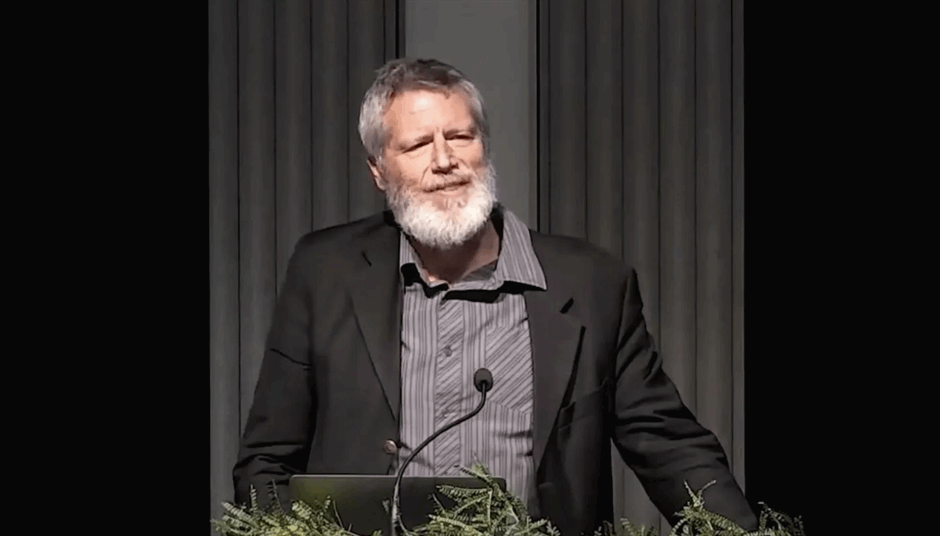 |
| Rod Carr IMAGE: Terra Nova Foundation |
ETS levy?
He would like to see the commission with its own independent revenue stream: “for example a small levy on banked units in the Emissions Trading Scheme (ETS) and/or levy on industrial free allocations or surrender obligations in the ETS, which could be set and reviewed by the Auditor General and could still be overturned by Parliament, would provide some protection.”
Carr also suggests funding and a mandate for the commission or another entity – such as the Parliamentary Commissioner for the Environment – to start judicial review of government decisions on targets, budgets and plans “would give teeth” to hold governments to account for their decisions.
“Reliance on civil society to raise the funds or volunteer the time to hold the government to account undermines accountability and more than tilts the playing field in favour of delayed emissions reductions, rewarding those profiting from high-emitting businesses.”
Carr says mandating and funding the commission for public education initiatives on emissions reduction and climate adaptation could tackle underhanded tactics from bad actors. “[It] would be one way to confront the influence of stakeholders with vested interests in profiting from high-emitting activities for as long as possible, often through spreading misinformation, obfuscation, false claims and implausible promises.”
‘Bad politics’ on ag emissions
Carr believes that farmers will come to regret not taking up agricultural emissions pricing under the He Waka Eke Noa partnership.
“Pricing agricultural emissions has been a contentious issue since first proposed in 2008. In part this is due to the assertions that New Zealand meat and milk protein production produces relatively low levels of emissions on average compared to other national averages, that there are few abatement technologies available and that any price on emissions would reduce farm profitability, employment in rural communities and have little or no impact on global temperatures.
“In my view the agricultural sector will come to see the proposals presented by the agricultural partnership He Waka Eke Noa as a lost opportunity. If adopted, the proposal would have seen a very low emissions levy, ring-fenced for sector interests and managed by sector leaders, that would have created decades of certainty.”
Late last year the Government scrapped plans for agricultural emission pricing, which it had previously promised would be in place by 2030.
“To assert that emissions pricing is a primary instrument to achieve emissions reductions in sectors responsible for all greenhouse gas emissions except biogenic methane, where price should play no part, is bad economics and, in the medium term, bad politics,” Carr writes.
He says the commission should be given a formal role in advising on agricultural emissions pricing.
Advice on international climate targets
The commission should be mandated and funded to provide advice on New Zealand's Nationally Determined Contribution (NDC), according to Carr. “Aligning our global ambition with domestic action is likely to greatly enhance the acceptability of emissions budgets and emissions-reduction plans. As with other advice, the government would not be bound to take the advice given and could seek advice from other sources. A coherent, integrated, independent, expert stream of advice, while not compelling, would surely be useful.”
For the same reason, the commission should have a formal role in advising on how much offshore mitigation New Zealand should commit to – and the integrity of procurement and compliance monitoring, if and when offshore credits are purchased.
He also wants to see business leaders step up: “Business leaders need to call out the public subsidies secured by high-emitting incumbents, including the drawing down of the publicly owned reservoir of natural capital for private profit. Polluters should pay and there should be no private property right in the right to pollute.”
The Emissions Trading Scheme shouldn’t be the Government’s only tool for climate action. “A transition that is fair requires government interventions beyond a simple market price on emissions or letting losses lie where they fall.”
And Carr says the Commission can’t decarbonise the country by itself.
“The Climate Change Commission is necessary, but it is surely not sufficient. Only climate action makes any difference and the time for urgent action is now.”
print this story
Story copyright © Carbon News 2026

Greens promise to take forestry out of the ETS
Mon 27 Jul 2026
The Green Party launched its election manifesto at its AGM yesterday, promising action to reduce climate pollution and boost resilience, with an emphasis on Emissions Trading Scheme reform.
Groundbreaking steel startup cuts production time while slashing emissions
Mon 27 Jul 2026
Startup CullBeck has raised a record $20 million to commercialise its new ironmaking technology, which replaces coal with hydrogen to eliminate carbon emissions from one of the world's most emissions-intensive industries.

National deer management strategy urgently needed to halt 'catastrophe' for native forests
Mon 27 Jul 2026
Scientists are calling for an urgent national deer management strategy, with deer numbers now at unsustainable levels and decimating native forests.
Greens bill aims to keep supermarket food out of landfill
Mon 27 Jul 2026
By Shannon Morris-Williams | The Green Party has introduced a member's bill that would require New Zealand's largest supermarkets to donate edible surplus food to food rescue organisations instead of sending it to landfill, saying the move would reduce waste, cut emissions and help tackle food insecurity.
Contact: New biodiversity goal may be 'highly problematic' for renewable projects
Fri 24 Jul 2026
By Oli Lewis | The goal of no net loss of indigenous biodiversity in the new resource management system may be highly problematic for renewable energy developments, Contact Energy says.

Politicians need to ‘get over themselves’ to reduce emissions
Fri 24 Jul 2026
New Zealand needs to face up to two big areas of climate emissions: transport and agriculture, says climate policy expert Bronwyn Hayward.
Biomass can free-up electrons to perform higher value roles – with multiple other benefits
Fri 24 Jul 2026
By Rob Mallinson | OPINION: New Zealand’s energy debate too often treats electricity as the universal solution.
Expert election briefings on climate and the polycrisis now free to the public
Fri 24 Jul 2026
Expert briefings on climate change and the wider "planetary polycrisis" from the Reality of Everything symposium have been made freely available online, with organisers aiming to broaden public understanding of the interconnected issues ahead of New Zealand's general election.

Media round-up
Fri 24 Jul 2026
In our round-up of climate coverage in local media: Labour leader Chris Hipkins floats the idea of a carbon border tax; two-way charging between the garage and the grid will slash power bills; and cost isn't everything when it comes to rooftop solar.

Red Stag boss questions $60m cement support as timber ETS reforms stall
Thu 23 Jul 2026
By Oli Lewis | The Government has granted $60 million to an emissions-intensive industry while dragging its feet on a proposal to allow firms making harvested wood products to earn carbon credits in the Emissions Trading Scheme, an industry leader says.
