
Mission for ancient climate clues beneath 500m of antarctic ice gets underway
15 Dec 2025
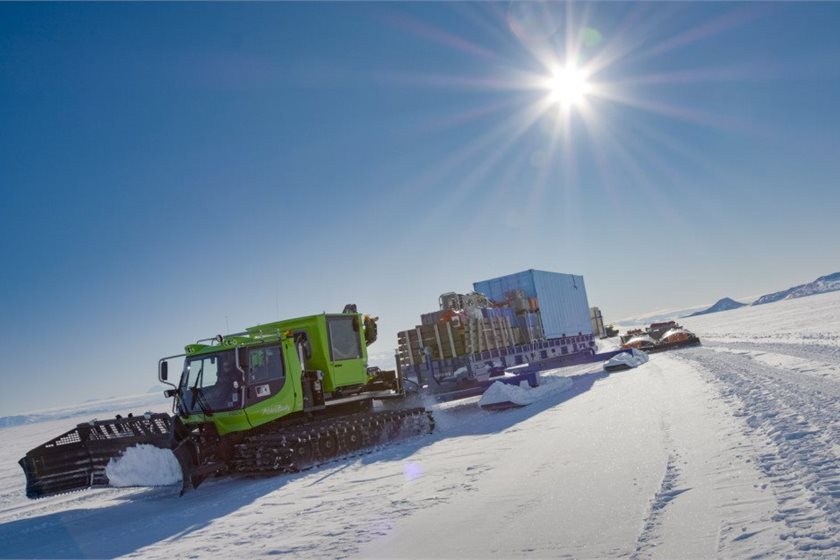
Media release: Antarctica New Zealand | An international team has set up a remote camp on the ice 700 km from the nearest base (New Zealand’s Scott Base) to attempt to drill for mud and rocks holding critical insights about the fate of the West Antarctic Ice Sheet in our warming world.
The vast West Antarctic Ice Sheet holds enough ice to raise global sea level by 4-5 m if it melts completely. It is protected on one side by the Ross Ice Shelf, the world’s largest floating ice mass, that serves as a buttress slowing the flow of glaciers and ice streams towards the sea. As our climate warms, the Ross Ice Shelf is becoming increasingly vulnerable, but there is uncertainty around what global temperature increase will trigger unsustainable melting of the shelf, and the subsequent loss of the West Antarctic Ice Sheet.
Retrieving a geological record to provide direct evidence of this temperature tipping point is the challenge driving the SWAIS2C (Sensitivity of the West Antarctic Ice Sheet to 2°C) project, a collaboration between 10 countries (New Zealand, the United States, Germany, Australia, Italy, Japan, Spain, Republic of Korea, the Netherlands, and the United Kingdom) involving more than 120 scientists. Earth Sciences New Zealand, Te Herenga Waka – Victoria University of Wellington and Antarctica New Zealand are at the helm leading project management, drilling operations, and logistics.
An ‘on-ice’ team of 29 scientists, drillers, engineers and Antarctic field specialists have embarked on the project’s third attempt to drill for a 200 m sediment core – a series of cylindrical samples of mud and rocks – from the bedrock deep beneath 500 m of ice at the Crary Ice Rise on the Ross Ice Shelf.
Along with a relatively recent geological record, the core is expected to contain layers of sediment laid down within the past 23 million years, containing periods in Earth’s history when temperatures were warmer than they are today.
“We’ll analyse the samples to collect environmental data about how the Ross Ice Shelf responded in these past times of warmth. This record from the past will help us build a much clearer picture of what temperature will trigger the retreat of the West Antarctic Ice Sheet and significant sea-level rise,” says Molly Patterson, SWAIS2C Co-Chief Scientist from Binghamton University, USA.
They’ll search for tiny microfossils of marine algae in the sediment, organisms that need light to survive. Their presence suggests open ocean conditions and the retreat of the Ross Ice Shelf.
No one has ever successfully obtained such a deep sediment core so far from a base and so close to the centre of the West Antarctic Ice Sheet. SWAIS2C has spent the past two Antarctic summers attempting to drill at KIS3, a site around 260 km from Crary Ice Rise, but both attempts were thwarted by technical issues with the custom-designed drilling system.
“This is Antarctic frontier science, and what we’re trying to do is complex and hugely challenging, from an engineering and logistical perspective as well as being world-leading science. We’ve made great progress towards our goal over the first two seasons and have modified the drilling system for success this year,” says Huw Horgan, SWAIS2C Co-Chief Scientist from Te Herenga Waka – Victoria University of Wellington and ETH Zurich, Switzerland.
Crary Ice Rise is a ‘pinning-point’ for the Ross Ice Shelf, a place where the seabed below the floating ice shelf is elevated and meets the base of the ice, anchoring the ice shelf and resisting the flow of the ice away from the continent. The researchers will analyse the sediment to learn more about the recent history of the ice rise and the role it plays in stabilising the ice shelf. There are indications that the ice at this site has become pinned and unpinned over the past 1100 years.
“Pinning points can play a critical role in stabilising the ice shelf. By examining the underlying geology, we can better understand how this pinning point might behave in the future. This is particularly key as our climate continues to warm, and the ice shelf becomes more at risk of retreating inland,” says Patterson.
SWAIS2C’s third season is underway with an even greater sense of urgency. 2024 was the first calendar year in which the average increase in Earth’s annual surface temperature exceeded the 1.5°C target of the Paris Agreement.
“We are well on track to permanently cross this warming threshold in the next 5 to 10 years unless we curb global emissions. The information we’re seeking about when and how much of the West Antarctic Ice Sheet we will lose is vital to help the world better adapt and prepare for sea-level rise, especially for the 680 million people living in low-lying coastal areas,” says Horgan.
An extreme polar road trip followed by eight weeks living in tents on the snow
Drilling in the deep field so far from the nearest base requires a large amount of equipment, both for the drilling itself and the operations of the camp, which must be set-up from scratch.
The six member Antarctica New Zealand traverse crew departed New Zealand’s Scott Base on 8 November – operating a convoy of PistenBully polar vehicles towing the load of fuel, science and drilling equipment, and supplies to sustain the camp for the approximately eight-week season. Their 1100 km journey over the Ross Ice Shelf required the use of a Ground Penetrating Radar to help them detect and avoid treacherous crevasses.
Arriving at Crary Ice Rise, the traverse team created a ‘skiway’ on the ice for ski-equipped aircraft, allowing the drillers and scientists to fly in (700 km ‘as the crow flies’). The team will live in tents on the snow, and work in shifts around the clock to make the most of the limited time at this hard-to-reach location.
print this story
Public conservation land maps show risk of sale
Today 11:30am
Media release | Forest & Bird has today released new maps highlighting public conservation land across Aotearoa New Zealand that could be more exposed to development or sale.
Coromandel protections could be stripped away for mining through hidden law change
Wed 17 Jun 2026
Media release| Forest & Bird is warning that a hidden provision in the Government’s Conservation Amendment Bill could strip away long-standing protections and open up parts of the Coromandel Peninsula to mining.

ANZ confronted with petition and video screening after report exposes fossil fuel ties
Mon 15 Jun 2026
Media release: 350 Aotearoa | A petition signed by over 3000 New Zealanders was handed over to ANZ, calling on the bank to cut banking services to coal expansion companies. The petition comes as the annual ‘Banking on Climate Chaos’ report has confirmed that ANZ continues to back fossil fuel expansion.
Communities need to prepare for increased landslide risk
Fri 12 Jun 2026
Media release: Te Whare Wānanga o Waitaha University of Canterbury | New UC-led research shows where future Cyclone Gabrielle-like storms could cause more landslides and how communities can reduce the risk.

NZ’s largest rooftop solar switched on at Fisher & Paykel Healthcare
11 Jun 2026
Media release | Sunergise, New Zealand’s leading commercial solar company, has switched on the country’s largest-ever rooftop solar installation at Fisher & Paykel Healthcare’s East Tāmaki campus in Auckland.
Antarctic surface melt set to increase dramatically this century, new study finds
10 Jun 2026
Media release – Victoria University | New research shows surface melting across Antarctica is set to intensify and spread dramatically over the 21st century, with melt increasing by 10 times and the area affected growing by more than 10 percent by 2100 if global temperatures continue to rise.

The environment needs fixes now, says new director
5 Jun 2026
Media release: Auckland University | Innovative solutions to environmental problems are urgently needed, because our wellbeing depends on it, says Professor Dan Tompkins, the new director of the Centre for Climate, Biodiversity and Society, Ngā Ara Whetū, at the University of Auckland.

Entries open for 2026 Sustainable Business Awards
2 Jun 2026
Media release - Sustainable Business Network | Entries are now open for the 2026 Sustainable Business Awards, New Zealand’s pre-eminent sustainability awards. Now in their 24th year, the Awards celebrate outstanding innovation and leadership in sustainability.

Science losing the long game
29 May 2026
Media release: New Zealand Association of Scientists | Budget 2026 pushes the science system into a quiet purgatory, with zero announcements from the Minister’s office since 1 April.
New Plymouth residents say “no to LNG”
29 May 2026
Media release: Climate Justice Taranaki | At a public meeting in New Plymouth this Tuesday attended by about 100 local residents, the vast majority signed an ‘Urgent Plea’ to stop the proposed Liquefied Natural Gas import facility, addressed to Prime Minister Christopher Luxon, Energy Minister Simeon Brown, and Cabinet Ministers.
