
‘It felt bloody awful’: Hope rises from Tongariro’s wildfire ashes
21 Nov 2025
By Moana Ellis, Local Democracy Reporter
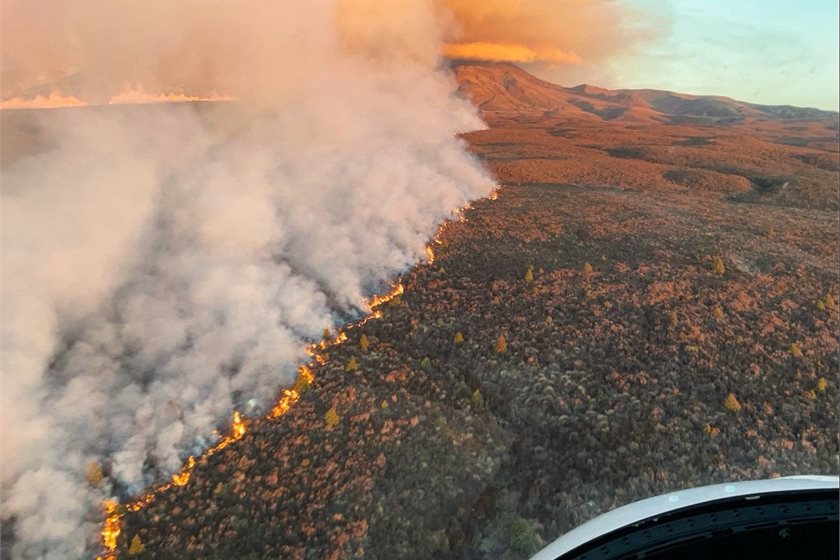
A devastating wildfire scorched 3000 hectares of Tongariro National Park, but as recovery gets underway, conservation leaders say the blackened landscape could offer a rare chance for large-scale native regeneration. Local Democracy's Moana Ellis reports.
A unique ecological legacy could rise from the ashes of the Tongariro National Park wildfire if long-term recovery work succeeds.
Conservation Minister Tama Potaka said eradicating weed and animal pests from the blackened landscape would be “top of mind” to give natural native regeneration the best chance.
The massive blaze tore through 3000 hectares of New Zealand’s oldest national park last week, burning out of control for nearly three days across the Central Plateau. Helicopters, planes and ground crews fought to contain it as flames triggered evacuations of trampers and residents.
Department of Conservation (DOC) Central North Island operations director Damian Coutts described the desperate situation of the fire, which broke out on Saturday, November 8.
“It felt bloody awful,” Coutts said.
“Sunday night this thing was not under control and spreading rapidly, even with 21 machines hitting it with everything they had. They couldn’t stop it,” he told a meeting of the Waimarino (National Park Village) community on Monday night.
Civil defence controller, district council chief executive Clive Manley, told residents the fire was one-and-a-half times the size of Wellington, and had ripped through four percent of the national park.
“It was huge in firefighting terms. No lives were lost, few properties were lost. There was a lot of work to protect them and to get people out – a superb effort – but it was a huge, huge drain on the people in our community and [it will have] a lasting impact.”
Monday night’s meeting gathered Ministers, Fire and Emergency NZ, Civil Defence, DOC and local and regional council leaders to brief the community on response and recovery efforts.
The fire swept through sub-alpine and alpine scrub, tussock grassland, wetland and forest habitats for threatened plants and wildlife including insects, kārearea/New Zealand falcon and whio/blue duck.
Rain eventually helped bring the blaze under control. It was officially declared extinguished on Sunday, 16 November.
Coutts said specialists were now assessing the damage.
“We are committed to doing a fire environmental impact assessment first and a restoration framework linked to that assessment,” he said.
“It looks really black out there but the fire went through so fast there isn’t [a thick] ash layer. When firefighters were in there digging up the hotspots, there was green in there. So plants below the ground are still green – they will come back.”
The fire has cleared a vast swathe of land, and with it competition for invasive weeds such as heather, gorse, broom and wilding pine that can take hold rapidly after disturbance.
Replanting was unlikely, Coutts said. Natural regeneration would recover the area if weed and animal pests were kept in check.
“It will re-shoot quite quickly. There’s a risk that we’ll see hares, rabbits, deer coming in and browsing on the new growth, so there’s going to have to be both an animal and a weed pest control programme.
“The opportunity here is to build a bigger programme of biodiversity inside Tongariro National Park and to go after broom, gorse and some of its friends on a broader scale.”
DOC Tongariro operations manager Libby O’Brien said the blaze was among the largest fires ever seen in Aotearoa on conservation land.
“Even the tiniest fire is a massive scar on that landscape, but from any vantage point within the national park, so much of what you can see is black.
“It’s whenua that is ridiculously important and special to anyone that’s ever been there, whether you whakapapa to that land, whether you live here, or whether you’ve visited.”
Established in 1887 and spanning 79,000 hectares, Tongariro was New Zealand’s first national park and the fourth in the world. Its three active volcanoes and cultural and geological significance make it a UNESCO dual World Heritage site.
A week-long rāhui placed by local iwi on the Tongariro Alpine Crossing and surrounding area was lifted early Monday, the day after the fire was extinguished. A second, decade-long restorative rāhui was placed over the burn area by Ngāti Hikairo ki Tongariro, a hapū of Ngāti Tūwharetoa, to protect the whenua as it heals.
O’Brien said the park was “relatively lucky” from a recreation viewpoint. Damage to the Tongariro Alpine Crossing carpark would limit use for several weeks, while the Mangatepopo Track – part of the Tongariro Northern Circuit Great Walk – would be closed for at least the season as DOC plans for a replacement hut and track upgrades.
It was still too early to fully understand the ecological toll.
“We’ve only just been able to get people out there to assess the issues,” O’Brien said.
“We know we’ve lost a lot of biodiversity. Wildlife – there will be a lot missing. There are a lot of birds up there flying around – birds of prey having a look – and I’ve seen more hares than I’ve ever seen up there. It will be interesting to see how that ecosystem shifts or evolves as regeneration occurs.”
She said the fire had been devastating and traumatic but had united the community behind recovery.
“The silver lining is we’ve got this amazing opportunity to stop those weeds from coming back, and to keep out browsing animals that move seeds around.”
The challenge ahead would be securing and coordinating a long-term restoration workforce.
“We could always do more if we had more people. The trick’s going to be working with the willing – volunteers, partner agencies, hapū and iwi … so many people are keen to help.”
The cause of the wildfire remains under investigation.
Recovery plans take shape
Emergency Management Minister Mark Mitchell told residents the Government’s National Emergency Management Agency (NEMA) was working with central government agencies and the national recovery coordination group to pinpoint where recovery investment was needed.
“We’ll try to get that done as quickly as we can so that we can get things moving,” Mitchell said.
Conservation Minister Tama Potaka acknowledged the “hits and shocks” the region had endured in recent years, from ski industry turbulence and mill shutdowns to the closure of the Chateau Tongariro.
He said regeneration opportunities could include cycle trails, a potential solution for the Chateau, and new housing developments, including social housing projects led by local iwi Ngāti Rangi.
Potaka said he would work to ensure new hapū initiative Maunga Ora was an “all-of-iwi, government, community effort to restore the place and continue to amplify Ruapehu as a place of iconic and majestic status”. DOC would also speak with the Tourism Minister about possible funding.
“It might be funded out of existing funding or it might be out of funding we find at the back of the sofa. The key is that we’ve got to have a plan before we figure out how much money is needed.
“That plan should not take six months to figure out – it should be weeks, not months. That’s the direction that I’ve given to the team this afternoon.”
Ngāti Hikairo ki Tongariro said on Monday it would lead the long-term restoration phase alongside DOC and key agencies.
“The mamae for our maunga runs deep,” Hikairo rangatira Te Ngaehe Wanikau said. “The true restoration of Tongariro will take time, unity and aroha.”
The carved pou whenua Te Ririo, which stands at the start of the Tongariro Alpine Crossing, had been charred to its core and was still smouldering on Monday.
Wanikau said the four-metre pou had survived as a symbol of resilience and hope. Installed a year ago to acknowledge the cultural significance of the landscape and protect hikers, it will be strengthened at its core and base following the fire damage to ensure stability.
The hapū said Maunga Ora – a shared commitment to healing, regeneration and the future wellbeing of Tongariro – would be developed in partnership with DOC, FENZ, iwi and the people of Aotearoa.
“We will help the land heal,” Wanikau said.
Ruapehu mayor Weston Kirton said the wildfire had left deep physical and emotional scars.
“I want to acknowledge the shock, fatigue, frustration and the uncertainty,” Kirton told residents.
“I want to express my deepest thanks to FENZ, DOC, NEMA and our Police, iwi partners, volunteers, local businesses and our own council staff. Your efforts protected lives, protected key assets and allowed us to start our recovery journey as quickly as possible.
“Despite that incredible work, the damage is significant. Our whenua has been hurt and so have the communities who rely on it, love it and draw identity from it.”
Kirton said the disaster had created space for renewal. Immediate priorities included building strong partnerships, supporting community wellbeing, sustaining tourism and managing environmental impacts.
“Long-term recovery will build on this and it must be guided by a model that ensures all voices are heard and reflected in a comprehensive recovery plan.”
Horizons Regional Council chair Nikki Riley said the council would back the region’s recovery efforts.
“We would be willing and enabling partners and you will have our full support.”
Conservation leaders said Tongariro Alpine Crossing bookings were “back to normal” and the department was preparing for potentially increased visitor interest.
“We could have a different phenomenon where people come not just to walk the Alpine Crossing but to experience the fire zone. We’re going to have to be agile and keep working with tourism operators to manage this,” DOC Central North Island operations director Damian Coutts said.
“There’s a real concern emerging about people walking off-track, where the ecology will be fragile.”
LDR is local body journalism co-funded by RNZ and NZ On Air.

print this story

Budget quietly kills renewable energy innovation centre Ara Ake
Fri 29 May 2026
By Pattrick Smellie | The axe has fallen in the Budget on the last Labour-led government’s Ara Ake future energy development centre.

Climate Leaders Coalition tight-lipped on companies lobbying to change climate legislation
Fri 29 May 2026
By Liz Kivi | The Climate Leaders Coalition is facing tough questions over Fonterra and Z Energy’s membership, after the companies successfully lobbied to change New Zealand’s climate legislation to protect their bottom lines.

Climate takes back seat in Budget 2026
Fri 29 May 2026
By Shannon Morris-Williams | Climate change featured only lightly in Budget 2026, with most climate-related spending focused on resilience and disaster recovery rather than emissions reduction, while the Government again left out any updated estimate of the cost of meeting New Zealand’s Paris Agreement obligations.
Westport climate case study highlights need for national adaptation support
Fri 29 May 2026
By Shannon Morris-Williams | A new Climate Change Commission case study on climate adaptation in Westport has highlighted growing concerns about flooding, climate resilience, and the psychological toll of repeated extreme weather events, with residents and councils calling for clearer national direction and greater funding support.

‘Shameful’ move to scrap Ministry for the Environment passes
Thu 28 May 2026
By Shannon Morris-Williams | The curtain has fallen on the Ministry for the Environment after legislation paving the way for its merger into a new mega ministry passed its third reading in Parliament yesterday, with the opposition condemning the move as a major weakening of environmental protection and nature’s voice within government.
Climate health response falling short – report
Thu 28 May 2026
By Shannon Morris-Williams | New Zealand’s latest National Climate Change Risk Assessment has exposed major gaps in the country’s response to climate-related health risks, with researchers warning current policies are underfunded, poorly coordinated, and failing to adequately protect vulnerable communities.
Huntly biomass option no cheap fix, Genesis tells MPs
Thu 28 May 2026
Genesis Energy says biomass can be burned in Huntly's Rankine units, but current costs put it in roughly the same price range as imported LNG and extra Rankine capacity would be expensive and could take years.
Wetland protections failing to stop losses
Thu 28 May 2026
By Shannon Morris-Williams | New mapping commissioned by the Environmental Law Initiative shows wetlands across New Zealand are still being converted to pasture, forestry and mining despite stronger national protections introduced in 2020, with researchers warning enforcement gaps may be undermining the rules.

Officials told Govt not to stop climate court case
Wed 27 May 2026
By Liz Kivi | Government officials advised ministers not to intervene in a groundbreaking climate court case, according to newly released documents.

ETS auction failures created $1.4b fiscal hole – Greens
Wed 27 May 2026
By Shannon Morris-Williams | Finance Minister Nicola Willis has hit back at the Green Party's claim that the repeated failure of New Zealand’s carbon auctions has added a $1.4 billion 'fiscal hole', with Green Party co-leader Chlöe Swarbrick blaming the Government for undermining the ETS.
