
Climate resolution conundrum for NZ
Today 11:30am
By Vernon Rive
COMMENT: While the United Nations resolution endorsing a landmark climate ruling is significant – politically, diplomatically and legally – its impact on international climate negotiations and domestic action is likely to be indirect and incremental.
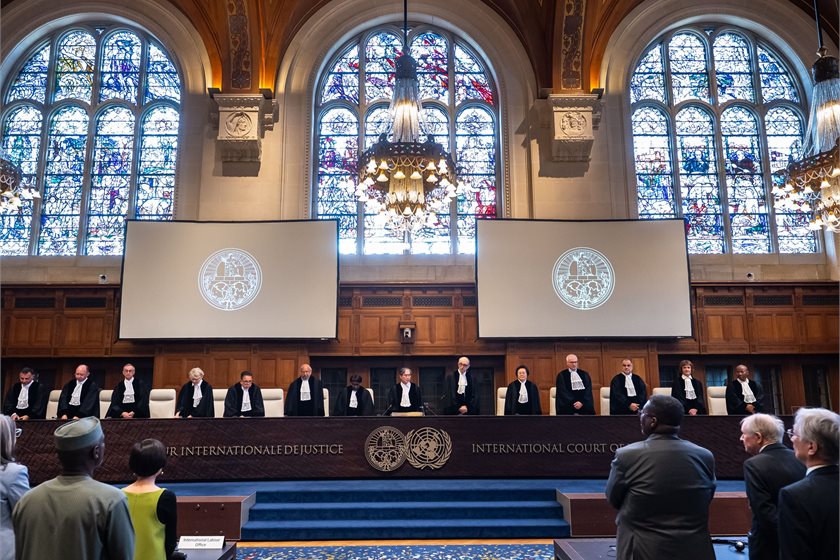
On 20 May 2026, the UN General Assembly – the main deliberative policymaking and representative forum of the United Nations containing all 193 UN members – by overwhelming majority (141 for; 8 against and 28 abstentions) endorsed the landmark advisory opinion of the International Court of Justice from July 2025 on the Obligations of States in Relation to Climate Change.
Among other things, the resolution called on states to comply with the obligations under international law set out by the ICJ, both under the provisions of the UN climate treaties (such as the UN Framework Convention on Climate Change and Paris Agreement) and legal obligations under customary international law. The 20 May resolution has been hailed as 'turning point in global climate leadership' (WWF); 'a major shift for climate justice' (Pacific Islands Students Fighting Climate Change); 'highly problematic' (US Mission to the United Nations) and 'a welcome step', but 'flawed' (Climate Rights International).
Which of these is it? How significant is the resolution to global climate change law and policy?
The resolution is significant: politically, diplomatically and legally. But its impact on international climate negotiations and domestic action, like most developments in international law and policy, is likely to be indirect and incremental.
It's significant politically, because adoption of the resolution by over two thirds of UN members is an overwhelming expression of political support for the core findings of the International Court of Justice.
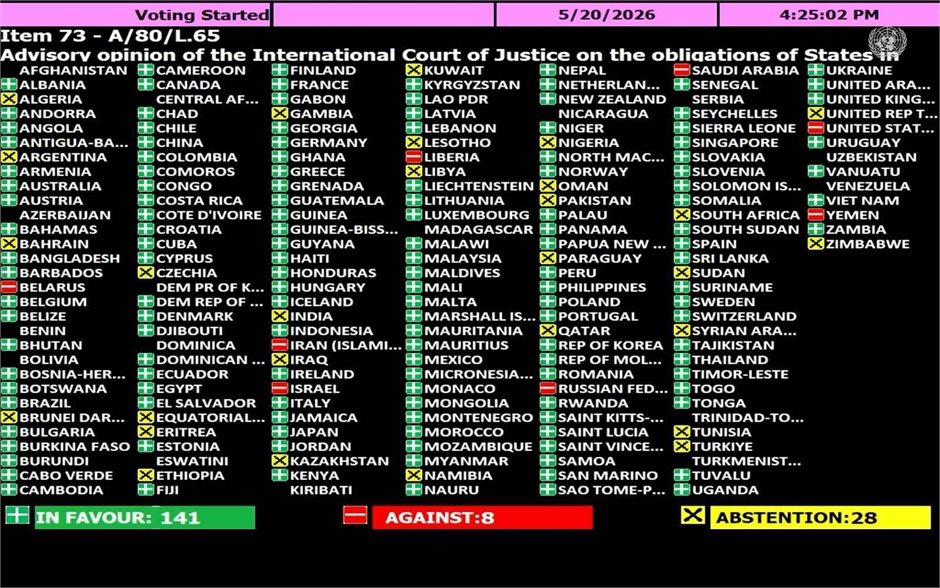
141 member states have signified their stated commitment to meaningful climate action; set against a small, although powerful, group of 8 states openly opposed to the ICJ's findings. In that group of opposing states are, not surprisingly, petrostates such as Saudi Arabia, Liberia and Iran, but also the United States, whose representative in the UN did not hold back in the US executive's criticism of both the draft resolution and the ICJ Advisory Opinion itself:
The resolution includes inappropriate political demands relating to fossil fuels and on other climate topics, and we believe there is no basis for the resolution’s mandate to the Secretary-General to report on the complex and nuanced legal issues addressed by the Court.
It's significant diplomatically, because this is another example of what are often thought of as less powerful small states, including small Pacific Island states, having a major impact on world affairs on climate change. It confirms, if there was any doubt, that small island states, including Pacific states, are a diplomatic and legal force to be reckoned with in international climate change law and policy. It sets the stage for further Pacific leadership, including Fiji and Tuvalu's role as hosts of the 'pre-COP' meetings in Suva later in 2026, with a special leaders' session taking place in Tuvalu.
And it's significant legally, because the content of the ICJ advisory opinion already being considered and applied by courts around the world now has a further boost with the UNGA's endorsement of it. The ICJ opinion is not enforceable in the same way that, for example, a judgment from the New Zealand High Court ruling on a dispute between two parties is enforceable. However, it is legally relevant to cases in courts around the world — in Canada, the Netherlands, Mexico and the European Court of Human Rights — already including references to the ICJ opinion in their judgments.
International lawyers have observed that courts around the world are treating the advisory opinion 'not as a remote statement of public international law, but as a live interpretive tool capable of shaping the content of domestic constitutional rights...' The 20 May resolution will add further weight to the ICJ's judgment and, in my view, increases the likelihood that domestic courts will refer to it, and perhaps, be influenced by it.
Where did New Zealand stand on the resolution?
New Zealand has navigated its way carefully through this process, holding its cards close to its chest until right before the vote. It ultimately sided with the majority, but also made clear in an intervention that its endorsement should not be seen as signalling that it agrees with everything in the ICJ's opinion. Ahead of the vote, the New Zealand representative Shannon Tau prefaced New Zealand's remarks explaining the government's decision to support the proposal with a statement:
This resolution does not fully reflect New Zealand’s position on the legal issues addressed by the International Court of Justice. Nor does it reflect all of the views expressed by the Court.
A similar position was taken by Australia. Both countries evidently considered the need to go on record as not accepting all of the ICJ opinion's content. In New Zealand's case this is probably not unexpected, given both the content of its representative's submissions before the ICJ (PDF), and the coalition government's current approach to climate change issues, both in New Zealand and internationally.
The vote may put governments who have supported the UN General Assembly resolution such as New Zealand and Australia in an interesting position where they are sued in domestic courts. It could create a conundrum for government lawyers whose Ministers instructing them have (through the government's representatives) internationally endorsed the ICJ opinion, but wish to downplay its significance in domestic proceedings.
It remains to be seen how the New Zealand High Court addresses the ICJ opinion in its forthcoming decision on a challenge to the government's emissions reduction plans, heard in Wellington a few weeks ago.
It will be even more interesting to see how government lawyers address the ICJ opinion in their submissions in the forthcoming Supreme Court case, Smith v Attorney-General, set down for a three-day hearing in Auckland on 17–19 August 2026.
Vernon Rive is an Associate Professor at Auckland Law School, where he teaches and researches public, environmental and climate change law.
Republished from Vernon Rive Environmental Law Academic.
print this story
Story copyright © Carbon News 2026

Govt’s LNG plan puts trade deals at risk, lawyers warn
Today 11:30am
By Liz Kivi | Lawyers for Climate Action are warning that the government’s plans for an LNG import terminal and to subsidise gas fields are in breach of New Zealand’s free trade agreements with the UK and the EU.

Thumbs up for Govt help for businesses transitioning from gas
Today 11:30am
By Liz Kivi | Businesses and climate advocates alike have welcomed the Government’s pre-budget announcement that it will help secure cheap lending for businesses transitioning from gas, as New Zealand’s domestic supply dwindles.

FMA urges sharper focus on climate risk disclosures
Today 11:30am
By Shannon Morris-Williams | New Zealand companies are making steady progress in climate-related financial disclosures, but the Financial Markets Authority says many organisations still need to provide clearer and more robust reporting on physical climate risks and their potential business impacts.

Greens bill to ban mining on conservation land drawn from ballot
Today 11:30am
By Shannon Morris-Williams | A Greens member’s bill seeking to ban new mining, prospecting and exploration on conservation land has been drawn from Parliament’s ballot, with the party saying the proposed law would close a loophole allowing mining on land set aside for environmental protection.

Climate Leaders Coalition on PM meetings: 'it wasn’t us'
Mon 25 May 2026
By Pattrick Smellie | The 81-member Climate Leaders Coalition is distancing itself from the actions of members who lobbied the Prime Minister’s Office to intervene and stop a landmark climate change court case.

Corporate coddling is killing our climate
Mon 25 May 2026
By Matt Halliday | COMMENT: The New Zealand Government’s recent move, undercutting citizens’ rights and the rule of law to cancel the country’s most important climate case, Smith v Fonterra, is a massive victory for corporate lobbying.

Mike Smith’s asymmetric victory
Mon 25 May 2026
By Pattrick Smellie | COMMENT: The New Zealand Government’s recent move, undercutting citizens’ rights and the rule of law to cancel the country’s most important climate case is a massive win for Mike Smith, the climate change activist who brought it.

Govt ramps up war on wilding pines with $79m boost
Mon 25 May 2026
By Shannon Morris-Williams | The Government is ramping up efforts to contain the spread of wilding pines with a $79 million funding boost aimed at protecting farmland, biodiversity hotspots, tourism landscapes and water catchments across New Zealand.

Rotorua extends diesel bus contract after NZTA declines extra funding
Mon 25 May 2026
By Mathew Nash, Local Democracy Reporter | Rotorua is stuck with its diesel-powered public buses after a funding snag played a part in setting back plans for zero-emission buses by years.
