
Rotorua extends diesel bus contract after NZTA declines extra funding
25 May 2026
By Mathew Nash, Local Democracy Reporter
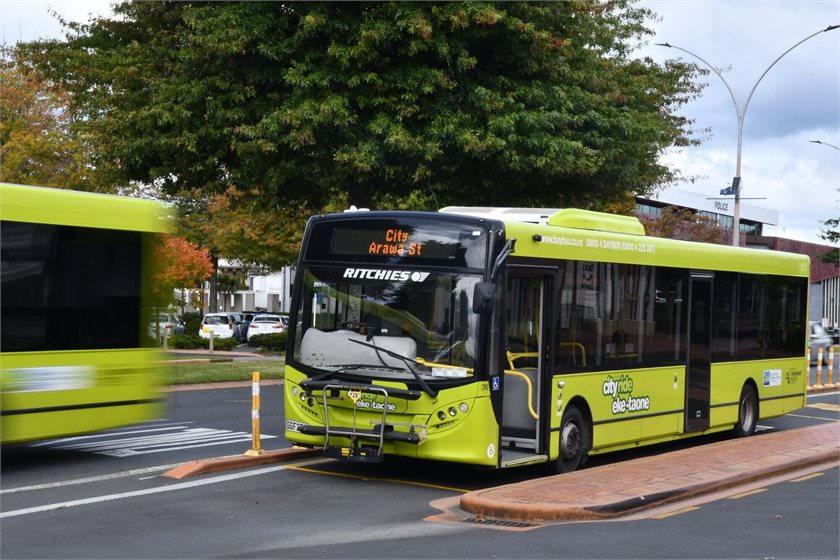
Rotorua is stuck with its diesel-powered public buses after a funding snag played a part in setting back plans for zero-emission buses by years.
The Bay of Plenty Regional Council, which runs the city’s urban bus network, had aimed to introduce zero-emission buses as part of plans to renew the operating contract for Rotorua this year.
After its request for an additional $2.6 million from the NZ Transport Agency was rejected, the council last month decided to extend the current contract by two years.
The funding request was made in 2024 as part of the national land transport budgeting process, according to material released to the Green Party by the council under official information laws.
The council said the extra funding was to help meet an expected rise in costs to transition to zero-emission buses under a new contract.
It would also fund other improvements to the Rotorua network.
Since July, a Government mandate has meant councils can buy only zero-emission buses.
This was decided in 2021 as part of a drive to have a zero-emission public transport fleet nationwide by 2035.
At the time, electric buses cost about twice as much as a diesel bus of the same size, according to the Ministry of Transport, but prices were expected to fall.
Tauranga has had electric public buses in its fleet since 2019.
The regional council’s funding request for Rotorua was denied with NZTA’s rationale that “all increased levels of service items” were declined.
The council decided not to proceed with plans for a new Rotorua bus contract because of “funding uncertainties”, according to a May 7 council report.
The council has since extended the city’s existing bus contract with operator Ritchies by 24 months.
Council transport strategy manager Andrew Williams confirmed zero-emission buses had formed part of the “early planning” for the original 2026 contract renewal process.
He said the diesel fleet was expected to continue through the extension period, to at least June 2028.
The Government’s funding position was one of “a range of factors” why the council decided not to procure a new contract.
Other factors included ongoing public transport network reviews, implementation of the national ticketing solution, and “alignment with the wider procurement programme”, he said.
Williams said the council still aimed to transition the full fleet, but the timing would depend on “funding availability, affordability and procurement timing”.
He said no reductions to existing Rotorua urban bus services were proposed, but there may be timetable changes.
“[The] regional council’s focus remains on maintaining existing services, improving reliability and making the best use of confirmed funding available,” he said.
The council had previously warned of the potential cost of the zero-emission transition when it was announced in 2021, saying its share of a nationwide $50m handout was only a “small fraction” of what would be needed. This funding ended in May last year.
Rotorua regional councillor Anna Grayling said extending the current deal kept services running while future changes and funding options were considered.
“Public transport planning always involves balancing local priorities, customer expectations, affordability and funding settings,” she said.
“This situation reflects that wider challenge, rather than a simple trade-off between climate goals and funding decisions.”
NZTA’s regional manager of system design for the Waikato and Bay of Plenty, Susan Collins, said there were always more bids than funds available within the NLTP process.
Projects that reflected the Government’s land transport policy were prioritised.
“In the Bay of Plenty region, the NLTP delivers a forecast total investment of $1.9 billion, $500m more than was previously allocated,” Collins said.
However, she said the forecast $119m investment in public transport was $14m lower than previously projected as funding was prioritised nationally towards maintaining existing services.
It was still $21m higher than the actual spend on public transport under the previous NLTP, 2021-24.
She said the “maintenance of existing services” was a public transport priority in the 2024-27 NLTP period and that NZTA had approved the 24-month extension to Rotorua’s services.
“This will allow them [the regional council] to plan network changes, consult with the community and plan to decarbonise the bus fleet,” she said.
The Government still aimed to decarbonise public buses nationwide by 2035.
LDR is local body journalism co-funded by RNZ and NZ On Air.

print this story

Weakening Clean Car Standard would hurt EV uptake, industry warns
Tue 7 Jul 2026
By Shannon Morris-Williams | Electric vehicle advocates say weakening the Clean Car Standard would reduce access to new EV models, undermining New Zealand's place in global supply chains and slowing the country's transition to lower-emissions transport.
Electric bus fleet coming as Go Bus loses Hawke’s Bay city routes to Tranzit
1 Jul 2026
By Linda Hall, Local Democracy Reporter | Go Bus will be gone on the urban streets of Hawke’s Bay next year as a fleet of all-electric buses takes over the runs.

Inaction on shipping decarbonisation could cost NZ up to $94b by 2050, report says
30 Jun 2026
By Oli Lewis | Failing to support and enable the decarbonisation of the shipping industry could result in losses of $17.5 billion to $94.4b to the New Zealand economy by 2050, according to a report from the Aotearoa Circle.
Labour pledges unlimited public transport for $20 a week
10 Jun 2026
The Labour Party is promising to cap weekly public transport fares at $20 in Auckland, Wellington and Christchurch, if elected in November.

NZ at risk of falling behind on EV transition
22 May 2026
By Shannon Morris-Williams | An EV lobby group is warning that New Zealand is at a crossroads on transport electrification, with inconsistent policy settings and lagging charging infrastructure slowing uptake, while global adoption accelerates and fuel price shocks renew interest in electric vehicles.
NZTA rejects covering $145m of Wellington public transport projects
20 May 2026
By Justin Wong, Local Democracy Reporter | More than $145 million of Wellington public transport projects - including new bus spines along the harbour quays and the redevelopment of ageing Waterloo station - never made it into the Government’s $32.9 billion national land transport plan.

NZ’s latest push to roll out more EV chargers is a good thing – but can it go the distance?
14 Apr 2026
A $50 million plan to expand New Zealand’s public electric vehicle (EV) charging network marks another step toward a lower-emissions transport system.
Free fares call as fuel crisis impacts school attendance
8 Apr 2026
An open letter is urging the Government to make public transport free for all school children and subsidised for students under 25, as rising fuel costs begin to impact attendance and access to education across the country.

Momentum speeds up for low-emissions heavy transport
2 Apr 2026
By Shannon Morris-Williams | New Zealand’s heavy vehicle sector is starting to move toward lower-emissions alternatives, with electric vehicles now delivering cost savings as well as lower emissions.
