
Momentum speeds up for low-emissions heavy transport
2 Apr 2026
By Shannon Morris-Williams
New Zealand’s heavy vehicle sector is starting to move toward lower-emissions alternatives, with electric vehicles now delivering cost savings as well as lower emissions.
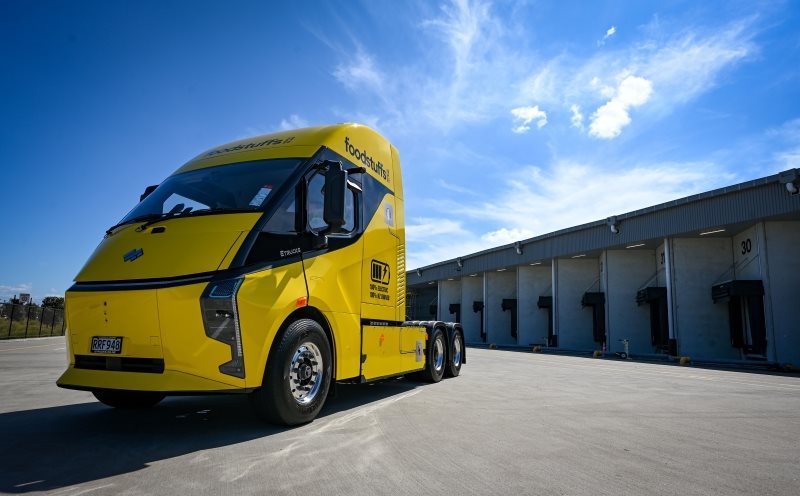
Major operators including Foodstuffs, WM New Zealand, Fonterra and NZ Post are already trialling and rolling out electric and low-emissions trucks across their fleets, with Foodstuffs North Island the latest to add a new electric truck, the Deepway, to its supply chain.
The Deepway
Developed by Baidu and Lionbridge in China, the Deepway Star was designed specifically for zero-carbon logistics and is Foodstuffs’ first electric heavy vehicle operating in the temperature-controlled distribution network.
The truck will tow an electric refrigerated trailer that joined the fleet in 2024, enabling the entire unit, including the refrigeration system, to operate on electricity.
Foodstuffs carbon manager Ben Riordan said a comparable diesel truck would produce around 750 kilograms of carbon emissions a day on the same route as the Deepway, while the electric truck, powered by New Zealand’s mostly-renewable electricity grid, produces about 80 kilograms per day, an estimated reduction of around 200 tonnes of carbon emissions each year.
Ross Linton, owner and director at E Trucks, the official New Zealand distributor for Deepway, told Carbon News the truck had a pricetag that easily competes with an equivalent diesel model, costing $100,000 to $150,000 less than a comparable 720hp diesel truck. While that included support from the Low Emissions Heavy Vehicle Fund – the truck will also deliver further savings in running costs.
“Plus a lot cheaper energy prices – always, not just with the present distortions – lower servicing costs, zero emissions and currently, no RUC. There's a lot to like.”
Since the current fuel crisis, Linton said they have seen an increase in enquiries, with customers now coming primarily for cost savings rather than emissions targets.
He said on-highway charging ability, including space for trailer on charging, and on highway charging costs remain the biggest barriers to operators for switching to electric trucks.
Linton said greater certainty around the no-RUC incentive, shifting the Low Emissions Heavy Vehicle Fund to a flat dollar subsidy rather than a percentage of vehicle cost, and more support for on-highway charging and business solar installations would help accelerate uptake.
Foodstuffs has a target to reduce emissions by 42 percent by 2030 from its 2020 baseline.
Head of environmental, social and governance Sandy Botterill said transitioning heavy freight to electric is one of the most effective ways Foodstuffs can reduce its emissions.
“About 70 percent of Foodstuffs’ Scope 1 and 2 emissions come from our supply chain fleet, so transitioning heavy vehicles away from diesel is critical.”
Electric moves
The new vehicle follows several earlier electrification milestones for Foodstuffs.
In 2020, the co-operative commissioned a custom-built electric truck, converting a standard Isuzu FVY 24-tonne diesel truck to run entirely on electricity when no suitable heavy electric vehicles were available to buy.
Support from the Energy Efficiency and Conservation Authority has also helped accelerate the transition, including co-funding for 61 fast-charging stations, 28 electric delivery vans and two ambient electric trucks.
Foodstuffs North Island plans to introduce six more electric trucks to the fleet by 2030.
Waste sector goes electric
Christchurch waste and recycling company EcoCentral has taken delivery of its first fully electric loader, marking the start of its transition from diesel to an all-electric loader fleet.
Ben Taylor, sustainability lead at Ecocentral, said loaders currently contribute to over 50% of the company’s operational greenhouse gas emissions, which is the single biggest source as a consequence of them running entirely on diesel.
The new 19-tonne loader features a 282 kWh battery pack capable of delivering up to eight hours of run time per charge.
“This is part of a multi-year plan to replace our entire diesel loader fleet with electric alternatives to cut down our emissions,” Taylor said.
“This move will also improve operational efficiency through reduced fuel costs.”
In February, a heavy EV charging hub opened at Lower Hutt landfill, capable of charging electric-powered loaders and up to 60 rubbish trucks.
Elsewhere, Waste Management New Zealand represents another tangible shift in heavy vehicle decarbonisation, with a nationwide fleet of 60 electric trucks that has travelled more than 3 million kilometres, avoiding around 5,600 tonnes of CO₂e.
EVs deliver
NZ Post is operating a 19-tonne Mercedes eActros electric truck on 300km daily routes in Auckland, while Mainfreight has been trialling electric trucks since at least 2020 and, alongside Fonterra, is developing battery-swapping infrastructure.
Supporting wider uptake, rental company TR Group has become the first in the Southern Hemisphere to offer electric heavy truck leasing.
And just this week, IKEA New Zealand announced it will roll out an electric vehicle charging network aimed at supporting zero-emissions home deliveries across Auckland, with plans to expand nationwide. The network includes connectors for Mainfreight and NZ Post last-mile delivery vehicles.
Fuel crisis changing behaviour
Fuel is one of the largest ongoing costs for a heavy vehicle fleet, with fuel costs accounting for more than a quarter of a business’ costs.
In a speech to the Automobile Association Annual Conference last week, Transport Minister Chris Bishop said the current fuel crisis is seeing significant shifts in behaviour across the country.
“Comparing the two weeks pre-conflict in mid-February against 7-day rolling averages for subsequent weeks, we have seen a reduction of approximately 20% in the vehicle kilometres travelled by cars. Not necessarily surprising when petrol prices have gone up 30%.
“Last week saw more than 1,000 electric vehicles registered, close to double the week prior. This makes it the biggest week in EV registrations since the end of 2023. Year-to-date registrations are nearly 2,000 higher than this time last year.”
Heavy vehicles - heavy footprint
Heavy vehicles make up a disproportionate share of the transport sector’s footprint, producing nearly a quarter of New Zealand’s transport emissions despite accounting for only a 7% share of total travel. Most heavy vehicles are run on fossil fuels.
Heavy freight vehicles transport 93% of New Zealand’s total freight by weight.
New Zealand’s Low Emission Transport Fund officially wrapped up in July last year. The nine-year programme put hundreds of millions of dollars towards accelerating the country’s shift to cleaner transport.
The fund supported projects including the world’s first electric milk tanker (Fonterra) and New Zealand’s first hydrogen-powered truck (NZ Post).
The fund offered grants covering up to 25% of the cost of new zero-emissions trucks or converting internal combustion engine vehicles, and providing data and insights on energy use and emissions across the transport sector.
CORRECTION: In paragraph 5 the article previously stated that the Low Emissions Heavy Vehicle Fund had closed. While the Low Emission Transport Fund has closed, EECA's current Low Emissions Heavy Vehicle Fund remains open and active. Updated at 1:15pm Thursday April 2.
print this story
Story copyright © Carbon News 2026
Electric bus fleet coming as Go Bus loses Hawke’s Bay city routes to Tranzit
Wed 1 Jul 2026
By Linda Hall, Local Democracy Reporter | Go Bus will be gone on the urban streets of Hawke’s Bay next year as a fleet of all-electric buses takes over the runs.
Inaction on shipping decarbonisation could cost NZ up to $94b by 2050, report says
Tue 30 Jun 2026
By Oli Lewis | Failing to support and enable the decarbonisation of the shipping industry could result in losses of $17.5 billion to $94.4b to the New Zealand economy by 2050, according to a report from the Aotearoa Circle.
Labour pledges unlimited public transport for $20 a week
10 Jun 2026
The Labour Party is promising to cap weekly public transport fares at $20 in Auckland, Wellington and Christchurch, if elected in November.
Rotorua extends diesel bus contract after NZTA declines extra funding
25 May 2026
By Mathew Nash, Local Democracy Reporter | Rotorua is stuck with its diesel-powered public buses after a funding snag played a part in setting back plans for zero-emission buses by years.
NZ at risk of falling behind on EV transition
22 May 2026
By Shannon Morris-Williams | An EV lobby group is warning that New Zealand is at a crossroads on transport electrification, with inconsistent policy settings and lagging charging infrastructure slowing uptake, while global adoption accelerates and fuel price shocks renew interest in electric vehicles.

NZTA rejects covering $145m of Wellington public transport projects
20 May 2026
By Justin Wong, Local Democracy Reporter | More than $145 million of Wellington public transport projects - including new bus spines along the harbour quays and the redevelopment of ageing Waterloo station - never made it into the Government’s $32.9 billion national land transport plan.

NZ’s latest push to roll out more EV chargers is a good thing – but can it go the distance?
14 Apr 2026
A $50 million plan to expand New Zealand’s public electric vehicle (EV) charging network marks another step toward a lower-emissions transport system.

Free fares call as fuel crisis impacts school attendance
8 Apr 2026
An open letter is urging the Government to make public transport free for all school children and subsidised for students under 25, as rising fuel costs begin to impact attendance and access to education across the country.

Fuel shock pushes buyers back toward EVs
31 Mar 2026
Surging fuel prices are pushing some New Zealand buyers back toward electric vehicles and hybrids, as households respond to the oil shock by trying to cut their exposure to petrol.
