
NZ votes in favour of key UN climate resolution
21 May 2026
By Liz Kivi
A pivotal United Nations resolution to recognise a landmark International Court of Justice climate ruling has passed with nations voting overwhelmingly in its favour, with New Zealand voting on the same side as Pacific allies who spearheaded the vote.
However, climate advocates say the Government’s stance exposes a growing gap between New Zealand’s international positioning and its ‘climate backsliding’ at home.
The vote, led by Vanuatu, with more than 60 other nations as co-sponsors, took place early this morning New Zealand-time. It was seen as a key test of climate leadership as well as nations’ willingness to tackle the climate crisis in a fair and legal way.
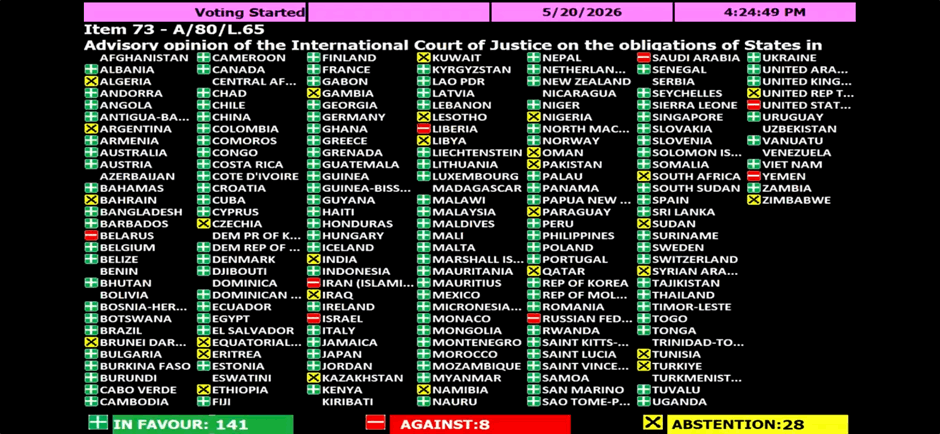
141 states voted in favour of the resolution, with 8 against, and 28 abstaining.
Ahead of the vote, Climate Change Minister Simon Watts declined to comment and instead referred Carbon News to the Ministry of Foreign Affairs and Trade. But MFAT also declined to comment ahead of the vote.
Critics say New Zealand’s stance is in stark contrast to the country’s position in 2023, when Aotearoa was a co-sponsor supporting the original resolution asking the International Court of Justice to issue its opinions on states’ climate change obligations.
Nathan Cooper, associate professor of law, University of Waikato, said that New Zealand’s vote was welcome following the country’s earlier refusal to confirm which way it would vote, but he criticised the country not taking more decisive action.
“By deciding not to co-sponsor the United Nations General Assembly (UNGA) Resolution endorsing [the] Advisory Opinion, the government has abandoned the country's role as a regional leader and global inspiration for climate action.”
Cooper said the ICJ's Advisory Opinion makes clear what states are legally obliged to do in relation to climate change.
"Now, with the Resolution adopted, it is time for our government to revisit recent climate-related decisions – including reversing the ban on off-shore oil and gas exploration - that the Advisory Opinion identifies as a breach of State obligations and an 'internationally wrongful act'.”
Teall Crossen, WWF-New Zealand special adviser on Climate Law and Policy, also welcomed New Zealand voting in support but says the move “rings hollow” while the Government continues expanding fossil fuels at home.
“Pacific nations pushed for the ICJ ruling and Vanuatu led the charge on this UN resolution because they are already facing catastrophic climate impacts and expect countries like New Zealand to show genuine leadership.
“Instead, we’ve reversed the ban on offshore oil and gas exploration, committed hundreds of million dollars to extend the life of the fossil fuel industry, and are pushing through bizarre plans to levy electricity users to import LNG.
“The ICJ has warned that new fossil fuel expansion is likely to be incompatible with international law, yet Aotearoa is continuing to actively prop up sunset fossil fuel industries,” she says.
“If the Government wants to be seen as a credible regional partner and uphold its responsibilities to Pacific communities on the frontline, it cannot continue doubling down on the industries driving the climate crisis at home.”
'Difficult to defend'
Lawyers for Climate Action NZ’s acting executive director, Laura MacKay, says the gap between New Zealand’s international rhetoric and domestic action is becoming increasingly difficult to defend.
“The ICJ opinion reinforced that climate obligations are grounded in existing international law and that governments are expected to take meaningful action to prevent climate harm.
“It is hard to understand why New Zealand is prepared to support a resolution that sets out States’ obligations to regulate private actors for contributions to climate harm while domestically considering law changes that shield major emitters from accountability through the courts.
“If the Government is serious about respecting the law on climate change, that commitment must extend beyond statements made at the UN.”
In a statement, a Ministry of Foreign Affairs and Trade spokesperson said that, while the resolution “does not fully reflect New Zealand’s position” on the legal issues addressed by the ICJ, “our support for the resolution is in keeping with Pacific advocacy on climate change and resilience issues.”
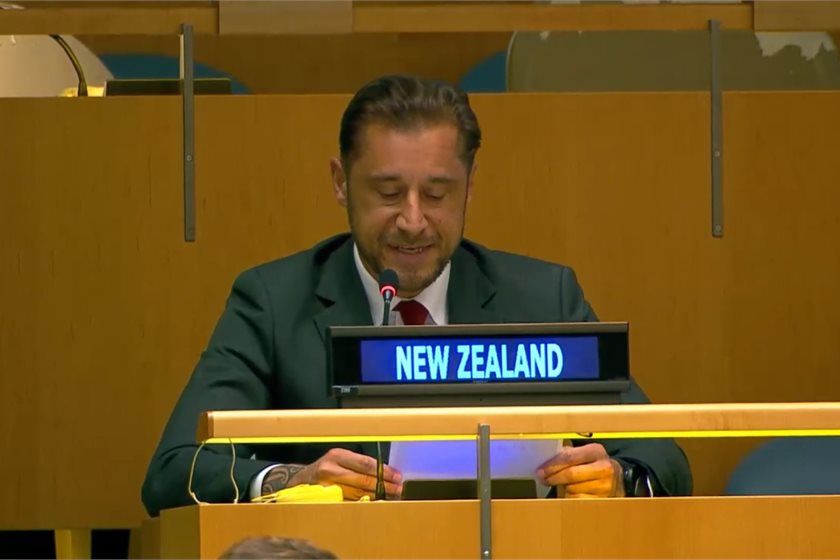
Speaking in support of New Zealand’s vote at the General Assembly, Shannon Tau, counsellor, Permanent Mission of New Zealand to the United Nations, commended Vanuatu for its work on the resolution, and its strong advocacy on behalf of Pacific Island countries.
He noted that New Zealand had also voted against amendments that would have had the effect of upsetting the outcome of the last three months of negotiations.
“New Zealand also observes that to be effective against the impacts of climate change, all major emitters – including Russia, China, India, the European Union and the United States – must take effective action,” Tau said.
“New Zealand is pleased that the resolution recalls the Court’s findings on the preservation of maritime zones and continuity of statehood in the face of climate-change-related sea-level rise, which endorse key elements of the Pacific Islands Forum position.
“New Zealand is a strong supporter of a rules-based international system, and of the International Court of Justice as the principal judicial organ of the United Nations. New Zealand considers it important and appropriate that the General Assembly take formal note of the Court’s Advisory Opinion.”
Operationalising the ruling
In last night’s vote, each member state was asked to back a series of landmark findings on climate justice from the International Court of Justice as part of the new political resolution to “operationalise” the ruling, meaning governments recognise they have a legal responsibility to cut their greenhouse gas emissions, including tackling fossil fuels.
The ICJ’s advisory opinion, published last year following a series of hearings in the Hague, had been requested by an unprecedented 132 states – including New Zealand – without opposition in 2023 and was hailed as a “historic win” for small island states.
The court’s advisory opinion is already being used in climate litigation around the world and judges are starting to reference it in their climate-related rulings.
In an opinion piece published in Project Syndicate ahead of the vote, Vanuatu’s Minister of Climate Change Ralph Regenvanu said there was “no defensible reason” for states to vote against the resolution.
“If we fail here, we will be signalling to current and future generations that we have moved from a system built on cooperation to one governed by power alone. We will be conceding that pressure from vested interests can derail the progress we have made toward guaranteeing our collective survival."
“It is no secret that powerful vested interests want to delay the transition away from fossil fuels. Despite the rapidly falling costs of renewables, they have no problem leveraging their money and influence to frustrate efforts to mitigate climate change. Small island states like Vanuatu are particularly vulnerable to these bad-faith actors.”
He also said he was under no illusion that the ICJ’s ruling would be difficult for some countries to implement.
“But we cannot ignore the costs of inaction. This is a critical moment, not just for the climate but also for the future of international cooperation. The entire postwar, post-colonial multilateral order is under significant pressure. Large states are withdrawing from international agreements and withholding funding from multilateral organizations. Bilateral deals are replacing collective frameworks. Many fear that the global architecture of rules, norms, courts, and international accountability is crumbling before our eyes.”
Regenvanu previously told Carbon News that New Zealand restarting fossil fuel exploration and subsidies is an obvious breach of international law, exposing the country to international and domestic litigation.
New Zealand also declined to back a landmark declaration calling for a fossil fuel free Pacific, led by Pacific nations last month.
At that time, Carbon News asked Climate Change Minister Simon Watts whether he recognised that continuing fossil fuel production and subsidies may constitute an "internationally wrongful act," according to last year's ICJ ruling.
Watts didn’t respond with a ‘yes’ or ‘no’ but with a sidestep: “The Government takes New Zealand’s international climate obligations seriously, including in the development of energy policy.”
The Government’s move to limit lawsuits holding climate polluters accountable for damage, announced just last week, has also been criticised as ignoring the ICJ ruling.
Carbon News asked Simon Watts to comment for this story but did not receive a response ahead of press time.
print this story
Story copyright © Carbon News 2026

Contact: Protected geothermal fields must be opened to meet 2040 goal
Mon 6 Jul 2026
By Oli Lewis | A goal to double geothermal energy generation by 2040 using existing technologies is unachievable unless some protected fields are reclassified for development, Contact Energy says.

Minister warns councils against 'extreme' climate forecasting
Mon 6 Jul 2026
By Liz Kivi | Minister Simon Watts has written to councils warning them off using extreme climate forecasting scenarios that can “drive unnecessary costs” for ratepayers.

Fast-track panel backs proposed Haldon Solar Farm
Mon 6 Jul 2026
The proposed Haldon Solar Farm in the Mackenzie Basin has moved to the final stages of the Fast-track Approvals Act process after the Fast-track Panel proposed granting approval for the project.

Labour promises to repeal bill to block climate lawsuits
Fri 3 Jul 2026
By Liz Kivi | The Government bill aiming to block climate lawsuits passed its first reading under urgency after a heated debate in Parliament last night, with the Labour Party promising it will repeal the bill if elected in November.

Taranaki offshore wind developer eyes mid-2030s commissioning after law change
Fri 3 Jul 2026
By Oli Lewis | The first offshore wind farm in New Zealand could be commissioned by the mid-2030s, with its developer saying a new permitting framework has bolstered investor confidence.

Confidence in tackling climate risks remains low
Fri 3 Jul 2026
By Shannon Morris-Williams |New Zealanders have little faith in the country's ability to tackle climate risks, with a new poll finding fewer than one in three are confident the country can reduce the impacts of climate change, while many are calling for stronger Government leadership on climate hazards.

EECA seeks answers on NZ's future fuel mix
Fri 3 Jul 2026
By Shannon Morris-Williams | The Energy Efficiency and Conservation Authority is looking for specialists to assess the role future low-emissions fuels could play in New Zealand’s energy system.

Australia is at least ten years ahead of us on solar. It’s time we caught up.
Fri 3 Jul 2026
By Ed Harvey | OPINION: Starting this week, millions of households across New South Wales, South Australia and Southeast Queensland will have access to three hours of free electricity every single day.

West Coast Conservation Board chair concerned over loosening commercial concessions
Fri 3 Jul 2026
By Vihan Dalal, Local Democracy Reporter | The West Coast Conservation Board chairman Mike Legge has raised concerns with a move by the Government to amend the Conservation Act to loosen how commercial concessions are granted on conservation land.

Media round-up
Fri 3 Jul 2026
In our round-up of climate coverage in local media: Getting the most impact from the Government's investment in school solar; NZ needs an objective assessment of LNG imports and renewable storage options; and while greener suburbs are healthier on all kinds of metrics, achieving them isn’t straightforward.
