
Tairāwhiti deserves better than weakened forestry rules
5 May 2026
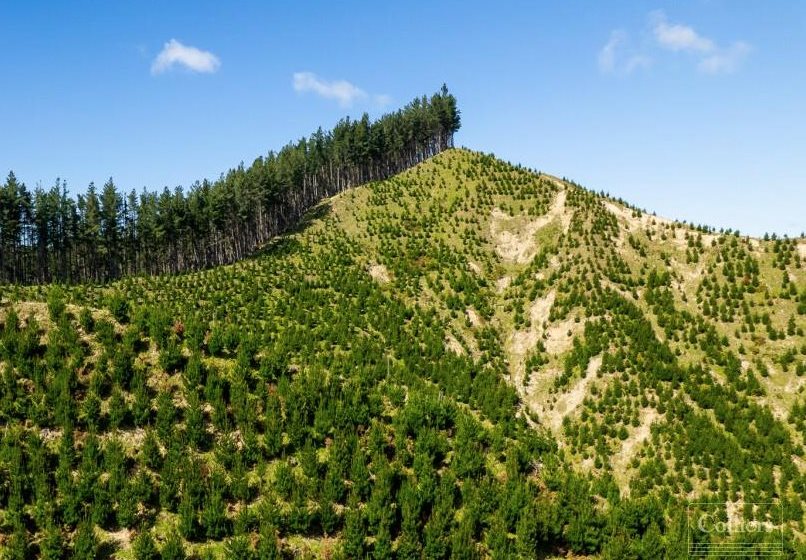
OPINION: The government's proposed amendments to forestry standards, released yesterday, ignore the hard lessons learned in our region and ignore the voices that have fought hardest to protect it, writes Manu Caddie.
Gisborne District Council has applied for three new enforcement orders against forestry operators in the past month. Tens of millions of tonnes of sediment was discharged into our waterways and coastal waters following cyclones Hale and Gabrielle. Ongoing legal battles are still continuing to force compliance with rules that never should have needed enforcement in the first place.
Yet the Coalition Government has just rejected the very reforms that Tairāwhiti fought for.
When Mana Taiao Tairāwhiti submitted recommendations on the proposed amendments to the National Environmental Standards for Commercial Forestry (NES-CF) in July 2025, they were drawing on three years of hard-won knowledge. The 12,000-person petition. The Ministerial Inquiry. The 49 recommendations that came from that inquiry. The community's lived experience of watching soil and debris pour off pine-covered slopes during heavy rain, smothering rivers and coastal ecosystems, destroying private property and public infrastructure.
MTT's submission was clear: retain and strengthen council powers to protect high-risk land, expand erosion controls beyond just slash management, and prohibit new pine planting in the most dangerous zones.
The government's response? “No. We're going the other way.”
Instead of giving Gisborne District Council stronger tools to prevent unsafe forestry, the government has removed the regulation that allowed councils to apply stricter rules in high-risk areas. Instead of requiring broad risk assessments, they've narrowed the focus to slash management alone. And instead of empowering local decision-makers who understand our terrain and climate, they've explicitly chosen "national direction rather than local plans."
This is the wrong call for Tairāwhiti. This is exactly the policy that delivered us the ongoing disaster.
In 2015 Trevor Freeman was the Gisborne District Soil Conservator. He participated in the working group charged with designing the National Environmental Standard for Plantation Forestry. Trevor and his colleague Kerry Hudson should be given national honours for trying in vain to convince the working group, which was stacked with forestry industry representatives after the process was shifted by the National-led Government from the Ministry for the Environment to the Ministry for Primary Industries. These guys argued regions like Tairāwhiti need more stringent rules than places like Kaingaroa Forest in the Central Plateau, which has no erosion issues. The two local government representatives on the working group were out-voted and New Zealand got a lax framework that enabled the industry to have only the bare minimum of environmental protections. And we know where that has got us.
Consider what's actually happening on the ground right now. Gisborne District Council is fighting through enforcement orders against companies that own pine trees planted on slopes they should never have planted on in the first place. These aren't disputes over minor technical breaches – they're about fundamental incompatibility between the land and the land use.
One independent expert testified in the Environment Court that he'd seen slopes where "pine should not have been planted on these slopes. The geology, slope angle, and rainfall intensity all combine to make this land inherently unstable, particularly once root structures are lost post-harvest." Another noted that "even with improved practices, some sites are not suitable for commercial pine forestry." A visiting international expert who assesses forestry practices across Asia, Africa, the Americas and Europe said Tairāwhiti had some of the most inappropriate plantings and harvesting he has ever seen.
These are not fringe opinions. Multiple experts, council staff, and even industry representatives themselves have acknowledged that a lot of land in Tairāwhiti was never suitable for pine. Yet the amended NES-CF contains no prohibition on planting new pines in Red and Orange erosion susceptibility zones – the highest-risk areas.
Likewise, responsible companies committed to best practice are Forest Stewardship Council certified. The FSC rules for New Zealand explicitly exclude the planting of inappropriate exotic species on highly erosion-prone slopes.
Yet the new rules require councils to provide detailed 1:10,000 scale mapping just to justify stricter rules. MTT specifically flagged that councils shouldn't be burdened with proving the case for protection – this requirement is totally backwards. Councils are already stretched thin. This requirement will slow protections, not speed them.
And the removal of Regulation 6(4A) – which allowed councils to prevent unsafe afforestation and harvesting in vulnerable areas – removes one of the hard-won tools that came from the last political battle and was implemented under the previous Labour Government as a direct result of the Ministerial Inquiry the public petition called for.
Here's what should trouble us most: Gisborne District Council and Mana Taiao Tairāwhiti have spent three years proving, in excruciating detail, that our region's terrain is too fragile and our climate too intense for casual pine forestry decisions. The enforcement orders working their way through the courts at great cost to both ratepayers and forest owners right now are the evidence. The sediment washing down our streams is the evidence. The 45 million additional tonnes of soil discharged in one year is the evidence.
Yet the government's response is to make it harder for councils to say "no" to risky afforestation and easier for forestry to continue in completely inappropriate places.
We've been here before. We've learned the hard way that weak rules and centralised decision-making don't work in Tairāwhiti. Three years ago, we mobilised 12,000 people to demand change. We got a Ministerial Inquiry. We got commitments to tighten up.
Now, those commitments are being rolled back.
The question isn't whether Tairāwhiti should accept this. The question is whether our council and our community will continue to push back – as they are doing right now with those three new enforcement order applications – regardless of what Wellington says.
We've proven we can win when we stand together. We can't stop now.
print this story
Story copyright © Carbon News 2026
Nature-based solutions – such as forestry – crucial for carbon removal
5 Jun 2026
COMMENT: Transitioning from erodible pasture to well-managed forest can yield substantial environmental benefits, writes James Treadwell.
Govt ramps up war on wilding pines with $79m boost
25 May 2026
By Shannon Morris-Williams | The Government is ramping up efforts to contain the spread of wilding pines with a $79 million funding boost aimed at protecting farmland, biodiversity hotspots, tourism landscapes and water catchments across New Zealand.
Govt presses ahead with forestry rule changes despite opposition
14 May 2026
By Shannon Morris-Williams | The Government is pushing ahead with changes to commercial forestry rules despite most submitters opposing the proposals, with critics warning the reforms will weaken councils’ ability to manage erosion and forestry slash risks in vulnerable regions such as Tairāwhiti.

Drop in ETS forestry registrations
5 May 2026
By Liz Kivi | ETS forestry registrations have dropped off this year, with the new mandatory emissions return period, new land-use rules, and carbon price volatility all meaning participants aren’t rushing to register forestry in the emissions trading scheme.

Wilding conifers continue to plague Southland
17 Apr 2026
By Matthew Rosenberg, Local Democracy Reporter | Fast-spreading conifer trees are causing headaches in Southland as inconsistent funding continues to hinder control efforts.
Wellington planting nears one million trees
30 Mar 2026
By Shannon Morris-Williams | Greater Wellington’s parks restoration programme will hit one million native trees this year, with the first dams to rewet peat wetlands in Queen Elizabeth Park now completed after a years-long effort to bring these ecosystems – and their carbon sequestering superpowers – back to life.
Tairāwhiti needs proper Govt support to heal the land – not empty announcements for political optics
24 Feb 2026
OPINION: The Government’s answer to Tairāwhiti’s severe erosion crisis – that the region apply for modest, contestable funding rounds – while rejecting the region's own land transition business case, leaves our long-term resilience hanging in the balance, writes Manu Caddie.

Slash for cash turns storm debris into jobs and climate resilience
19 Feb 2026
A community-led initiative in Tairāwhiti is transforming storm-damaged forestry slash into jobs, soil regeneration and long-term climate resilience.
'Damning' report challenges forestry’s role in Tairāwhiti as sector rejects conclusions
4 Feb 2026
By Shannon Morris-Williams | New independent analysis commissioned by Mana Taiao Tairāwhiti challenges long-standing claims that industrial forestry underpins the Tairāwhiti economy.
