
Climate change could sharply increase NZ landslide risk
14 Apr 2026
By Shannon Morris-Williams
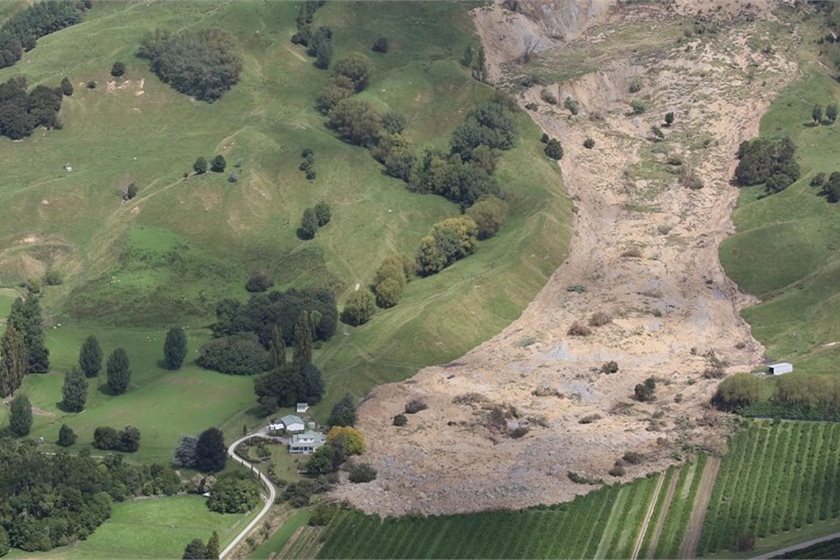
Climate change could significantly increase the number and intensity of landslides in New Zealand, with new research showing a Cyclone Gabrielle-scale storm in a warmer world could trigger tens of thousands more slips across a wider area.
The Increasing landslide susceptibility and intensity under climate change for Aotearoa New Zealand report says extreme rainfall from storms like Cyclone Gabrielle can trigger vast numbers of landslides, and warns those impacts are likely to intensify as the climate warms.
According to standard classifications, there are 32 different types of landslides, which are categorised by factors such as their failure mechanism, the speed at which they move and whether they’re constrained by topography, which could ‘super elevate’ material out of a channel.
Landslides are typically triggered by either earthquakes – which produced an estimated 40,000 landslide events when Kaikōura was struck in 2016 – or heavy rainfall, which can typically generate more than 10,000 landslides in a single major weather event.
Aotearoa New Zealand is especially prone to shallow landslides due to its steep topography, high number of earthquakes, and frequent severe weather events. Cyclone Gabrielle in February 2023 triggered 800,000 landslides across the North Island, and is one of the most extreme landslide-triggering storms recorded to date.
While research linking climate change and landslides in Aotearoa New Zealand remains limited – with only two studies focusing on Hawke’s Bay and Tairāwhiti using downscaled projections – this report uses Cyclone Gabrielle as a future “design storm” to assess landslide risks and improve understanding of potential impacts under a warming climate.
“Understanding how rainfall modulates landslide susceptibility and intensity is crucial for forecasting future hazards, particularly in the context of climate change,” the report said.
Under a +2°C warming scenario, a Cyclone Gabrielle-like storm could trigger up to 90,000 more landslides than the 2023 event, while the area experiencing extreme landslide densities could increase by up to 34%.
“Our findings suggest significant increases in landslide hazards due to climate change, providing an essential evidence base for land-use planning and targeted mitigation efforts in locations where landslide hazards are projected to intensify,” it said.
“Climate change projections for Aotearoa New Zealand indicate an increase in the frequency and intensity of extreme rainfall events. These changes are expected to amplify landslide hazards across susceptible landscapes, potentially increasing both the spatial extent of vulnerable areas and landslide intensities.”
The findings show new landslide-prone areas are likely to cluster around existing hotspots, suggesting climate change will intensify risks in already vulnerable locations rather than create entirely new hazard zones.
Recent projections for New Zealand suggest that while cyclone frequency may not change significantly, tropical cyclone intensity in the southwest Pacific could increase by 30–35% by the end of the century, reinforcing the likelihood of more severe rainfall-driven landslide hazards.
Warming-driven increases in the intensity of extreme rainfall are likely to drive a rise in both landslide susceptibility and severity.
“Our findings point to significant increases in landslide hazards under warming, likely concentrated in existing hotspots. Given the high probability of another Gabrielle-like storm in the coming decades (80% probability in the next 50 years), the outputs from this research are of immediate practical importance,” the report said.
“Our models quantify the degree of expected change and highlight the specific areas most susceptible to landslide intensification under a warmer climate. These findings allow adaptation efforts to be targeted effectively, providing an essential evidence base to inform land-use planning, prioritise mitigation investment, and enhance resilience in Aotearoa New Zealand.”
The research echoes earlier warnings that land use practices and development on unstable terrain are increasing landslide risks.
In 2023, following Cyclone Gabrielle, University of Auckland School of Environment Associate Professor Martin Brook said understanding the different kinds of landslides is the key to knowing more about New Zealand's shifting terrain.
He said some of the damage caused by landslides during Cyclone Gabrielle was preventable, with impacts exacerbated by human factors such as clearing trees and vegetation from slopes and cutting into hillsides for roads and residential developments.
“The soils are weak and very sensitive to changes in moisture content, very much the last place you’d build houses – but that’s where people were building.
“Land use change practices were causing a big problem in Gisborne, and it just makes the landscape less resilient when a big dump of rainfall comes along.”
Brook said climate change is expected to have an increased influence on the frequency of landslides because of extreme weather conditions, which include rainfall intensity and rising temperatures.
“It’s not just rainfall, but temperature extremes are probably an issue as well.”
Earlier this year the Government ruled out financial support for Gisborne District Council’s long-term storm and land-use transition plan, which the council says is needed to reduce damage and stabilise erosion-prone land.
print this story
Story copyright © Carbon News 2026

Budget quietly kills renewable energy innovation centre Ara Ake
Fri 29 May 2026
By Pattrick Smellie | The axe has fallen in the Budget on the last Labour-led government’s Ara Ake future energy development centre.

Climate Leaders Coalition tight-lipped on companies lobbying to change climate legislation
Fri 29 May 2026
By Liz Kivi | The Climate Leaders Coalition is facing tough questions over Fonterra and Z Energy’s membership, after the companies successfully lobbied to change New Zealand’s climate legislation to protect their bottom lines.

Climate takes back seat in Budget 2026
Fri 29 May 2026
By Shannon Morris-Williams | Climate change featured only lightly in Budget 2026, with most climate-related spending focused on resilience and disaster recovery rather than emissions reduction, while the Government again left out any updated estimate of the cost of meeting New Zealand’s Paris Agreement obligations.

Westport climate case study highlights need for national adaptation support
Fri 29 May 2026
By Shannon Morris-Williams | A new Climate Change Commission case study on climate adaptation in Westport has highlighted growing concerns about flooding, climate resilience, and the psychological toll of repeated extreme weather events, with residents and councils calling for clearer national direction and greater funding support.

‘Shameful’ move to scrap Ministry for the Environment passes
Thu 28 May 2026
By Shannon Morris-Williams | The curtain has fallen on the Ministry for the Environment after legislation paving the way for its merger into a new mega ministry passed its third reading in Parliament yesterday, with the opposition condemning the move as a major weakening of environmental protection and nature’s voice within government.

Climate health response falling short – report
Thu 28 May 2026
By Shannon Morris-Williams | New Zealand’s latest National Climate Change Risk Assessment has exposed major gaps in the country’s response to climate-related health risks, with researchers warning current policies are underfunded, poorly coordinated, and failing to adequately protect vulnerable communities.

Huntly biomass option no cheap fix, Genesis tells MPs
Thu 28 May 2026
Genesis Energy says biomass can be burned in Huntly's Rankine units, but current costs put it in roughly the same price range as imported LNG and extra Rankine capacity would be expensive and could take years.

Wetland protections failing to stop losses
Thu 28 May 2026
By Shannon Morris-Williams | New mapping commissioned by the Environmental Law Initiative shows wetlands across New Zealand are still being converted to pasture, forestry and mining despite stronger national protections introduced in 2020, with researchers warning enforcement gaps may be undermining the rules.

Officials told Govt not to stop climate court case
Wed 27 May 2026
By Liz Kivi | Government officials advised ministers not to intervene in a groundbreaking climate court case, according to newly released documents.

ETS auction failures created $1.4b fiscal hole – Greens
Wed 27 May 2026
By Shannon Morris-Williams | Finance Minister Nicola Willis has hit back at the Green Party's claim that the repeated failure of New Zealand’s carbon auctions has added a $1.4 billion 'fiscal hole', with Green Party co-leader Chlöe Swarbrick blaming the Government for undermining the ETS.
