
Climate change means a 2004-level flood would likely be worse today
10 Apr 2026
By Rebecca Hogan, Local Democracy Reporter
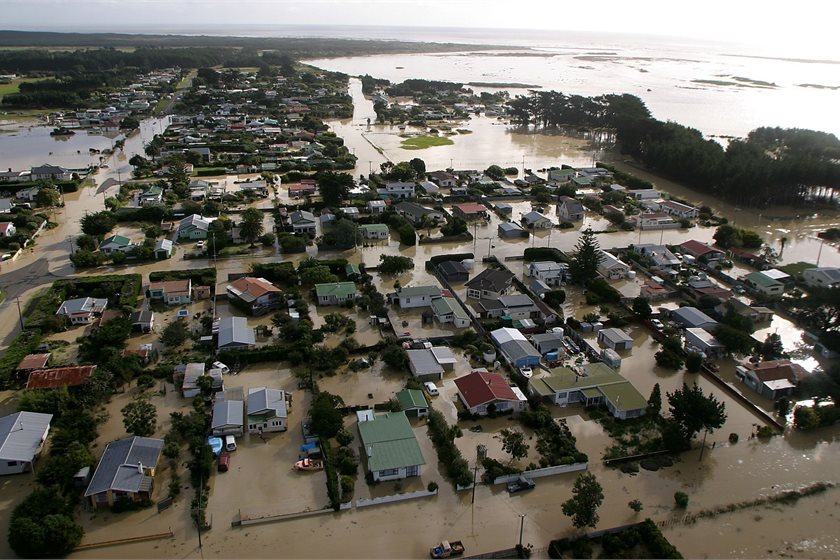
If floods equivalent to the devastating 2004 event hit Manawatū today, it is predicted the outcome would be more extreme “as a result of climate change”.
To see if the council had invested enough to prevent the level of destruction seen in 2004, Local Democracy Reporting sat down with Horizons Regional Council chief executive and Horizons group manager of catchment operations.
New Zealand has always been prone to flooding, but extremes such as Cyclone Gabrielle in 2023 and various weather events across the motū, including this week’s incoming tropical cyclone, were just “a little taster” of climate change, one of Aotearoa’s leading climate scientists Sam Dean said.
February was the first time all of Horizons region had been placed into a state of emergency since 2004’s indelible flood event, which hit much of the lower North Island .
Dean said a region’s vulnerability to flooding was an “interplay” between what mitigation methods the councils chose to invest in, the amount of money spent , and the increasing risk of extreme weather.
Large investments have been made into strengthening vulnerable areas, but Horizons council staff were concerned the scale of future weather events could be bigger than 2004 andthe risk of events happening more frequently was now much higher.
Had flood prevention work not been done by council in the last 20 years, council chief executive Michael McCartney said the weather event two months ago would have been a “damn sight worse and the mountain would be that much higher to climb now”.
Acting as controller during the 2004 floods and having “water pouring through his home”, McCartney understood how scary these events could be and how they could leave communities feeling powerless.
2004’s flood was a catalyst for significant investment in flood protection methods, infrastructure such as stop banks, erosion work, and civil defence responses across the Central District.
Effective and proactive flood investment from council “would pay for itself in a single day” when a big weather event occurred, Horizons group manager of catchment operations Jon Roygard said.
Much of Horizons’ work on flood protection had environmental return and was planned with the next generation in mind – those who would have to continue modifying infrastructure to adapt to Aotearoa’s changing environment.
McCartney said councils across Aotearoa had to “accept the fact that you can’t fight nature forever”.
“All the interventions you put in place, all your best endeavours, can be taken away again in five minutes by another event.”
Dean said the area controlled by Horizons was in a stronger position than regions who had not experienced a one-in-100 year flood, as “things tend to change after an event” and councils and communities were forced to respond.
The 2004 flood was understood to be one of those one-in-one-hundred-year events, but Dean said it was likely that within decades these events would become more frequent because of climate change.
“The easy rule of thumb is that you might see a halving. A one-in-100-year flood would be more like a one-in-50-year flood.”
That was yet to occur, but with the trajectory the world was on due to rising temperatures and subsequent rising sea levels, people stood “to lose quite a lot of what we value”.
Climate change was just one issue and despite being able to adapt in the short term, Dean was concerned such extreme weather could go on so long that other issues “become irrelevant”.
Climate change predictions and figures were included in Horizons recent flood vulnerability mapping to ensure at-risk townships were prioritised for mitigation methods and coastal townships at risk of sea level rise were properly managed.
LDR is local body journalism co-funded by RNZ and NZ On Air.

print this story

New legislation to bar climate torts proves polarising for submitters
Fri 17 Jul 2026
By Liz Kivi | Opponents of legislation to block climate lawsuits say it could seriously damage investor confidence, while supporters of the same legislation argue that not passing it could be “devastating” for the New Zealand economy.
Climate adaptation plans welcomed, but funding remains the missing piece
Fri 17 Jul 2026
By Oli Lewis | Experts are welcoming a proposal to make climate adaptation planning mandatory, but warn the plans may be ineffective without clarity around who will pay to implement them.

Conservation bill could put development ahead of protection, commissioner warns
Fri 17 Jul 2026
By Shannon Morris-Williams | Parliamentary Commissioner for the Environment Simon Upton says the proposed law changes could give economic development greater weight than conservation, undermining the purpose of the Conservation Act.

Sustainable Business Council listed on submission supporting climate torts bar
Fri 17 Jul 2026
By Liz Kivi | Business New Zealand’s submission supporting legislation to block climate lawsuits raised eyebrows this week for listing the Sustainable Business Council as seemingly in support of the controversial law change.

The arms race to climate calamity
Fri 17 Jul 2026
COMMENT: Both Australia and New Zealand are justifying spending millions of dollars on high-end killing machines by hyping the so-called China threat, while downplaying the very real threat of climate change to the Pacific region, writes Jeremy Rose.

Media round-up
Fri 17 Jul 2026
In our round-up of climate coverage in local media: The Prime Minister’s Office asked Z Energy to hand-deliver climate law briefing, the official watchdog warns of ‘catastrophic consequences’ if the electricity sector can’t adapt to a rush of rooftop solar, and angry customers are complaining about SolarZero contracts.

Government running out of time to lock in LNG import terminal deal before election
Thu 16 Jul 2026
By Oli Lewis | Procurement for a floating LNG import terminal in Taranaki is well advanced, the Government says, but the clock is ticking to sign contracts before the election.

Pacific coral reefs face mounting climate threat – experts
Thu 16 Jul 2026
By Shannon Morris-Williams | Coral reef scientists are warning that climate change is accelerating the decline of reef ecosystems across the Pacific, with rising ocean temperatures, marine heatwaves and sea-level rise threatening both biodiversity and the communities that depend on them.

Rich nations inflate climate finance as NZ urged to act
Thu 16 Jul 2026
By Shannon Morris-Williams | Rich countries have overstated the value of climate finance delivered to developing nations by around US$100 billion in 2024, Oxfam says. The non-profit is urging New Zealand to increase its climate finance while applauding the country's strategy of allocating finance as grants rather than loans.

Climate law introduced requiring adaptation plans and reducing Commission's role
Wed 15 Jul 2026
By Oli Lewis | The Government has introduced legislation to amend the Climate Change Response Act (CCRA), which includes stripping the Climate Change Commission of one of its core roles, adds a new requirement for councils to produce adaptation plans for higher-risk areas, and updates ETS settings.
