
Watts’s last stand: Simeon Brown takes energy portfolio
2 Apr 2026
By Pattrick Smellie
Energy Minister Simon Watts has lost the portfolio to Cabinet fixer Simeon Brown in a reshuffle announced by Prime Minister Christopher Luxon this morning.
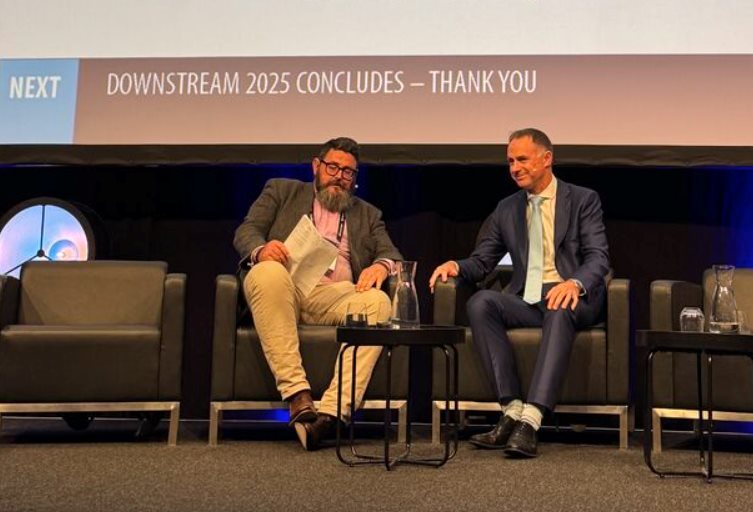
His demotion comes less than a day after Watts made what can now be seen to have been a defiant last stand appearance at the Downstream energy sector conference in Wellington yesterday.
Brown will keep the already enormous health portfolio and become point-man for the National Party members of the coalition Cabinet on the government’s response to the Iran war-induced fuel crisis.
He has held the role previously, between November 2023 and January 2025.
Luxon’s statement made no comment on Watts’s performance at all, although he remains the Minister of Climate Change, Local Government and Revenue, and has picked up the role of Minister for Auckland.
Asked at a press conference whether he had lost confidence in Watts, Luxon said: “No.”
“As we go forward, the dominant issue for the foreseeable future will be energy security.
“As an issue, I want to have a senior Minister associated with that.
“Simon’s a great contributor to our team. He’s done an excellent job on energy,” said Luxon.
Brown also takes the role of National Party campaign chair from Chris Bishop, exciting speculation that Bishop’s musing late last year on trying to replace Luxon had led to political punishment.
Luxon “rejected” that, saying Bishop had a major workload with the passage of Resource Management Act reforms and nominated Bishop, Brown, Finance Minister Nicola Willis, newly appointed Public Service Minister Paul Goldsmith, and Tourism Minister Louise Upston as his Cabinet “brains trust”.
Nicola Grigg is now Environment Minister, picking up the role from Penny Simmonds, with the Environment portfolio still outside Cabinet.
Tough week at the office
Watts had already been having a bad week as the Iran war fuelled speculation that the government’s preference for LNG imports no longer made sense.
On Monday, Luxon said in a radio interview that if the business case for LNG did not stack up, “we will not do it”.
On Tuesday, two generator-retailer chief executives made flippant reference to the proposal, leading Watts to hit back that the issue was “not a joke” and that such comments were “completely unacceptable”.
He was speaking to the final session of Freeman Media’s annual Downstream conference, which has become a signature event for the New Zealand energy sector.
Asked by Energy Resources Aotearoa chief executive John Carnegie whether the government “gone soft” on plans to procure an LNG import facility, Watts replied: “No, it has not.”
Watts not only made clear that he believes the business case remains robust, but also that he expects a Labour-led government would honour a contract for procurement if it had already been signed.
“The Opposition have said they will stand by a contract,” said Watts. “So I will sign the contract.”
Labour’s energy spokesperson, Megan Woods, called earlier this week for the LNG procurement process to be “paused” and her leader, Chris Hipkins, said it should be “scrapped”.
However, Labour agrees with the “problem definition” that New Zealand’s electricity system has a serious short to medium term problem during prolonged periods of reduced renewable energy sources, primarily dry winters that sap hydro-electric potential.
The party has yet to state a position but is understood to prefer burning indigenous and imported coal at Genesis’s Huntly power station rather than import LNG, and expecting that bio-fuel wood pellets will become competitive with coal over time at Huntly.
“This is not a joke,” Watts said of the LNG plan, reacting to quips at Downstream the previous day about the plan’s possible demise by Meridian and Genesis Energy CEOs Mike Roan and Malcolm Johns.
Roan said the Iran war might have put a “bazooka” through LNG, while Johns said perhaps LNG meant “likely no gas”. The comments infuriated the Beehive, where ministers are flat out trying to secure refined oil products to meet the demand shock created by the impact of the Middle East conflict on global oil product flows.
Such levity was “completely unacceptable”, said Watts.
He declined to say what the National Party’s policy would be for the 2026 election with respect to breaking up the generator-retailers, as both NZ First and the Green party are urging. So far, the coalition Cabinet has stuck with the current model.
Associate Energy Minister Shane Jones had noted a day earlier at Downstream that injudicious comments by then Telecom CEO Theresa Gattung had prompted then PM Helen Clark to initiate that company’s break-up.
In Parliament yesterday, Jones accused gentailer bosses of “trying to undermine” and “belittle” Watts.
Speaking at Downstream last night, Watts warned that if there was another dry winter like 2024 in 2028, when LNG is supposed to arrive, “the impacts will be twice 2024”.
It would be harder to manage because there would be less gas market flexibility by then as major current users are expected to have exited NZ.
“If we fast forward to 2028, the reality is the gas response capability is unlikely to be in play. In a situation where we do not have imported gas, our domestic stocks are reducing and will have reduced even more from where they are today.”
He bemoaned analysis suggesting that the current spike in global LNG prices because of the Iran war ruled out LNG for NZ.
The futures price for LNG in 2028 was still lower than the 10-year average and the current price lower than when Russia invaded Ukraine.
The government would seek to buy “long-dated” gas and would not face current prices.
“This is a serious problem,” said Watts. “That is New Zealand deindustrialising because we don’t have cover in a dry year.”
print this story
Story copyright © Carbon News 2026
Offshore renewable energy bill passes, opening path for developers
Thu 2 Jul 2026
By Oli Lewis | Feasibility permits for offshore wind developments could be issued within months after the Government passed a long-awaited law to establish a regulatory regime.

A tale of two electricity systems as NZ and Australia roll out new cost-saving measures
Wed 1 Jul 2026
By Oli Lewis | New rules requiring electricity retailers to offer time-of-use pricing plans, where consumers can access lower-cost electricity at off-peak times, have come into effect.

Savings gap doubles: all-electric households stand to save $3000 a year, report finds
Mon 29 Jun 2026
By Oli Lewis | The economic incentive for households to electrify has become more compelling, although overcoming upfront installation costs remains a barrier.

Lake Onslow pumped hydro consortium secures funding for consent push
26 Jun 2026
By Oli Lewis | The consortium behind Lake Onslow pumped hydro has secured funding to finalise its resource consent application, aiming to lodge it under the fast-track process before 2027.

National promises low-cost solar loans for households
25 Jun 2026
By Oli Lewis | The National Party is promising a Home Energy Fund to accelerate the roll-out of household solar, batteries, insulation and other energy resilience measures if it is re-elected this year.

Energy resilience conference axed due to Ara Ake closure
25 Jun 2026
By Shannon Morris-Williams | A national conference focused on energy affordability, resilience and hardship has been cancelled because of the Government's decision to end Crown funding for energy innovation centre Ara Ake.

'Stored solar': Bioenergy Association touts cost benefits of biomass boilers over gas
24 Jun 2026
By Oli Lewis | Businesses across New Zealand are warming to bioenergy, but advocates believe woody biomass could play a far greater role as a replacement for more expensive natural gas and electric heat options.

Gas transition loan scheme nears launch as savings modelled
23 Jun 2026
By Oli Lewis | Commercial gas users could potentially save thousands of dollars a year by using Crown-backed loans to fund fuel-switching and energy efficiency projects, new modelling indicates.

EECA head steps down
22 Jun 2026
By Shannon Morris-Williams | Chief executive Marcos Pelenur will step down after three years at the Energy Efficiency and Conservation Authority, leaving the organisation looking for a new CEO as it becomes the sole remaining government agency offering support for businesses looking to transition away from fossil fuels.

Canadian firm seeks Crown co-investment for Genesis-supported gas storage project
19 Jun 2026
By Oli Lewis | A proposed gas storage project supported by Genesis Energy has sought Crown co-investment through the $200 million Gas Security Fund.
