
GIDI-style help cheaper than LNG: MBIE
11 May 2026

By Pattrick Smellie
Officials advised ministers last July that the lowest-cost way to free up gas for use during dry winters was to assist industrial gas users to switch to electricity.
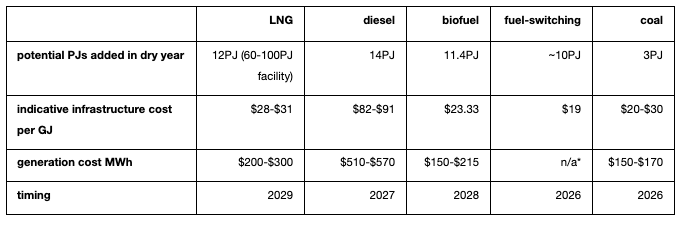
Official papers released to the Climate Foundation’s Christina Hood show the Ministry of Innovation, Business and Employment concluded that fuel-switching and energy efficiency could free up to about 10 Petajoules of gas for an estimated infrastructure cost of $19 per Gigajoule.
That compared to estimated build costs of between $28 and $31 per PJ for a conventional liquefied natural gas (LNG) terminal.
 |
| Source: MBIE |
The accompanying table only records MBIE findings for the five options deemed most viable.
While the cost of adding diesel-powered peaking power stations appears affordable on its build costs, its projected electricity generation cost of between $510 to $570 per MWh was by far the highest of all options.
MBIE described the fuel-switching option as both “scalable” and “impactful as [a] tool for reducing impacts on businesses/employment from declining gas”.
It warned elsewhere that “declining gas will see business closures” – a prediction subsequently borne out by a string of closures by firms using industrial quantities of gas, including Heinz Wattie, McCains and forestry processors.
Hood acknowledged that some industrial gas users could not switch to electricity.
However, the newly released analysis showed that “helping users who are able to switch from gas is the cheapest option and frees up gas for those unable to switch”.
Analysis by the Energy Efficiency and Conservation Authority and the Gas Industry Company also suggested that the 50/50 level of subsidy assumed in the MBIE analysis was higher than it needed to be.
If, as indicated, some 10PJs of gas could be freed up at a cost of $18 to $19GJ, “you wouldn’t need 50% government co-funding,” Hood said.
print this story
Story copyright © Carbon News 2026

Lake Onslow pumped hydro consortium secures funding for consent push
Fri 26 Jun 2026
By Oli Lewis | The consortium behind Lake Onslow pumped hydro has secured funding to finalise its resource consent application, aiming to lodge it under the fast-track process before 2027.

National promises low-cost solar loans for households
Thu 25 Jun 2026
By Oli Lewis | The National Party is promising a Home Energy Fund to accelerate the roll-out of household solar, batteries, insulation and other energy resilience measures if it is re-elected this year.

Energy resilience conference axed due to Ara Ake closure
Thu 25 Jun 2026
By Shannon Morris-Williams | A national conference focused on energy affordability, resilience and hardship has been cancelled because of the Government's decision to end Crown funding for energy innovation centre Ara Ake.

'Stored solar': Bioenergy Association touts cost benefits of biomass boilers over gas
Wed 24 Jun 2026
By Oli Lewis | Businesses across New Zealand are warming to bioenergy, but advocates believe woody biomass could play a far greater role as a replacement for more expensive natural gas and electric heat options.

Gas transition loan scheme nears launch as savings modelled
Tue 23 Jun 2026
By Oli Lewis | Commercial gas users could potentially save thousands of dollars a year by using Crown-backed loans to fund fuel-switching and energy efficiency projects, new modelling indicates.

EECA head steps down
Mon 22 Jun 2026
By Shannon Morris-Williams | Chief executive Marcos Pelenur will step down after three years at the Energy Efficiency and Conservation Authority, leaving the organisation looking for a new CEO as it becomes the sole remaining government agency offering support for businesses looking to transition away from fossil fuels.

Canadian firm seeks Crown co-investment for Genesis-supported gas storage project
19 Jun 2026
By Oli Lewis | A proposed gas storage project supported by Genesis Energy has sought Crown co-investment through the $200 million Gas Security Fund.

Lessons from Australia: Climate Change Authority chair cites rapid roll-out of household solar, batteries
19 Jun 2026
By Oli Lewis | Australia is rapidly outpacing New Zealand when it comes to new household solar and battery systems, lowering electricity costs and driving down the carbon intensity of installed generation.

Decision on controversial Waipara solar farm delayed
18 Jun 2026
By David Hill, Local Democracy Reporter | The fire risk assessment for a proposed 181 hectare solar farm in North Canterbury will need to be redone over conflict of interest concerns.
Fonterra backs Canterbury solar in long-term power deals
17 Jun 2026
By Shannon Morris-Williams | Fonterra has signed two long-term power purchase agreements with solar developers in as many days, backing more than 170MW of new renewable generation in Canterbury.
