
Seabed miners quit South Taranaki fast-track bid
20 Feb 2026
By Craig Ashworth, Local Democracy Reporter
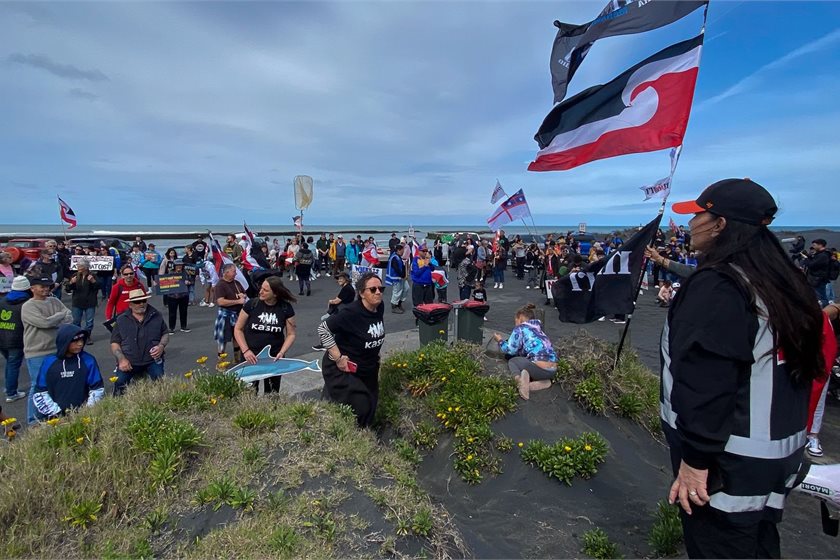
Would-be seabed miners have abandoned their fast-track bid to mine in South Taranaki waters, saying they can’t change the minds of the panel that rejected their application.
An expert panel turned down Trans-Tasman Resources’ Fast-Track application to mine the seabed off Pātea in a draft decision two weeks ago.
Trans-Tasman had till Thursday to respond with fresh evidence before a final ruling, but the Australian company said there was no point and instead quit the Fast-track Approvals Act process.
Trans-Tasman Resources (TTR) said the panel misunderstood key foundations of its application and the company believed it couldn’t “resolve or lessen these issues.”
The Fast-track panel found TTR failed to prove its mine could avoid environmental and cultural damage, and the experts weren’t convinced claimed economic benefits were worth the risk.
Trans-Tasman’s lawyers wrote that the panel had given no hint of its “negative views across such a wide range of issues”.
“The issues of concern to the Panel could have been addressed by TTR within the time available under the fast-track process, by directing the Panel to relevant parts of the information that TTR has already provided.”
But last August the panel said the company had slowed its fast-track bid with a cynical failure to hand over more evidence demanded by officials.
Mana whenua from South Taranaki to Whanganui have fought Trans-Tasman for over a decade, with the miners losing court cases right through to the Supreme Court.
Te Rūnanga o Ngāti Ruanui pou whakahaere Rachel Arnott worried history was repeating itself.
“In 2024, TTR suddenly sulked away when they realised the Environmental Protection Authority process was going against them.
"They banked on the newly-minted Fastrack process to circumvent the will of the people."
Arnott said TTR’s latest withdrawal avoided a formal rejection, keeping the project “on life-support while they look for a new back door, or friendlier legislative loophole”.
"After forcing our uri and the public through the gruelling and experimental fast-track process, they have cut and run.”
Trans-Tasman announced it had quit the fast-track the same day the Government announced an $80 million fund to develop critical minerals.
The resources and regional development minister Shane Jones said money from the Regional Infrastructure Fund would turn resources into “jobs, investment and long‑term value for communities”.
“It makes sense to create this $80m package to help realise those benefits while supporting our Minerals Strategy,” Jones said.
Kate Paris of Kiwis Against Seabed Mining (KASM) said Jones’ announcement on the same day as TTR’s withdrawal “feels super slimy.”
“If TTR thinks it can attempt another pathway, especially through what looks like a potential backdoor being set up by this Government, it’ll be met with the same resistance it has faced every step of the way,” said KASM’s Pātea spokesperson.
Greenpeace Aotearoa seabed mining campaigner Juressa Lee said TTR had arrogantly dismissed the panel’s careful deliberation of a wealth of expertise and evidence.
"They know their project doesn’t measure up even under the pro-industry Fast-track Approvals Act process,” Lee said.
“TTR is out of ideas and fast running out of options.”
Whanganui District councillor Charlotte Melser convinced her colleagues to oppose the mine then travelled to Taranaki councils lobbying for the same.
Melser said the Fast-track law might be suitable for bridges, roads and housing developments – but not for seabed mining.
“It’s the wrong vehicle for projects of this magnitude and complexity,” Melser said.
“Mining needs robust scrutiny and environmental safeguards that I just don't see within the Fast-track Approvals Act, especially now in its amended form.
“It’s designed to shut out the voices of communities and iwi and hapū.”
Te Tai Hauāuru MP Debbie Ngarewa-Packer began fighting TTR as kaiarataki of Te Runanga o Ngāti Ruanui 13 years ago.
The Pāti Māori co-leader has lodged a Members Bill to outlaw seabed mining in New Zealand.
Ngarewa-Packer said regulators had concluded the risks were too high and it was time for a blanket ban.
“Be warned Shane Jones will let them rebrand, regroup and reapply."
“We should as a nation – we should as a Parliament – agree and say for Christ's sake there're other ways to make money.”
The miners want to suck up 50 million tonnes of South Taranaki seabed sediment annually for at least 20 years, to extract iron, titanium and vanadium.
A factory ship would discharge 45 million tonnes of slurry a year back into the waters of the Pātea Shoals – 170,000 tonnes a day, allowing for downtime.
Ecological risks include drifting sediment plumes smothering thriving reefs and the impact of underwater noise pollution on protected marine mammals.
LDR is local body journalism co-funded by RNZ and NZ On Air.

print this story

Climate law introduced requiring adaptation plans and reducing Commission's role
Today 12:30pm
By Oli Lewis | The Government has introduced legislation to amend the Climate Change Response Act (CCRA), which includes stripping the Climate Change Commission of one of its core roles, adds a new requirement for councils to produce adaptation plans for higher-risk areas, and updates ETS settings.

Clock ticks on Gas Security Fund as Tariki developer reports ongoing losses
Today 12:30pm
By Oli Lewis | A Canadian company advancing a major gas storage project in New Zealand continues to report ongoing losses.

Planetary Facts dashboard aims to make environmental costs visible
Today 12:30pm
By Shannon Morris-Williams | Consumers can now compare the environmental impacts of everyday products with a new online dashboard designed to do for sustainability what nutrition labels have long done for food.
Climate change is here and we’re all paying for it
Today 12:30pm
By Raewyn Peart | COMMENT: Another week, another storm. Just days ago, Kaikōura saw two months of rain fall within 48 hours, the most recent in a long line of adverse weather events.

Quarry land swap gains habitats, loses area for rare native trees
Today 12:30pm
By Justin Wong, Local Democracy Reporter | A proposed land swap could add better-quality natural habitats to the public conservation estate but at the expense of handing over parts of Belmont Regional Park that features rare native trees to expand Lower Hutt’s Belmont Quarry, according to a Department of Conservation (DOC) report.
What’s next for Sams Creek after failed mining bid?
Today 12:30pm
Max Frethey, Local Democracy Reporter | A controversial gold mining application at Sams Creek has been declined, leaving question marks hanging over the future of the land.

Climate remains top priority for Pacific leaders
Tue 14 Jul 2026
By Shannon Morris-Williams | Major regional events in Vanuatu and Fiji this month have underscored the Pacific's continued focus on climate action, with locally led innovation and sustainable farming highlighted as critical tools for tackling the region's environmental challenges.

$3m Govt boost for Tauranga geothermal energy
Tue 14 Jul 2026
By Liz Kivi | Resources Minister Shane Jones has announced a $3 million grant for the Gas to Geoheat Tauranga Geothermal System Project as part of the Government's plan to double geothermal energy by 2040.
Batteries and full lakes flatten winter power peaks
Tue 14 Jul 2026
Large batteries and more strategic use of hydro generation are starting to flatten winter electricity price peaks, reducing reliance on expensive thermal generation.

NZ lagging in energy storage investment – report
Tue 14 Jul 2026
Investment in energy storage is maturing globally, with the need for resilient and flexible power driving demand for storage, but New Zealand has some catching up to do, according to a new report.
