
NZ’s sodden January explained: what’s driven this month’s big wet?
28 Jan 2026
By James Renwick, Te Herenga Waka — Victoria University of Wellington
For many people, it has felt like midsummer never really arrived. Is it simply bad luck, or is there something more going on?
As with most aspects of our climate and weather, the answer isn’t straightforward. It reflects the interplay between New Zealand’s geography, warmer-than-average ocean temperatures, large-scale regional climate patterns and long-term global warming.
What the data shows – and why it’s been so wet
Climate observations back up what many New Zealanders have been feeling this month. Across northern regions in particular, sunshine hours have been well below average, while rainfall totals have been far above normal.
In central Auckland, a weather station in Albert Park had recorded around 244mm by January 27 – nearly three times the (1981–2010) average for the month. At Mount Maunganui, the month-to-date total had climbed to roughly 385mm, more than four times the norm.
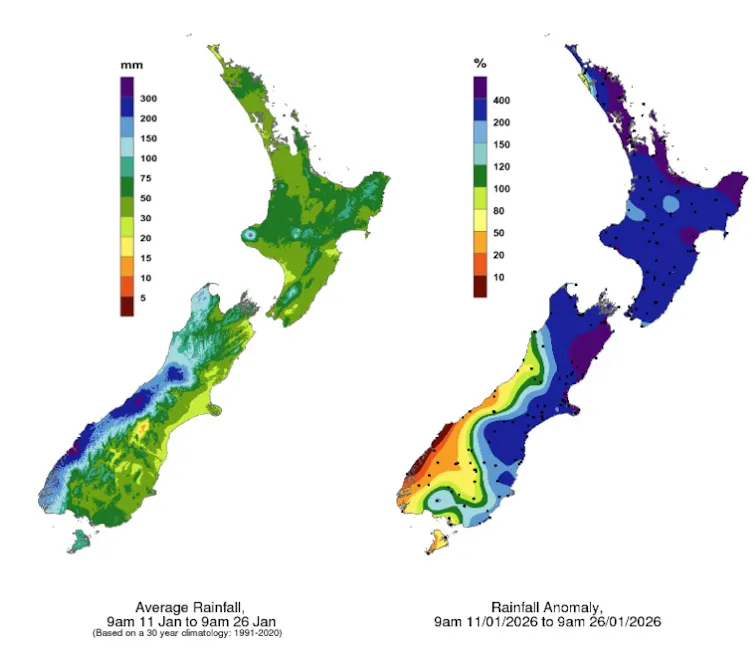
Similar patterns have been seen in many parts of the upper North Island, with repeated heavy rain events, high humidity and prolonged cloudy spells. The result has often been soggy soils, swollen rivers and increased risks of flooding and landslides.
While each storm that affects New Zealand is different, many of the systems visiting the country this summer share some common features. Several have originated in the tropics, subtropics or the north Tasman Sea before drifting south toward New Zealand. These systems typically carry warm, moisture-laden air – and the potential for intense rainfall.
When these moist air masses interact with cooler air from the south, or encounter New Zealand’s rugged topography, conditions become ripe for heavy rain.
As air is forced upwards over hills and mountain ranges – particularly along the Coromandel Peninsula, Bay of Plenty, East Cape and Gisborne regions – moisture condenses rapidly, producing very high rainfall totals. This is why northern and eastern parts of the country so often bear the brunt of these subtropical events.
The regional patterns loading the dice
One background factor this summer has been the lingering influence of La Niña, part of the El Niño–Southern Oscillation (ENSO) system that dominates climate variability across the Pacific.
During La Niña, atmospheric pressure tends to be lower than normal over Australia and the north Tasman Sea, and higher than normal to the south and east of New Zealand. This effectively flips our usual weather pattern on its head, reducing westerly winds and increasing the frequency of easterly and northeasterly flows.
Those northeasterly winds draw warm, humid air from the subtropics toward New Zealand. Because our temperatures are highly sensitive to wind direction, even small shifts can have large effects.
La Niña also tends to be associated with warmer-than-average sea surface temperatures, which have again been observed around New Zealand. So, when northeasterly winds blow across these warmer waters, they pick up additional heat and moisture, further fuelling heavy rainfall potential.
Another background driver that constantly shapes New Zealand’s weather and climate is the Southern Annular Mode (SAM), which describes the north–south movement of the westerly wind belt that circles Antarctica.
A positive SAM phase, which has dominated much of this summer, tends to bring higher pressures over the South Island and southern New Zealand. This allows storms from the subtropics more room to drift south and linger near the North Island.
Climate change as an intensifier
Overlaying these regional drivers is the broader influence of climate change, which is steadily warming both the atmosphere and the oceans surrounding New Zealand.
As the planet heats, the atmosphere can hold more moisture – about 7% more water vapour for every 1°C of warming. This means that when storms do develop, they have more fuel available, increasing the potential for heavier rainfall and stronger winds.
Climate change does not cause individual weather systems, nor does it directly control large-scale climate patterns like ENSO or the SAM. But it acts as a powerful intensifier.
Event-attribution studies in New Zealand to date have shown climate change can increase the total rainfall from intense storms by around 10–20%.
But for the most intense downpours – when the atmospheric “sponge” is wrung out most vigorously – rainfall intensities can increase by as much as 30%, depending on the frame of time being looked at. These short, extreme bursts of rain are often what cause the greatest damage.
There are still important uncertainties. Scientists are actively researching whether climate change will alter the frequency or strength of La Niña and El Niño events, but so far there is no clear answer. The same is true for long-term trends in the Southern Annular Mode.
What we can say with confidence is that background warming is shifting the risk profile.
As global temperatures continue to rise, the kinds of extremes we’ve experienced this season are likely to become more common. The biggest unanswered question is how quickly we can reduce greenhouse gas emissions to limit how severe these impacts ultimately become.
James Renwick, Professor of Physical Geography (Climate Science), Te Herenga Waka — Victoria University of Wellington
This article is republished from The Conversation under a Creative Commons license. Read the original article.
print this story

Labour promises to repeal bill to block climate lawsuits
Fri 3 Jul 2026
By Liz Kivi | The Government bill aiming to block climate lawsuits passed its first reading under urgency after a heated debate in Parliament last night, with the Labour Party promising it will repeal the bill if elected in November.

Taranaki offshore wind developer eyes mid-2030s commissioning after law change
Fri 3 Jul 2026
By Oli Lewis | The first offshore wind farm in New Zealand could be commissioned by the mid-2030s, with its developer saying a new permitting framework has bolstered investor confidence.

Confidence in tackling climate risks remains low
Fri 3 Jul 2026
By Shannon Morris-Williams |New Zealanders have little faith in the country's ability to tackle climate risks, with a new poll finding fewer than one in three are confident the country can reduce the impacts of climate change, while many are calling for stronger Government leadership on climate hazards.

EECA seeks answers on NZ's future fuel mix
Fri 3 Jul 2026
By Shannon Morris-Williams | The Energy Efficiency and Conservation Authority is looking for specialists to assess the role future low-emissions fuels could play in New Zealand’s energy system.

Australia is at least ten years ahead of us on solar. It’s time we caught up.
Fri 3 Jul 2026
By Ed Harvey | OPINION: Starting this week, millions of households across New South Wales, South Australia and Southeast Queensland will have access to three hours of free electricity every single day.

West Coast Conservation Board chair concerned over loosening commercial concessions
Fri 3 Jul 2026
By Vihan Dalal, Local Democracy Reporter | The West Coast Conservation Board chairman Mike Legge has raised concerns with a move by the Government to amend the Conservation Act to loosen how commercial concessions are granted on conservation land.

Media round-up
Fri 3 Jul 2026
In our round-up of climate coverage in local media: Getting the most impact from the Government's investment in school solar; NZ needs an objective assessment of LNG imports and renewable storage options; and while greener suburbs are healthier on all kinds of metrics, achieving them isn’t straightforward.

Offshore renewable energy bill passes, opening path for developers
Thu 2 Jul 2026
By Oli Lewis | Feasibility permits for offshore wind developments could be issued within months after the Government passed a long-awaited law to establish a regulatory regime.

Ombudsman upholds complaint PM’s office ‘unreasonably withheld’ climate law briefing
Thu 2 Jul 2026
By Liz Kivi | The Ombudsman has upheld a complaint that the Prime Minister’s office unreasonably held information, as Parliament is set to read – under urgency – the climate bill at the centre of the scandal.

High Court upholds forestry directors' environmental liability
Thu 2 Jul 2026
By Shannon Morris-Williams | The High Court has dismissed appeals by a forestry company, its directors, and a landowner, against enforcement orders over environmental damage in a Gisborne forest, reinforcing that company directors can be personally liable for environmental breaches.
