
Communities must be central to climate adaptation strategies – 10 insights to guide national policy
17 Dec 2025

Discussions about how New Zealand should adapt to a changing climate have been going on for more than two decades.
While both major political parties agree on the need for a nationally coherent adaptation plan, there is an impasse between the previous Labour government’s Treaty-based, equity-centred approach and the current National-led coalition’s fiscal discipline and burden-shifting logic.
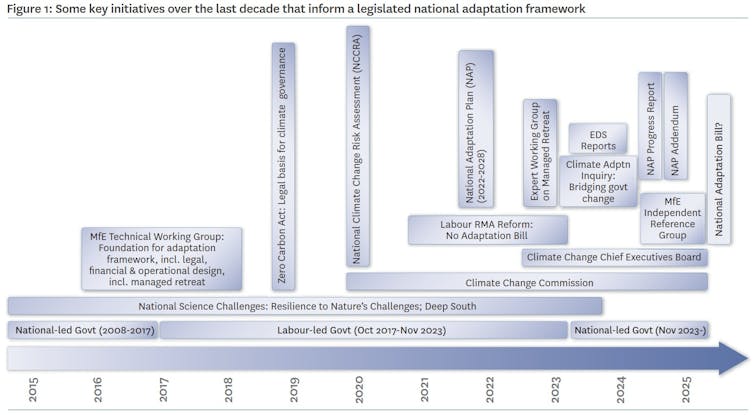
The recently released National Adaptation Framework aimed to close this gap, but the four-page document merely touches on foundational issues such as the sharing of risk information and costs.
Most troubling is the government’s signal it intends to withdraw Crown support for post-disaster bailouts and managed retreat in about two decades.
Serious interventions such as seawalls and planned relocation are unaffordable for virtually all at-risk local communities, tangata whenua and their governing authorities. We argue that Crown cost-sharing is essential.
The profound multi-generational implications of escalating climate risk require robust, informed debate to make sure new adaptation legislation establishes an enduring, equitable framework for generations to come.
But despite the policy gap at government level, local adaptation action is underway. And we are learning valuable lessons from these efforts.
How to enable communities to adapt
We identified ten adaptation imperatives based on research with four frontline communities: Tangimoana and Pūtiki in the Manawatū-Whanganui region, and Rōhutu and Waitōtara in the Taranaki region.
These communities have already been affected by climate-compounded extreme events. Adaptation is key to their future.
Located on the banks of the Whanganui River, Pūtiki has experienced major flooding, as has Tangimoana and the Waitōtara village.
Rōhutu is also exposed to flood risk. Other than Waitōtara village, all these communities are exposed to the impacts of rising sea level.
We worked with at-risk residents, tangata whenua, local government and government agencies to understand the barriers and enablers for mainstreaming community-based adaptation.
We argue the following ten insights should be embedded in the national adaptation framework:
1. Community-based adaptation is a relationship-building process. It is rooted in trust and centred on at-risk residents. It enables community leadership supported by local government, tangata whenua and other relevant parties such as local businesses.
2. It is important to build shared understanding about natural hazard risk, adaptation options and plausible pathways. But sharing hazard data is merely a starting point. More important is understanding how to build adaptive capabilities, founded on mātauranga Māori (which includes accumulated local knowledge of place over many generations), robust science and professional expertise.
3. The communities most exposed and vulnerable to climate-compounded risks must be prioritised. Risk is the intersection of exposure to natural hazards and social vulnerability. The government has a duty enshrined in law to enable Tiriti-led, just and equitable adaptation in fiscally responsible ways.
4. Local government support is crucial. Strategic, sustained institutional support is vital, prioritising the most at-risk communities. Adaptation strategy and practice need to be aligned within and between regional councils and territorial authorities. The latest announcement to abolish regional councils does not eliminate the need for local adaptation efforts to be aligned within and across regions.
5. Tangata whenua are and should be foundational partners. Mana whenua should lead adaptation in Māori communities, with support from other governance bodies, to enable tino rangatiratanga (self-determination) and mana motuhake (political authority and control over a peoples’ destiny).
6. Community-based adaptation is best framed as pact-making. Agreed values and principles for working together and enduring commitments should be recorded in agreements that enable partners to work together and adapt as circumstances, needs and capabilities change over time.
7. Climate action partnerships enable enduring community-based adaptation. Agreements need to be mainstreamed into strategies and day-to-day operations of partner organisations so they can be monitored, evaluated and adjusted as work progresses through inevitable change, contestation and uncertainty.
8. Mainstreaming community-based adaptation into regulatory and non-regulatory processes and practices is not linear and sequential. Rather, it is an entanglement of mobilisation, reflection, planning, action and evaluation.
9. Independent but trusted individuals or small teams of intermediaries can play a vital mediation role to build trust and broker agreements between interested and affected parties.
10. Given escalating climate-compounded risk, rising premiums and insurance retreat, and the ever-increasing cost of adaptation interventions amid a cost-of-living crisis, a cross-party, legislated national adaptation framework is essential to enable just and equitable adaptation action.
Addressing these ten insights to shape the national adaptation framework before it is enacted will help those most at risk navigate the climate challenges they face.
We are grateful to all project partners, including Pūtiki Emergency Response Group, Pūtiki Hapū Working Group, Pūtiki community; Tangimoana Community Committee, Tangimoana Resilience Group members, and residents; Rōhutu Trustees and residents; staff and elected members of the Horizons Regional Council and Taranaki Regional Council and the District Councils of Whanganui, Manawatū, New Plymouth, and South Taranaki; and NZ Transport Waka Kotahi. Many others contributed in valuable ways, especially our research assistants, Robbie Richardson and Michael Pye, and Palmerston North City Council planner Hilary Webb, who was a core member of the research team while at Massey University.
By Bruce Glavovic, Professor in Natural Hazards Planning and Resilience, Te Kunenga ki Pūrehuroa – Massey University; Derrylea Hardy, Research Officer in Environment and Planning, Te Kunenga ki Pūrehuroa – Massey University; Huhana Smith, Professor in Creative Arts, Te Kunenga ki Pūrehuroa – Massey University, and Martin Garcia Cartagena, Lecturer in Environmental Planning, Te Kunenga ki Pūrehuroa – Massey University
This article is republished from The Conversation under a Creative Commons license. Read the original article.
print this story

Labour promises to repeal bill to block climate lawsuits
Fri 3 Jul 2026
By Liz Kivi | The Government bill aiming to block climate lawsuits passed its first reading under urgency after a heated debate in Parliament last night, with the Labour Party promising it will repeal the bill if elected in November.

Taranaki offshore wind developer eyes mid-2030s commissioning after law change
Fri 3 Jul 2026
By Oli Lewis | The first offshore wind farm in New Zealand could be commissioned by the mid-2030s, with its developer saying a new permitting framework has bolstered investor confidence.
Confidence in tackling climate risks remains low
Fri 3 Jul 2026
By Shannon Morris-Williams |New Zealanders have little faith in the country's ability to tackle climate risks, with a new poll finding fewer than one in three are confident the country can reduce the impacts of climate change, while many are calling for stronger Government leadership on climate hazards.

EECA seeks answers on NZ's future fuel mix
Fri 3 Jul 2026
By Shannon Morris-Williams | The Energy Efficiency and Conservation Authority is looking for specialists to assess the role future low-emissions fuels could play in New Zealand’s energy system.

Australia is at least ten years ahead of us on solar. It’s time we caught up.
Fri 3 Jul 2026
By Ed Harvey | OPINION: Starting this week, millions of households across New South Wales, South Australia and Southeast Queensland will have access to three hours of free electricity every single day.

West Coast Conservation Board chair concerned over loosening commercial concessions
Fri 3 Jul 2026
By Vihan Dalal, Local Democracy Reporter | The West Coast Conservation Board chairman Mike Legge has raised concerns with a move by the Government to amend the Conservation Act to loosen how commercial concessions are granted on conservation land.

Media round-up
Fri 3 Jul 2026
In our round-up of climate coverage in local media: Getting the most impact from the Government's investment in school solar; NZ needs an objective assessment of LNG imports and renewable storage options; and while greener suburbs are healthier on all kinds of metrics, achieving them isn’t straightforward.

Offshore renewable energy bill passes, opening path for developers
Thu 2 Jul 2026
By Oli Lewis | Feasibility permits for offshore wind developments could be issued within months after the Government passed a long-awaited law to establish a regulatory regime.

Ombudsman upholds complaint PM’s office ‘unreasonably withheld’ climate law briefing
Thu 2 Jul 2026
By Liz Kivi | The Ombudsman has upheld a complaint that the Prime Minister’s office unreasonably held information, as Parliament is set to read – under urgency – the climate bill at the centre of the scandal.
High Court upholds forestry directors' environmental liability
Thu 2 Jul 2026
By Shannon Morris-Williams | The High Court has dismissed appeals by a forestry company, its directors, and a landowner, against enforcement orders over environmental damage in a Gisborne forest, reinforcing that company directors can be personally liable for environmental breaches.
