
Wilding pines threaten Kaikōura ranges in ‘looming catastrophe’
27 Nov 2025
Kira Carrington, Local Democracy Reporter
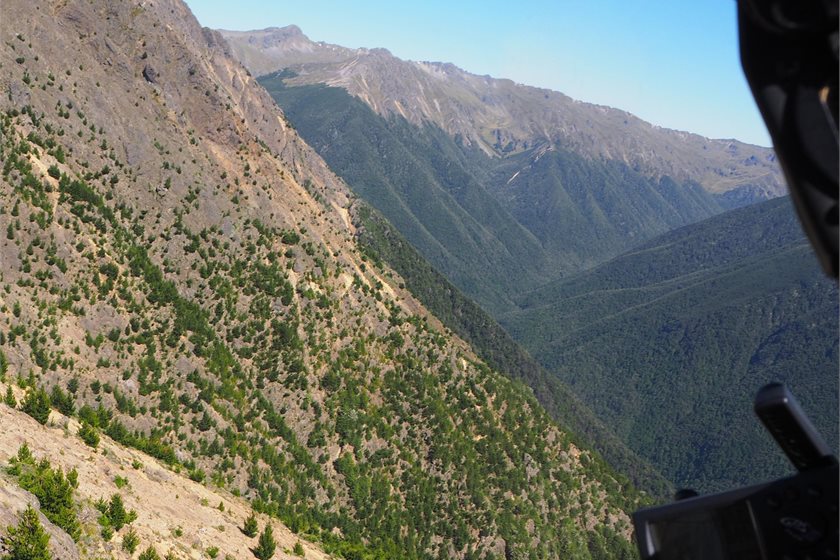
Wilding pines are threatening to make their way into the Kaikōura ranges, as their rampant spread sparks a renewed call for more central government funding.
The Marlborough District Council’s Environment and Planning committee heard about the incursion in south Marlborough during an update on the invasive exotic pest on Thursday.
South Marlborough Restoration Trust chairperson Johnny Oswald told the committee the trust’s wilding pine control team had discovered a patch of wilding trees about 3km from the as-yet uninfected Inland Kaikōura Range.
The nearest conifers were 25km to 30km away in the Branch-Leatham, so the seeds had travelled quite a distance, he said.
The trust’s 10-year plan said Marlborough needed at least $10m per year for conifer control, far more than it currently had, Oswald said.
“If we don’t do this, the cost to the country is far, far greater than that.
“You can kiss goodbye to the wine industry for a start. There just simply won’t be the water coming down the river," Oswald said.
“I think that we can do this, and that it needs a lot of work and a lot of money, but we're certainly not giving up.”
Oswald had taken the opportunity to speak at a presentation from council staff members about the National Wilding Conifer Control Programme.
The council’s senior biosecurity officer, Rob Simons, said the invasion of wilding pines in river catchments could lead to severe water shortages.
“Our catchments here actually supply the main water aquifer,” Simons said.
“So ultimately there’ll be no water for irrigation [or] drinking water.
“Not to mention the fact that [the] trees also impact or increase the risk of wildfires.”
Wilding pines had infected more than 2 million hectares around New Zealand, despite pest control efforts, Simons said.
If left unchecked the trees would cover a quarter of the country in 30 years.
While $150 million of government funding had gone towards the national response to wilding pines since 2016, the funding was halved in 2024 from a baseline of $20m per year to $10m.
Rangitahi Molesworth Reserve received about $2.3m towards wilding pine control this year, which was about 90% of Marlborough’s $2.6m wilding pine budget.
That budget was funded from the International Visitor Levy ($1.1m) the National Wilding Conifer Control Programme ($1.1m), and the rest from the council and the Department of Conservation.
Simons said the cut to national funding had severely hampered the response in Marlborough, and they were now losing ground.
“Maintenance work that should have been carried out hasn’t been able to be carried out.”
Similar alarms had been raised in other regions, with Environment Southland saying they too were “going backwards” in their fight against the pines.
Simons said that Molesworth Station, New Zealand’s largest farm and a major biodiversity hub, would need at least $5.5m per year just to maintain the progress already made.
“And probably after that, another $5 million per year to put the programme back on track.”
Without more funding, pines could soon cover between 600,000ha and 800,000ha of south Marlborough, Kaikōura and North Canterbury, Simons said.
Councillor John Hyndman said the spreading pines were a “looming catastrophe”.
“Southern Marlborough is going to turn into a pine forest, an impenetrable pine forest. I don't think there's anything we’re doing at the moment to stop that,” Hyndman said.
Councillor Gerald Hope said council did not have the resources to fund the response without Government funding.
“It has got to be elevated up central government,” Hope said.
“I just find that frustrating, because here we [are] as a unitary authority, with a massive area to cover, [and] a huge national responsibility to deal with an invasive crop.
“And we’re stuck between a rock and a very large crop of trees that we can't actually deal with.”
Hope told mayor Nadine Taylor they had no choice but to lobby the Government for more money.
Taylor suggested calculating the full economic impact to Marlborough if the trees were not stopped.
“We need to understand their long-term impact in order to bring leverage, I think, to the rationale for the Government [to be] investing in this right now.”
Biosecurity Minister Andrew Hoggard’s office was approached for comment.
LDR is local body journalism co-funded by RNZ and NZ On Air.

print this story

New legislation to bar climate torts proves polarising for submitters
Today 11:45am
By Liz Kivi | Opponents of legislation to block climate lawsuits say it could seriously damage investor confidence, while supporters of the same legislation argue that not passing it could be “devastating” for the New Zealand economy.
Climate adaptation plans welcomed, but funding remains the missing piece
Today 11:45am
By Oli Lewis | Experts are welcoming a proposal to make climate adaptation planning mandatory, but warn the plans may be ineffective without clarity around who will pay to implement them.

Conservation bill could put development ahead of protection, commissioner warns
Today 11:45am
By Shannon Morris-Williams | Parliamentary Commissioner for the Environment Simon Upton says the proposed law changes could give economic development greater weight than conservation, undermining the purpose of the Conservation Act.

Sustainable Business Council listed on submission supporting climate torts bar
Today 11:45am
By Liz Kivi | Business New Zealand’s submission supporting legislation to block climate lawsuits raised eyebrows this week for listing the Sustainable Business Council as seemingly in support of the controversial law change.

The arms race to climate calamity
Today 11:45am
COMMENT: Both Australia and New Zealand are justifying spending millions of dollars on high-end killing machines by hyping the so-called China threat, while downplaying the very real threat of climate change to the Pacific region, writes Jeremy Rose.

Media round-up
Today 11:45am
In our round-up of climate coverage in local media: The Prime Minister’s Office asked Z Energy to hand-deliver climate law briefing, the official watchdog warns of ‘catastrophic consequences’ if the electricity sector can’t adapt to a rush of rooftop solar, and angry customers are complaining about SolarZero contracts.

Government running out of time to lock in LNG import terminal deal before election
Thu 16 Jul 2026
By Oli Lewis | Procurement for a floating LNG import terminal in Taranaki is well advanced, the Government says, but the clock is ticking to sign contracts before the election.

Pacific coral reefs face mounting climate threat – experts
Thu 16 Jul 2026
By Shannon Morris-Williams | Coral reef scientists are warning that climate change is accelerating the decline of reef ecosystems across the Pacific, with rising ocean temperatures, marine heatwaves and sea-level rise threatening both biodiversity and the communities that depend on them.

Rich nations inflate climate finance as NZ urged to act
Thu 16 Jul 2026
By Shannon Morris-Williams | Rich countries have overstated the value of climate finance delivered to developing nations by around US$100 billion in 2024, Oxfam says. The non-profit is urging New Zealand to increase its climate finance while applauding the country's strategy of allocating finance as grants rather than loans.
Climate law introduced requiring adaptation plans and reducing Commission's role
Wed 15 Jul 2026
By Oli Lewis | The Government has introduced legislation to amend the Climate Change Response Act (CCRA), which includes stripping the Climate Change Commission of one of its core roles, adds a new requirement for councils to produce adaptation plans for higher-risk areas, and updates ETS settings.
