
Science cuts will hold back climate research
17 Sep 2025

By Liz Kivi
A crisis in government-backed science funding is worsening, with dire implications for climate research in New Zealand, according to experts from the scientific community.
Earlier this month the Marsden Fund, New Zealand’s pre-eminent fundamental research funding scheme, announced further cuts to its budget.
Its pool for new projects is now down by about $24 million, a drop from about $80 million in available funding this year, after government budget cuts and funding being redirected to help set up the government’s new Public Research Organisations.
Last year, a government directive led to the Marsden fund abandoning support for social sciences and humanities, and awarding at least half its funding to research with clear economic potential.
The country’s biggest applied research fund, the Endeavour Fund, also announced which large research programmes would be funded this month, revealing that the funding rate in this scheme had dropped to 12%.
Partly for this reason, the Endeavour Fund has paused and is not taking applications for a year, raising the question of where the best proposals of the 88% that didn't make the cut can turn.
Troy Baisden, co-president of the New Zealand Association of Scientists and principal investigator at Te Pūnaha Matatini Centre of Research, says both the previous and current government had acknowledged that our research institutions and funding are in crisis and need a major rethink.
“While an expansive programme of change had been considered in 2021 and 2022, the current process means cutting funding and then cutting it more to support the institutional changes, including merging Crown Research Institutes and developing a new Advanced Technology Institute.”
Impacts for climate research?
Baisden says the impacts on climate change research appear to be significant and worrying.
“The integrated areas of research required to address climate change and other challenges of the 21st century have never been easy to fund in our system, but smart researchers often succeeded. We may now be making that success impossible for scientists and other researchers at earlier stages of their career, and yet we very much need those careers.”
The scope of the problem is visible in the various components of our science system, Baisden says. “The first problem is that the applied research funding that addresses impacts, adaptation and impacts has either been recently eliminated, cut or paused.”
Two of the eleven government-funded National Science Challenges directly addressed climate change and storm impact and others supported links to climate change impacts but all eleven were stopped abruptly just over a year ago. “Their integrated efforts to understand and communicate how our society, local government and communities can respond to climate change are now gone, leaving gaping holes.”
Other long-term programmes that weren’t folded into the Challenges are funded through what is called the Strategic Science Investment Fund (SSIF). This includes support for greenhouse gas monitoring and emissions reductions. “There are some further cuts to SSIF, but the long-term story of SSIF is one of trying to carry on for over 20 years with almost no adjustments for inflation. That means the only way to develop new ideas is to go to the main contestable research funding bodies, Endeavour and Marsden.”
Endeavour has two different proposal rounds each year, one for smaller 2–3 year programmes up to $1m, which is called Smart Ideas. These Smart Ideas often included new calculations or tools related to climate change that could lead to useful ways forward, or help justify a larger research programme, which is typically about $10 million over 5 years and is intended to support research that is ready for use by industry and government.
“But many of the research programmes, on topics like sea level rise conduct research on problems that aren’t going away. Many have managed to keep going, but have often faced losing funding for their team for a year while they try to get funded again.
“This is a real problem, and funding rates continue to decrease – reaching 12% this year. That’s roughly the point where, across the system, the cost of writing proposals may match the amount of funding awarded.”
The Endeavour rounds for next year have been paused, while the government reflects on what can be done about these problems.
“But with no announcements, researchers, including those with great proposals almost funded this year, have no idea where they and their stakeholders can turn for support. Sadly, every dollar spent on this type of research typically generates pay offs of 5 to 20 dollars in the future economy.”
Baisden says that the best proposals of the 88% that didn't get funding would likely have similar benefits to the few that were funded.
“Having so many proposals sitting unfunded seems like a tragic cost to our future economy, including our ability to fund future research as well as responses to climate change and hazards.
“It gets worse: because many Endeavour Research Programmes, particularly those on topics like sea level rise, will cite Marsden Funding as having provided the fundamental research their big programmes are based on.”
Marsden grants are the most prestigious, because they are so hotly contested and represent fundamental or pure research, which often forms the foundation for much bigger applied research programmes. “Marsden also supports a smaller Fast Start grant, which allows budding researchers to lead their first project with PhD students and significant publications,” Baisden says.
A decade ago, the government lifted funding for the Marsden fund to try to get funding rates up to 20% and encourage more fundamental research. The funding hasn’t increased in over five years, and saw an overall funding rate of 11% last year.
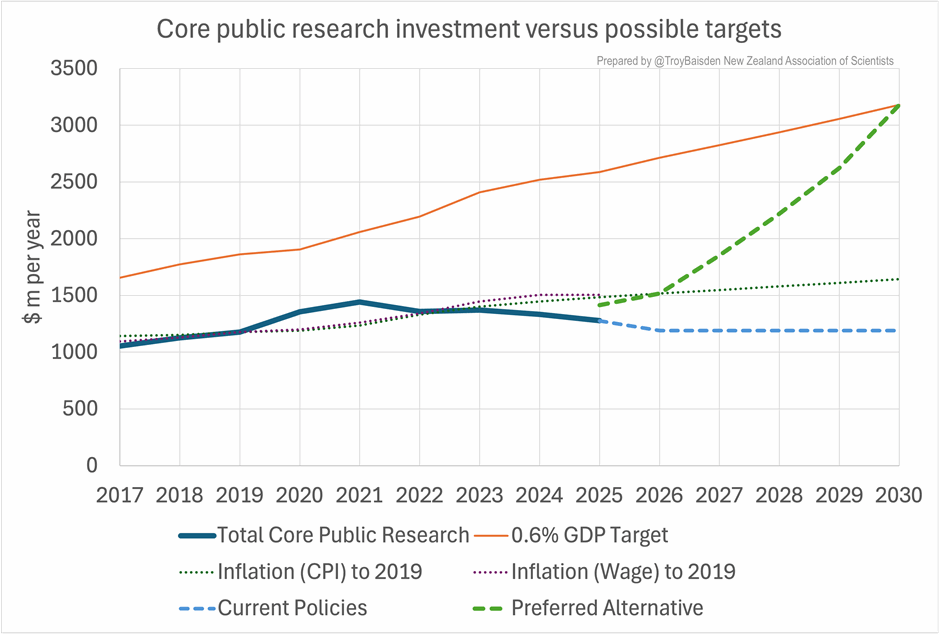
Future funding to drop further
“The government’s reprioritisations have cut Marsden funding for future years back to about 2015 levels, after adjusting for inflation. This means that future funding rates are likely to drop well below 10%.”
On top of all this, social science and the humanities have been told they won’t be supported in Marsden, and may also be reduced in support from wider funding to universities if the current Draft Tertiary Education Strategy is finalised in its present form.
“This means it could be hard to develop or engage social science that is crucial for effective climate change responses, including policy experts and those from disciplines like anthropology and human geography who study how societies and communities respond to threats. It is perhaps also notable that ‘environment’ is nowhere to be seen in the new PRO names,” Baisden says.
“The real impact is on the connectivity and integrity of the system to deliver useful and usable research, as part of a programme mapped out by researchers building a career. The potential to strategically connect ongoing and contestable funding sources was achievable but could now be nearly impossible, particularly for complex fields like climate change research. This is depressing for senior researchers, but is even worse for those still trying to build successful careers.”
Many mid-career scientists in New Zealand are staring into a future where they can’t connect the projects on their CV into something that looks like an internationally credible career, Baisden says.
“Many may have felt it was going well that way when they had a main project that took half or more of their time. But alas, now as their senior colleagues retire or move into management, most don’t get the chance to lead the areas they’ve been working in and have their time scattered across a dozen or more projects. Many already find their CVs look incoherent to international colleagues, and they have trouble getting international roles like IPCC authorship. As it stands now, all of these problems are about to get much harder for researchers who have aimed their careers at addressing climate change."
Loss of funding will hamper our climate response
Sara Walton, professor in the Department of Management at Otago University, who specialises in sustainability, climate change and business, says the loss of research funding will hamper both mitigation and adaptation responses.
“Addressing climate change requires interdisciplinary thinking — technological solutions alone will not suffice. Both emissions reduction (mitigation) and preparing for unavoidable climate impacts (adaptation) demand integration of physical sciences, engineering, and social sciences. Behavioural change, governance, community engagement, and cultural perspectives are central to creating pathways that actually work in practice.”
Moving away from supporting social science research is at odds with what is needed, Walton says. “If we neglect the social dimensions, the innovations we develop risk being ineffective or poorly adopted. The cuts across the science sector are particularly concerning given that New Zealand already invested relatively little in research and development as a proportion of GDP, and now that proportion is even lower.
“At a time of profound change driven by climate impacts, reducing research investment undermines the country’s ability to design and implement credible decarbonisation pathways. In effect, it reduces our capacity to respond to one of the greatest challenges facing Aotearoa-New Zealand.”
Walton says it’s also notable how little has been said about the loss of the National Science Challenges, and the amount of money that loss has taken out of the whole science system in New Zealand. “And the brain drain that would have occurred as a result. Huge!”
Science system in ‘dire straits’ even before cuts
Craig Stevens, Professor of Physics University of Auckland, Waipapa Taumata Rau, says the scientific community “has been banging on about this” for ages.
“It feels like the sector is being gaslit because we are fighting to get back to a system that was already in dire straits.
“The National Science Challenges were woefully underfunding for the important problems they faced. An individual Marsden Fund project was getting to the point of being insufficient funding to do anything like what had to be promised to get the funding.”
Stevens says we can look to our COVID response to see the benefits of having science-informed decision-making. “The COVID response immediately highlights the social response to science-informed decision-making. It’s been very encouraging seeing the disquiet from the so-called traditional sciences over the cuts to Marsden's humanities and social sciences.
“Climate is at its heart, a people-problem,” he says.
“You can think about a research system as an ecosystem or a rugby team – it doesn’t matter. It’s clear that you can’t put all your effort into the delivery because soon you have nothing to deliver. The Marsden Fund is about giving ideas some breath and giving researchers some room to make that grow – to get the ball rolling.
“While the scale of science in Aotearoa is challenging, it also brings a huge benefit in terms of connectivity. If science is properly enabled here in Aotearoa, I argue that the ability to connect between underpinning, applied and delivery research is much more readily achieved at our scale.
“You could have groups working on a particular theme with funding coming from Marsden, through to industrial contracts. Similarly, you can cross disciplines in this system more readily than in other national research ecosystems.
“All this is predicated on actually having enough funding to survive and do good science for the nation.”
Economic outcomes?
If the country is truly looking for improved economic outcomes, we need to improve our understanding of potential future climates, Stevens says. “We are a small island nation in a large ocean – we will experience the increasing climate pressures in our own special way – not like Europe, not like China, not like Canada. Sea level rise, forest fires, extreme weather, marine heatwaves – and then the ecosystem and economic fallout will all come to us in a unique way.”
“[For] some of this we can go to tried and tested models and tools but some of it is new because the challenges are new. And we’ll need resources like the Marsden Fund and National Science Challenges to come up with ways of responding.
“So much of what we do know with climate science is building on previous work and data – if we stop that underpinning work and focus on so-called impacts we will quickly run out of powder.”
Climate research has long timelines – data needs to be collected for years and needs to be valued, Stevens says.
“As pointed out by the [Parliamentary Commissioner for the Environment] we have arrived at a system where it is almost impossible to collect long climate relevant datasets. A shifting climate is taking our planet to new places.
"We can’t AI our way out of this.”
Stevens says Cyclone Gabrielle was “a tiny taste of what is to come” in terms of impacts.
“Gabrielle all took place in a day or so. As bad as this was, it is sobering looking west to South Australia where a very large, marine heatwave driven toxic algal bloom is lasting for months and proving devastating to coastal ecosystems. They are discovering the myriad of social and economic impacts that they hadn’t necessarily anticipated. And they have a reasonably well funded environmental sector so we will find ourselves even more vulnerable.
“When this type of impact arrives here, the National Science Challenges would have provided the response focal points – and the NSC’s were fed by Marsden ideas – an ecosystem.”
print this story
Story copyright © Carbon News 2025

Labour condemns Govt plan to stop climate litigation
Fri 15 May 2026
By Liz Kivi | The Labour Party has slammed the Government’s move to block climate lawsuits against big emitters but won’t say if they would repeal the legislation if elected in November.

Mercury eyes $1b geothermal expansion near Taupō
Fri 15 May 2026
Mercury is planning the next phase of its geothermal expansion near Taupō, with two proposed projects carrying a potential investment of up to $1 billion and enough new renewable generation to power an additional 125,000 homes.

Why ‘greenhushing’ signals deeper issues with NZ’s climate risk reporting regime
Fri 15 May 2026
By Hang Pham, Te Herenga Waka — Victoria University of Wellington | Most of us are familiar with the concept of greenwashing: organisations exaggerating or overstating their environmental credentials. But in New Zealand, there are signs the country’s climate disclosure regime may inadvertently be driving a very different trend: not saying much at all.

Media round-up
Fri 15 May 2026
In our round-up of climate coverage in local media: The government's move to change climate law removes a key protection for NZ citizens, farmers should be paid to use methane-busting tools, and it's one step forward, three steps back on environment policy.

Move to block lawsuits could strengthen climate case against Govt
Thu 14 May 2026
By Liz Kivi | The Government’s plan to block climate lawsuits – while potentially fatal for one groundbreaking climate case – could actually bolster claims in another live climate case underway against the Government.

Govt presses ahead with forestry rule changes despite opposition
Thu 14 May 2026
By Shannon Morris-Williams | The Government is pushing ahead with changes to commercial forestry rules despite most submitters opposing the proposals, with critics warning the reforms will weaken councils’ ability to manage erosion and forestry slash risks in vulnerable regions such as Tairāwhiti.

World Nuclear Association chief to address NZ energy conference
Thu 14 May 2026
The head of the World Nuclear Association will speak at a Hamilton energy conference as debate grows over whether emerging nuclear technologies could play a role in New Zealand’s future energy mix.

Opposition slams environment ministry merger
Wed 13 May 2026
By Shannon Morris-Williams | Opposition MPs accused the Government of downgrading climate and environmental protections as legislation to abolish the Ministry for the Environment and merge it into a new mega-ministry passed its second reading in Parliament.

Govt undermining judicial process yet another act of sabotage against our national interest - Carr
Wed 13 May 2026
By Rod Carr | COMMENT: The Government’s plan to pre-empt the judicial outcome of a climate case before the courts seems driven by capture and corruption and should concern us all.

Govt moves to block climate change litigation
Tue 12 May 2026
By Liz Kivi | The Government’s move to limit lawsuits holding climate polluters accountable for damage is putting the interests of big emitters ahead of communities, according to Lawyers for Climate Action.
