
‘Serious’ game looks at coastal climate change
13 May 2025
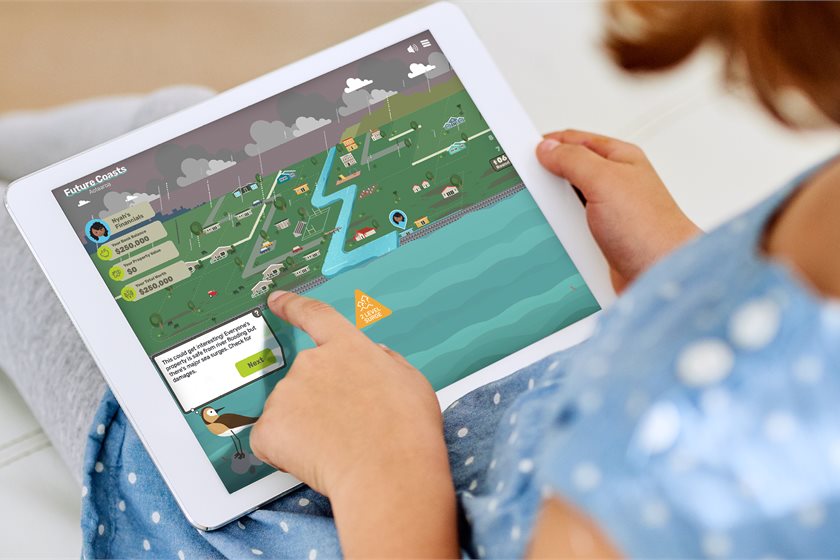
Media release | A new online game that enables New Zealanders to experience a climate-changed future and explore choices has been launched this month to get 10,000 game-plays over the wettest time of the year.
The Future Coasts Aotearoa game is a ‘serious game’, enabling players to take on roles within coastal and lowland communities to experience the long-term effects of climate-driven changes, including rising sea levels, extreme weather and flooding.
The free-to-play game, which can be played on laptops, tablets or desktop computers individually or by households, teams and workplaces, simulates the difficult choices and complex challenges facing communities on New Zealand’s coasts and lowland plains, says NIWA Coasts and Estuaries Chief Scientist Scott Stephens.
“With around three-quarters of Kiwis living within 10km of the sea, the game is about the places where most people live, work, and play. As well as incorporating multiple weather-related hazards, based on real science showing what could happen, the Future Coasts game features different land uses, from farms and marae to small settlements and towns. Players experience a community response to these events and build an understanding of the impacts and adaptation options to plan for the future. People can play multiple times to try creating different outcomes over the 80-years of the game.”
The simulation is based on real science showing what could happen, but closes a huge knowledge gap, says Dr Stephens. “The environmental processes of river floods, rising sea levels, storm surges from extreme weather, and rising groundwater are known and understood. However, we don’t how people might make decisions and act when faced with future challenges. We could ask people how they would adapt to a changing climate. But the solution this game provides is giving people a real experience of the possible scenarios, to see their actual actions. So as the game unfolds, with different scenarios, we see their choices, whether they decide to do nothing, protect assets and infrastructure with stopbanks or seawalls, or use nature-based solutions such as wetlands.”
The game, by aggregating anonymous data on player choices, will look at clusters and patterns of behaviour, and it will feed into models of behaviour. “We don’t know how people might respond given several choices to adapt to complex and rapid environmental change. So by simulating real-world situations and consequences over the 80 years of the game, data from thousands of game plays will be used to develop models of human behaviour. By taking part in this citizen science, people are not just learning about the impacts of a changing climate, but also enabling better decision-making and shaping policy.”
Dr Stephens says rather than being pessimistic or alarmist, the game gives insight into solutions. “For some playing the game, they have an ‘aha’ moment when they become aware of the natural hazards and environmental changes, and the urgency to act. They really do ‘feel the squeeze’ – it is not just an intellectual exercise, but a real experience. Actions can be taken to maximise the benefits to individuals, households and communities. Because while sea-level rise is not going to stop, we have to explore ways of doing things differently by the coast and plains to find the best way forward. The game offers a chance to experience the future, and empowers people to help shape it too. That’s why we’d like as many people as possible play the game and help reach 10,000 game plays by July.”
Games have enormous potential to move beyond entertainment and become powerful tools for education, insight, and change, says CEO of Geo AR Melanie Langlotz, who was involved in developing the game.
“In Future Coasts Aotearoa, you take on the role of someone from a coastal community — a local farmer, a kaumātua from a marae, or a townsperson — and get to experience the rising sea levels, the floods, the rising groundwater. The goal isn’t to escape the problem, but to experience what you can do to navigate future solutions.”
This turns conventional game design on its head, says Langlotz. “Rather than building a game that explains climate change, we created one that reveals the ripple effects of decisions and policies. You’re not playing to win — you’re playing to understand. And what’s truly exciting is that the choices players make in the game can help inform real-world policy. It gives us a glimpse into how people might respond to climate change when they’re not in crisis mode — and that insight is incredibly valuable.”
The multi-hazard, multi-player Future Coasts game is part of a five-year collaborative research programme led by NIWA, an MBIE Endeavour Research Programme, which aims to transform coastal lowland systems threatened by relative sea-level-rise into prosperous communities, with the game one of the tools to support decision-making and change.
print this story

Fifth new petroleum application targets Taranaki
Wed 8 Jul 2026
Media release: New Zealand Government | An application targeting frontier deepwater in the Taranaki Basin marks the fifth permit application to prospect or explore for petroleum since the removal of the exploration ban, Resources Minister Shane Jones says.
Government supporting Wairarapa farmers after heavy rain
Mon 6 Jul 2026
Media release | The Government is working closely with farmers and rural communities in the Wairarapa to assess the impacts of recent heavy rain, which has damaged local roads and bridges and caused significant erosion on hillside farms.
Tarakihi on verge of extinction: Stock collapse exposes major fisheries management failings
3 Jul 2026
Media release: Environmental Defence Society | Fisheries NZ is consulting on new sustainability measures for the country’s two tarakihi stocks.

New report sounds alarm on risks of unregulated radioactivity from deep-sea mining
3 Jul 2026
Media release | A groundbreaking scientific report released today by the Deep Sea Mining Campaign exposes a critical, unaddressed threat to global ocean health: the mobilisation of naturally occurring radioactive materials by proposed deep sea mining operations.
Next Govt must restart action on plastic pollution
1 Jul 2026
Media release - Zero Waste Aotearoa | Plastic Free July begins with an urgent call to put plastic pollution back on the political agenda. Plastic Free July is a worldwide campaign to reduce plastic waste and eliminate single use plastics.

Fed Farmers back National’s plan to slash solar red tape
30 Jun 2026
Media release | Federated Farmers says the National Party's commitment to make small-scale solar projects a permitted activity is exactly the commonsense farmers need.

What whale poo reveals about survival in warming seas
30 Jun 2026
Media release: University of Auckland | During his morning runs, Rod Keogh had no doubt that the whale poo he saw washed up on the beach had value. Science has finally caught up with him.

The Reality of Everything: A sold-out symposium at VUW
25 Jun 2026
Media release: Victoria University of Wellington | What do rising grocery bills, soaring insurance premiums, food producers under pressure, and growing international instability have in common? According to organisers of The Reality of Everything Symposium in Wellington, they are all part of a much bigger story – one that New Zealanders urgently want to understand.

New map highlights mining threat associated with controversial conservation reforms: Greenpeace
24 Jun 2026
Media release | Greenpeace has launched an interactive online map exposing the overlap between known deposits of minerals the Government has deemed "critical" and the public conservation land that would be easier to sell off and exploit under the Government's Conservation Amendment Bill.

Sustainability profession ‘comes of age’ – but pressure remains beneath the surface
24 Jun 2026
Media release: Sustainable Business Council | New research shows the sustainability profession in Aotearoa New Zealand has firmly established itself at the centre of business strategy – but ongoing pressures around capability, career pathways and pay are threatening to stall its progress.
