
Gisborne community team up with experts to combat climate challenges
31 Oct 2024
 |
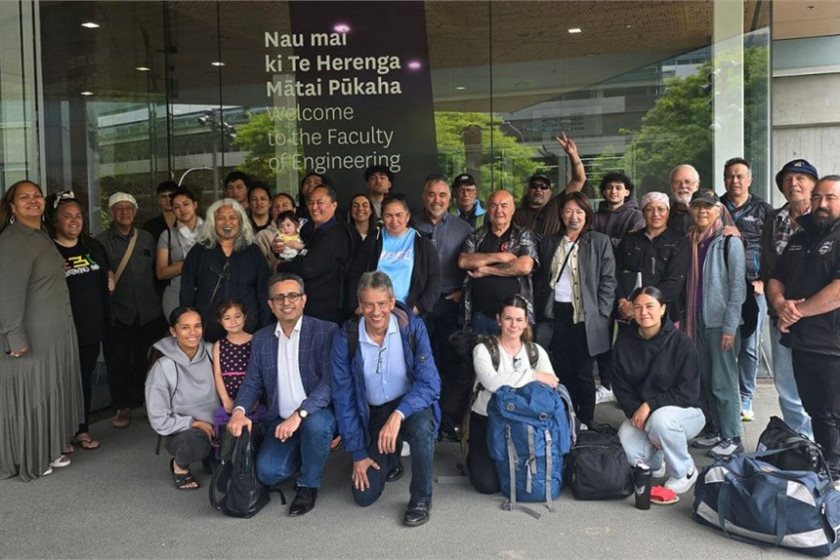
| Community members from Whareponga Valley travelled to the University for a series of educational workshops. |
Media release | University of Auckland researchers are working with a Gisborne iwi to tackle the pressing issues facing their remote community.
A unique collaboration between the University of Auckland and an isolated valley community in Tairāwhiti Gisborne aims to reshape how the region confronts climate-related challenges.
Around 40 community members of a local iwi from Whareponga Valley, located in the Ruātoria region, travelled to the University this week for a series of educational workshops on 21 and 22 October.
Together with researchers and students from the Faculty of Engineering and Business School, the group are focused on developing sustainable technological solutions to tackle the valley's reliance on diesel generators for electricity and LPG gas for cooking and heating.
Recent extreme weather events, such as Cyclone Gabrielle, have made these issues more pressing by causing power outages, disrupting access to clean water, and damaging roads and infrastructure.
Professor Saeid Baroutian from the Department of Chemical and Materials Engineering and Executive Director of the CIRCUIT Research Centre said the workshops were designed to empower community members through hands-on training.
“Our approach integrates mātauranga Māori with scientific innovation to create sustainable, resilient and self-sufficient solutions. The key aspects include developing renewable energy sources, creating circular waste management systems, designing water purification systems, and developing ecological and economical solutions for road construction.”
One of the workshops focused on converting the community's organic waste into valuable resources, such as biogas for energy and digestate for soil enrichment.
The community also explored using digital twins – virtual models that help improve the efficiency of energy use – as well as marine energy harvesting systems and water purification methods to ensure reliable access to clean water. They also examined soil stabilisation methods to strengthen roads, which is crucial for maintaining access to and from the valley.
The group also visited Manufacturing Systems Ltd’s site in Albany where they saw cutting-edge Kiwi technologies for solar energy, hydrogen energy and water quality monitoring.
Dr Kiri Dell from the Business School and the Whareponga community said that this is an exemplar model for how universities need to rethink what research impact looks like for Indigenous communities.
The project includes a transdisciplinary team of researchers from the Circular Innovations Research Centre (CIRCUIT), Energy Centre, Green Energy Engineering Centre (GEEC), Ngā Ara Whetū - Centre for Climate, Biodiversity & Society, Faculty of Engineering and Business School.
“By strengthening ties between the University and the local Māori community, the project underscores the importance of transdisciplinary partnerships in addressing the challenges posed by climate change,” says Baroutian.
The research team plans to continue supporting the community as they move forward. The next step is to work with them to prioritise the proposed solutions, co-develop and implement them, and continue offering educational programmes to ensure long-term success and community empowerment.
print this story

The Reality of Everything: A sold-out symposium at VUW
Thu 25 Jun 2026
Media release: Victoria University of Wellington | What do rising grocery bills, soaring insurance premiums, food producers under pressure, and growing international instability have in common? According to organisers of The Reality of Everything Symposium in Wellington, they are all part of a much bigger story – one that New Zealanders urgently want to understand.

New map highlights mining threat associated with controversial conservation reforms: Greenpeace
Wed 24 Jun 2026
Media release | Greenpeace has launched an interactive online map exposing the overlap between known deposits of minerals the Government has deemed "critical" and the public conservation land that would be easier to sell off and exploit under the Government's Conservation Amendment Bill.

Sustainability profession ‘comes of age’ – but pressure remains beneath the surface
Wed 24 Jun 2026
Media release: Sustainable Business Council | New research shows the sustainability profession in Aotearoa New Zealand has firmly established itself at the centre of business strategy – but ongoing pressures around capability, career pathways and pay are threatening to stall its progress.

Calder Stewart to invest $110m for solar across industrial portfolio
23 Jun 2026
Media release | NZ’s largest industrial landowner is preparing one of the country’s most significant industrial rooftop solar rollouts, with Calder Stewart set to invest more than $110 million in solar panels and battery storage across its property portfolio.

High Court hearing highlights the 'shrinking pool' for fisheries research and science
22 Jun 2026
Media release: Environmental Law Initiative | At the close of a four-day High Court hearing challenging the government’s under-levying of the fishing industry, the Environmental Law Initiative (ELI) says more science, research and observer coverage is needed to protect marine wildlife and ecosystems from the impacts of fishing.

Forest owners call for wider FENZ review as funding changes considered
22 Jun 2026
Media release - Forest Owners Association | The Government’s review of how Fire and Emergency New Zealand (FENZ) is funded should be accompanied by a wider examination of whether FENZ is delivering for rural communities, forest owners say.
Public conservation land maps show risk of sale
18 Jun 2026
Media release | Forest & Bird has today released new maps highlighting public conservation land across Aotearoa New Zealand that could be more exposed to development or sale.
Coromandel protections could be stripped away for mining through hidden law change
17 Jun 2026
Media release| Forest & Bird is warning that a hidden provision in the Government’s Conservation Amendment Bill could strip away long-standing protections and open up parts of the Coromandel Peninsula to mining.

ANZ confronted with petition and video screening after report exposes fossil fuel ties
15 Jun 2026
Media release: 350 Aotearoa | A petition signed by over 3000 New Zealanders was handed over to ANZ, calling on the bank to cut banking services to coal expansion companies. The petition comes as the annual ‘Banking on Climate Chaos’ report has confirmed that ANZ continues to back fossil fuel expansion.
Communities need to prepare for increased landslide risk
12 Jun 2026
Media release: Te Whare Wānanga o Waitaha University of Canterbury | New UC-led research shows where future Cyclone Gabrielle-like storms could cause more landslides and how communities can reduce the risk.
