
The price of international citizenship
Wed 29 Jul 2026
By Jeremy Rose
OPINION: In the run-up to the 1975 New Zealand election, the Labour, National, Social Credit, and Values parties all committed to the target of spending 1% of Gross National Product on foreign aid, with 70% of that coming from the government (or 0.7% of GNP.)
If we’d met that target, the government would have spent $3 billion this year rather than the $1.2 billion – or 0.27% of GNP – allocated to foreign aid.
That 0.7% figure wasn’t plucked out of thin air. In 1970, the UN General Assembly passed a resolution calling on wealthy nations to commit that amount annually to Official Development Assistance (ODA).
Three years later, Prime Minister Norman Kirk committed the country to the 0.7% target with the aim of reaching it by 1976. By the time Labour was voted out of office in 1975, it had reached 0.524%.
Kirk was clear: wealthy countries had an obligation to help poorer ones, and they needed to get on with it.
In the run-up to the last election, the National, Labour, and Green parties all committed to meeting the country’s climate change commitments under the Paris Agreement – an international treaty aimed at keeping global temperature rise well below 2 degrees.
No surprises there. The Paris Agreement was signed by the John Key National government in 2015, and Jacinda Ardern had been elected on making climate change her generation’s “nuclear-free moment.”
The then leader of the opposition, Christopher Luxon, had stressed the importance of climate change action in his maiden speech in March 2021.
Luxon said he was proud that Air New Zealand had become a foundation member of the Climate Leaders Coalition during his tenure as CEO of the company.
“I understand, of course, that a country is not a company,” he said. “However, New Zealanders look to the government to get things done. It’s not good enough saying you’re going to lower greenhouse gas emissions, but not do it.”
Coming up to the end of Prime Minister Luxon’s first term in office, emissions reductions are falling at less half the rate required to meet our Paris targets, according to the Climate Change Commission’s latest report.
The economy has stalled, petrol prices are at record highs, manufacturing is in crisis, consumption levels are well down, renewable electricity generation levels are at record highs, and yet the dial on carbon emissions has barely moved.
The reason for that can be summed up in a word: “zero.” Not as in the net zero carbon emissions by 2050 promised by the Paris Agreement, but zero action or commitment to reducing carbon emissions.
As Newsroom’s Marc Daalder has argued, the coalition government’s strategy amounts to: Let it burn.
And in the run-up to October’s election, Prime Minister Luxon has ruled out spending the $5 billion Treasury has estimated it would cost to meet the country’s Paris Agreement with offshore mitigation.
That $5 billion shortfall – or about 84 million tonnes of CO2 equivalent – covers the decade from 2021 to 2030. So, about $500 million a year.
Add that figure to New Zealand’s current spend on ODA and it comes to close to 0.4% of GNP – significantly less than was being spent in 1975 and well below the 0.7% target.
Climate change mitigation under the Paris Agreement and overseas aid are not the same thing. But as Switzerland, the first country to enter into bilateral mitigation agreements under Article 6 of the agreement, has shown, they can be.
To date, Switzerland has signed 17 bilateral agreements with countries in South America, Asia, Africa, Europe, and the Pacific.
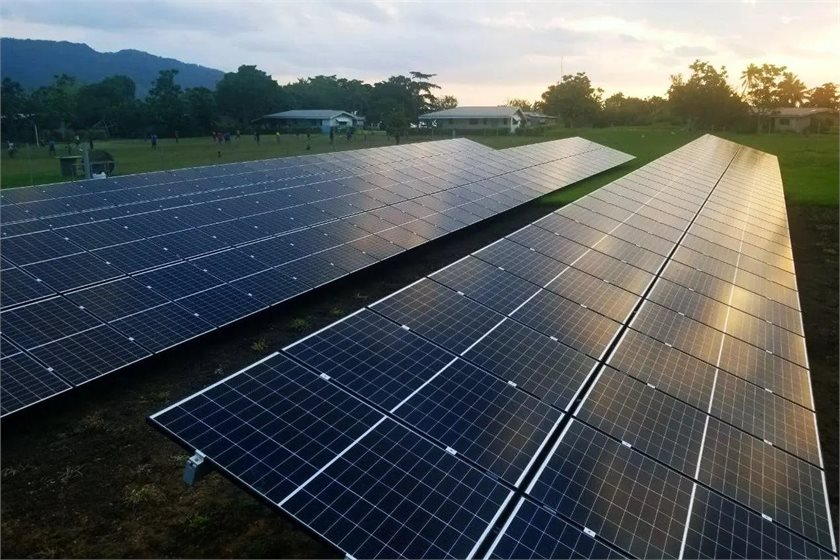
In Vanuatu, it’s funded off-grid solar power projects; in Thailand, electric buses; in Chile, battery storage and electric transit; and, in Senegal, biogas digesters to prevent deforestation by reducing reliance on firewood.
Switzerland is meeting its Paris obligations and improving the lives of tens of thousands of people in the process.
We can choose climate justice over preparing for war
The great Māori statesman Sir Apirana Ngata argued that the Māori contribution in the two world wars was the “price of citizenship.”
It’s surely one of the saddest sentences spoken in the history of Aotearoa. The idea that young Māori men who were shipped to Europe in the First World War to kill and be killed for “God, King and Empire” – as the memorials have it – had a debt to pay to a settler colonial state that had brutally dispossessed their parents and grandparents is tragic.
But it’s not surprising that, faced with the reality of building a liveable future in that state, the Māori world divided between those like Ngata who sought accommodation and acceptance with those in power and those like Princess Te Puea Herangi who rejected the war and actively opposed conscription.
A generous interpretation of the coalition government’s decision to increase the country’s military spend by $1.58 billion – to $5.9 billion – this year is that they think it is the price of international citizenship.
More likely, they know it’s the cost of being accepted by the powerful. It’s nearly 60 years since Martin Luther King described the USA as “the greatest purveyor of violence in the world today.”
And it’s as true now as it was then. It’s hard to reconcile a commitment to a “rules-based order” with cosying up to a US regime that is not only trashing the rules but committed to destroying the courts that adjudicate them.
Their lack of public condemnation of the US’s attacks on sovereign states, the murder of school children, assassinations and kidnapping of world leaders, extrajudicial killings of alleged drug runners, and the funding of a genocide suggests our government is more interested in being close to power than supporting those attempting to uphold international law.
And no doubt the government hopes that it will be a boon for the country’s fledgling arms industry. Rocket Lab – now a supplier to the Pentagon – has shown the stratosphere is the limit when it comes to the military-industrial complex, and New Zealand’s anti-nuclear legislation is no obstacle.
The one type of stimulus right-of-centre governments approve of is military Keynesianism.
There was no real public debate over whether prioritising spending on the likes of MH-60R Seahawk helicopters, at a cost of more than $2 billion, over the existential threat of climate change – to not only New Zealand and its Pacific neighbours but the world – is the right thing, or most cost-efficient thing, to do.
That increase in the military budget alone is close to what New Zealand spent on ODA for 2026 plus the $500 million Paris annual shortfall.
The $5.49 billion being spent on the military – with the aim of making New Zealand’s military interoperable with the US and its allies – is money not being spent on transitioning New Zealand and its Pacific neighbours to renewable energy and climate change mitigation and adaptation.
Ecological catastrophe and nuclear war are the two existential threats facing the world.
Choosing to prioritise military spending over international aid and climate change mitigation brings us closer to both.
Jeremy Rose is a Wellington-based journalist and former editor of Carbon News. This op-ed is from his Substack: Towards Democracy.
print this story
Story copyright © Carbon News 2026
Govt’s first post-ban offshore exploration permit draws backlash
Today 11:30am
By Shannon Morris-Williams | The Government has approved the first offshore petroleum exploration permit since repealing the 2018 ban. But lawyers say the decision raises 'serious' legal questions, as seemingly at odds with guidance from the country's highest court.
NZ Steel closes in on first heat from electric arc furnace
Today 11:30am
By Oli Lewis | The first truckloads of scrap steel are being delivered to New Zealand Steel as the company works through the final stages of a significant emissions reduction project.

Rail revival key to reducing transport emissions: new strategy
Today 11:30am
By Shannon Morris-Williams | Future is Rail has launched an election manifesto setting out a national strategy for the incoming Government to rebuild New Zealand's passenger and freight rail network, with proposals ranging from overnight train services to nationwide electrification.

Upton: Environmental information is critical national infrastructure
Today 11:30am
By Oli Lewis | New Zealand has a once-in-a-generation opportunity to ensure environmental management decisions are based on shared, high-quality data.

Financial returns the best motivator for restoring land
Today 11:30am
Most farmers and other rural landowners in New Zealand need to see financial returns to enable native forest restoration on their land, according to recent research.

Major climate tech summit to connect investors and startups
Wed 29 Jul 2026
By Oli Lewis | A two-day summit connecting climate tech startups, investors and policymakers starts in Wellington on Thursday.

Petition latest bid to stop climate torts bill
Wed 29 Jul 2026
By Shannon Morris-Williams | Climate activist and iwi leader Mike Smith has launched a petition calling on the Government to abandon its legislation to bar climate torts, marking the latest step in his campaign against a bill criticised as shielding major emitters from legal accountability.

Meridian gets green light for Waikato solar farm
Wed 29 Jul 2026
Meridian Energy has secured resource consent for a 110MW solar farm near Morrinsville, paving the way for a project capable of generating enough electricity to power more than 25,000 homes a year.

Indoor ski venue partners with Sunergise on solar install to reduce grid reliance by 30%
Wed 29 Jul 2026
Auckland's Snowplanet indoor ski venue has partnered with commercial solar company Sunergise on a 1MW solar array, cutting the facility’s grid energy reliance by about 30%.
