
Carbon markets and biochar: a golden opportunity for NZ?
Wed 1 Jul 2026
By John O’Brien
COMMENT: New Zealand’s abundant and increasing forestry waste could become a multi-billion dollar opportunity for biochar carbon sequestration – as long as the right policies, programmes, and incentives are in place.
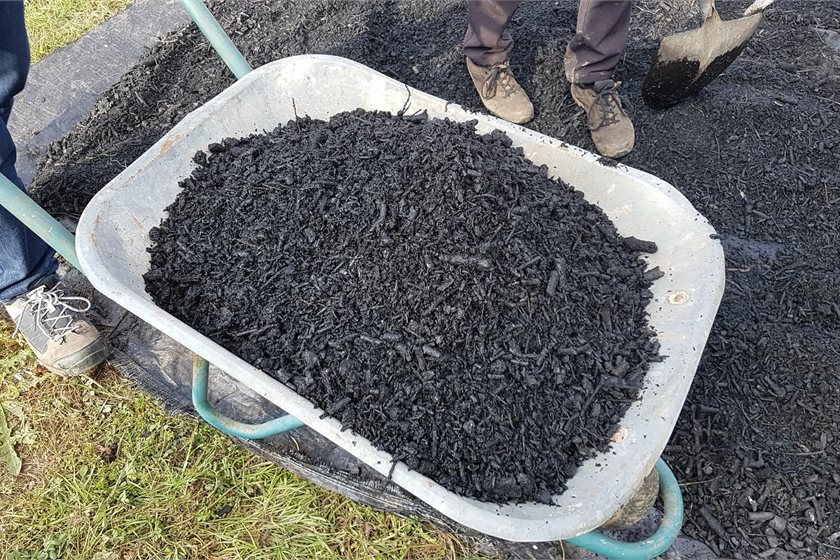
Biochar, created via pyrolysis, can convert volatile forestry residue into a solid stable form.
When applied to soil, it can retain water, filter pollutants, and mitigate climate change by locking up CO2, potentially for hundreds of years.
While biochar markets in New Zealand are still in their infancy, markets for biochar include its multiple uses as a fertiliser enhancing soil quality, as a feedstock for livestock, and as a source of permanent carbon sequestration.
Research from organisations such as the Biochar Network of New Zealand, Ag Research, Landcare Research, and in the 2023 Cameron Jones study entitled Evaluating Opportunities for Biochar production from New Zealand plantation forestry harvest revenues, all show there is a high potential for biochar projects in New Zealand because of our high quantity of forestry waste, which is set to increase over the next few years as more trees are harvested.
About 32.7 million cubic metres of forest were harvested in New Zealand in 2024, generating substantial forestry residues. This waste could be developed into a multi-billion dollar market in New Zealand in future once the right policies, programmes, and incentives are in place.
In theory, a biochar project combining revenues from fertiliser for soil enhancement, animal feedstock enhancement, and from carbon credits from carbon sequestration, could be highly profitable.
The average international price on the puro.earth platform for biochar projects in March 2026 has been €137 or about NZ$275 – five times higher than the average NZU (New Zealand Emissions Trading Scheme) price. This makes it highly attractive to develop a biochar project for carbon credits in the voluntary carbon market, and sell the carbon credits internationally, as well as for future compliance carbon markets.
New investments in biochar projects have the potential for a very high internal rate of return
and payback periods as low as two or three years.
Despite this opportunity, and while there are a few companies who have looked into the issue, nobody has yet successfully developed a biochar project in New Zealand which has issued carbon credits, sold them, and then transferred them to a buyer.
Considering the opportunities for regenerative agriculture and from carbon markets, why isn’t the biochar market taking off in New Zealand?
As of May 2026, there were only a handful of successful commercial scale projects being implemented here and, according to a 2025 Ministry of Primary Industries report, only three companies in New Zealand produced biochar at any scale.
Most biochar producers in New Zealand make just a few tonnes a year, if that. For any of these small scale producers, it makes no sense to develop a biochar project for carbon credits because of their inability to scale. A minimum of 500 tonnes of biochar a year is really the absolute minimum to consider developing a biochar project for carbon credits.
Bundling smaller biochar producers into one larger carbon removals project could be an option for a carbon removals project but it would be very challenging due to high transaction costs and the need to use the same types of waste across the various projects.
In New Zealand’s fertiliser market, biochar competes with large producers, such as Ballance Agri-Nutrients and Ravensdown, who sell super-phosphate to farmers and control 98% of the domestic fertiliser market.
Getting farmers to switch from using superphosphate on their land, when they have been using it for many years, is not easy. While superphosphate is a short-term direct nutrient fertilizer, biochar is a long-term soil conditioner with superior long-term benefits.
At the moment, superphosphate is significantly cheaper than biochar, making it difficult to persuade farmers to make the change.
Other barriers to developing a commercial scale biochar market in New Zealand include a lack of government support. There are no government financial incentives and there is no methodology or approach for using biochar for carbon credits (NZUs) in the New Zealand Emissions Trading Scheme.
This situation may change in the future. In June 2026, the Ministry for the Environment released its assessment for carbon removals, which provides a pathway for non-forest carbon removals, which of course includes biochar, to be included in the NZ ETS.
Project developers are encouraged to engage with the government on these new project types, which will then be assessed for contribution to climate goals, market credibility, liability, economic impacts, and impacts on communities including for Māori owned land. The government will then decide whether or not these new removals can be included in the NZ ETS or in New Zealand’s international climate targets (the Nationally Determined Contribution or NDC).
The timeline for these assessments is unclear but hopefully it will not take many years.
Biochar is easily measurable, it can be validated, it should easily pass an additionality test, and it is permanent, meaning that it should eventually be included in the NZ Emissions Trading Scheme.
While prices for biochar carbon credits in the international voluntary carbon market are currently significantly higher than prices in the New Zealand Emissions Trading Scheme, the ETS market should be more liquid, meaning it should be easier to find a buyer if and when biochar is included in the scheme.
While the Government releasing its carbon removals framework is promising, New Zealand lags behind Australia, where the government is already developing a methodology for carbon credit generation (Australian Carbon Credit Units) and there are already successful biochar projects selling carbon credits internationally in the voluntary carbon market.
Australia has a full biochar 2030 road map report, produced by ANZBIG (Australia New Zealand Biochar Industry Association) which outlines the support needed to help the Australian biochar market grow to a billion dollar plus market by 2030.
New Zealand, through the Ministry of Primary Industries, is currently in the process of developing a dedicated biochar roadmap but progress remains slow.
In Australia, the government has already developed a standardised quality assurance framework defining industry standards, with labs for analysis, and government support for commercial projects.
While the New Zealand government is just thinking about a carbon removals framework for biochar, the Australian government is already implementing one.
The government is developing an Australian methodology for generating carbon credits from biochar, and there are multiple companies that include biochar investment as part of their sustainability strategies. Regional government initiatives in Australia are also designed to help grow the market.
New Zealand hasn’t yet started developing a methodology for biochar projects which could be used in the NZ Emissions Trading scheme. But this is something that may be considered in future as the government has already announced it intends to open up the NZ ETS to other types of carbon removal projects.
There is also the potential, in future, to use Article 6 of the Paris Agreement to generate government backed carbon credits from biochar projects, which can be traded either in New Zealand or internationally.
New Zealand is yet to explore developing a proper legal and regulatory framework for international Article 6 carbon trading, despite the fact that one of New Zealand’s largest companies, Air New Zealand, will be required from 2028 to send tens of millions of dollars offshore every year to buy Article 6 carbon credits because there are none available in
New Zealand.
This makes no sense – it is not in New Zealand’s interest to have no Article 6 framework in place.
For many years, the New Zealand Government has aimed to “plant lots of trees” as its main strategy to meet its Paris Agreement target of a 50% reduction in greenhouse gas emissions below 2005 levels.
This has been a misguided strategy because, while the country has had a regulatory framework with carbon pricing for planting trees since 2008, there is still no carbon pricing for agricultural emissions, despite the sector being responsible for over half the country’s greenhouse gases.
This is extremely poor policy, meaning that a farmer planting one hectare of pine trees could generate about 28 tonnes per hectare, multiplied by the current NZU price of about $50, earning about $1400 NZD per hectare in the NZ ETS.
Meanwhile, the same farmer can earn nothing from sequestering carbon from biochar or even avoiding livestock emissions using methods such as feed additives, manure management, or soil carbon enhancement.
Carbon removals from biochar projects are relatively easy to measure and verify as well as easy to monitor compared with other project types, such as blue carbon projects.
Biochar is a perfect candidate for inclusion in the NZ ETS and offers a golden opportunity for our agricultural and forestry sector.
John O’Brien is Managing Director of Carbon Market Solutions Limited.
print this story
Story copyright © Carbon News 2026

CARBON PRICE
Today 11:45am
Exclusively for subscribers, the Carbon News NZU Index tracks daily movements in the compliance carbon market across multiple trading platforms.

BNZ and Pāmu team up on ‘carbon insetting’ with existing native forests
Tue 30 Jun 2026
By Liz Kivi | BNZ and state-owned enterprise Pāmu (Landcorp) have teamed up on what they say could be a model for landowners to earn revenue from existing native forests, while businesses pay for carbon removals. The organisations involved say this is “not offsetting,” with less stringent rules needed than for carbon credits.

ETS settings: Minister favours biennial cycle, officials prefer annual updates
18 Jun 2026
By Oli Lewis | The Ministry for the Environment and the Climate Change Minister, Simon Watts, hold differing views on how often emissions trading scheme (ETS) settings should be updated.

NZ biodiversity credits top global rankings
16 Jun 2026
By Shannon Morris-Williams | A New Zealand biodiversity credit project has topped global sales rankings, with Sanctuary Mountain Maungatautari accounting for 43% of worldwide biodiversity credit transactions in May and adding momentum to the country's emerging voluntary nature market.

Govt looks to tighten ETS auction supply
12 Jun 2026
By Liz Kivi | The Government is consulting on auctioning fewer ‘pollution permits’ for 2027-2031, a move it says would help meet the country’s domestic emissions targets while also maintaining short-term confidence in the ETS.

‘A shame’: experts on decision to send Govt carbon auctions offshore
10 Jun 2026
By Liz Kivi | Carbon market experts are questioning whether the Government has made the right decision in sending its auctions of carbon 'pollution permits' worth billions of dollars offshore.

No bidders again: NZ carbon auction extends losing streak
9 Jun 2026
By Shannon Morris-Williams |New Zealand's carbon auction has failed for the sixth consecutive time, with no bidders emerging for the 2.6 million NZUs on offer as secondary market prices remain well below the Government's $71 auction floor price.

Carbon auction set to fail while new data suggests sharp decline in stockpile
8 Jun 2026
By Liz Kivi | Tomorrow’s carbon auction is odds-on to fail again, even as the latest figures from the Environmental Protection Authority show the ‘stockpile’ of NZUs continuing to decline.

NZ’s ‘light‑touch’ approach to voluntary carbon and nature markets may unlock finance but risks credibility
2 Jun 2026
By Jennifer Campion, University of Waikato | The government’s recent announcement of support for voluntary carbon and nature markets effectively offers a “warrant of fitness” to signal which markets can be trusted, without directly regulating them.
