
Hormuz crisis critical to New Zealand
10 Mar 2026

By Nathan Surendran
COMMENT: Why the Hormuz crisis is a symptom, not the disease – and what it means for New Zealand.
One week after US-Israeli strikes on Iran triggered the effective closure of the Strait of Hormuz, the crisis has moved well beyond a shipping disruption.
This matters to New Zealand more than almost any other developed nation, because since the closure of the Marsden Point refinery in 2022, we import 100% of our refined fuel.
Approximately 81% of it comes from South Korean and Singaporean refineries that process Middle Eastern crude – crude that reaches them through the Strait of Hormuz.
Force Majeure declarations are now cascading through the entire supply chain that New Zealand depends on for 100% of its refined fuel, from Gulf producers through to the South Korean and Singaporean refineries that supply our petrol, diesel, and jet fuel. When a supplier declares Force Majeure, it is legally stating that it cannot fulfil its contracts.
Our minimum diesel stockholding provides roughly 21 days of cover. The increase to 28 days isn’t scheduled until July 2028.
New Zealand may have only two to three weeks of physical fuel in the country, the pipeline of future deliveries is being disrupted by Force Majeure, and the bulk of our stated 90-day reserves consist of untested paper agreements with overseas governments.
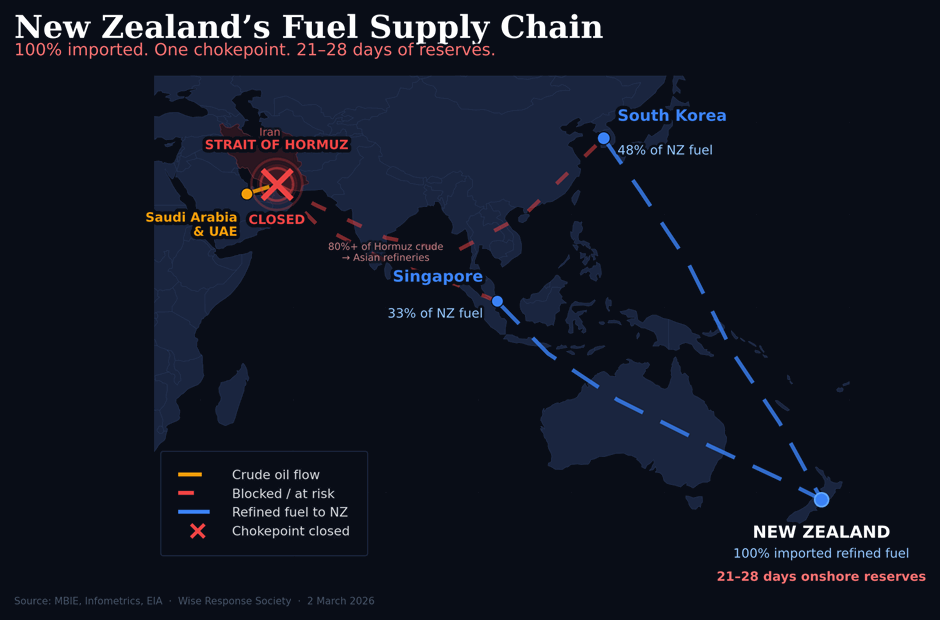 |
| Image: Wise Response |
Last week, the Wise Response Society – which I chair – issued a press release calling on the government to be transparent about the severity of our exposure, to activate the National Fuel Plan, and to investigate equitable rationing frameworks before shortages arrive rather than after.
If the New Zealand government has a plan for rationing fuel, it has not discussed it with the public. It is the position of the Wise Response Society that it must do so immediately.
But this article isn’t about the crisis of the week. It’s about the crisis underneath it.
The whitepaper
I have released a whitepaper: The Limits to the Energy Transition: What Physics Means for New Zealand’s Economy. It represents a summary of my current understanding synthesising the biophysical economics literature – Hall, Keen, Murphy, Garrett, Hagens, Smil, Delannoy and others – and applying it specifically to New Zealand’s situation.
The central argument is straightforward, even if the implications are not.
The global economy is not a financial system that happens to use energy. It is an energy system that happens to use money. When the net energy available to society contracts – as it is now doing, due to the rising energy cost of extracting what remains – the real economy must also contract. No monetary policy, no financial engineering, no amount of optimism can override this. The constraint is physical.
What the paper covers
The paper works through several connected arguments.
First, that the Energy Cost of Energy is rising. We harvested the best, most accessible fossil fuel reserves first. What remains is deeper, more dispersed, and more energy-intensive to extract. The net energy peak for oil – the energy actually available to society after extraction costs – likely occurred around 2025, even though gross production continues.
Second, that the proposed renewable replacement is constrained by mineral availability and energy density limits. Solar panels, wind turbines, and batteries are better described as “rebuildables” – they harvest renewable energy flows, but the stock of materials and fossil fuel energy required to build, install, maintain, and replace them is finite and substantial. The transition is being built by the very energy source it proposes to replace.
Third, that New Zealand sits in a uniquely exposed position: no domestic refining, 21 days of diesel reserves, complete dependence on maritime supply chains through contested chokepoints, and an agricultural export economy that runs on diesel from paddock to port.
The paper also steel-mans the rapid transition case – the solar cost revolution, emerging battery chemistries like sodium-ion, electrification efficiency gains. These are real, welcome developments. Solar should be deployed aggressively. Electrification of light transport and heating should be accelerated. But the claim that these developments can sustain current levels of economic complexity, let alone continued growth, is not supported by the physical evidence.
Why this matters now
The Hormuz crisis is not an anomaly. It is a preview. The conflicts over remaining fossil fuel resources – in the Middle East, Ukraine, the South China Sea – follow a well-documented pattern of major powers competing for control of the energy that underpins their economies. As the highest-quality reserves deplete, these contests intensify. New Zealand cannot control this. What it can control is its level of preparation.
The whitepaper concludes that the appropriate response is not to abandon the renewable transition – it is essential – but to plan honestly for a smaller, less energy-intensive economy alongside it. That means prioritising food security, water, and essential services. It means building resilience rather than optimising for efficiency. It means preparing equitable distribution mechanisms – like Tradable Energy Quotas – for deployment when supply disruptions materialise.
And it means honest communication. The most dangerous aspect of our current situation is not the physical constraints themselves.
Managed early, they are navigable. The danger is the refusal to acknowledge them – every year of continued investment in a growth-dependent model that cannot be sustained is a year of misallocated capital, deferred adaptation, and increased fragility.
The physics is not negotiable. Our response to the physics is.
I’ve tried to write the whitepaper so that the arguments can be engaged with on their merits, with full references. Some of the conclusions are unwelcome. I ask only that you engage with the physics before reaching for the reassurance of conventional economic assumptions. Strategic descision making from this point forwards must take into account the world as it is, not as we’d like it to be.
If you’re a business owner, board member, or policymaker in New Zealand, the question is no longer whether these constraints will affect you. It’s whether you’ll have prepared, mentally, personally, and corporately for them when they do.
Nathan Surendran is the principal consultant at Schema Consulting Ltd and chairperson of the Wise Response Society. He specialises in biophysical economics, energy systems engineering, and long-term resilience planning for New Zealand businesses and communities. He is based in Southland.
print this story
Story copyright © Carbon News 2026

Contact: New biodiversity goal may be 'highly problematic' for renewable projects
Fri 24 Jul 2026
By Oli Lewis | The goal of no net loss of indigenous biodiversity in the new resource management system may be highly problematic for renewable energy developments, Contact Energy says.

Biomass can free-up electrons to perform higher value roles – with multiple other benefits
Fri 24 Jul 2026
By Rob Mallinson | OPINION: New Zealand’s energy debate too often treats electricity as the universal solution.

Businesses told to plan ahead as energy risks mount
Thu 23 Jul 2026
By Shannon Morris-Williams | Switching to electricity and improving energy efficiency are becoming increasingly attractive investments in the face of rising costs – and companies can no longer afford a "business as usual" attitude to energy, according to a new report.
Only Genesis can invest in Huntly, Treasury told ministers
Thu 23 Jul 2026
Treasury backed Crown investment in Genesis Energy because only Genesis could invest in Huntly Power Station, but argued the company had no special claim on building more renewable generation.

Green Party takes ‘electric election’ up a notch
Tue 21 Jul 2026
By Liz Kivi | The Green Party is promising to cut power bills and establish a publicly owned company, ‘Kiwipower,’ to deliver affordable renewable energy.

SEANZ urges Govt not to sign contract for LNG before the election
Tue 21 Jul 2026
The Smart Energy Alliance has penned an open letter to the Government urging ministers not to sign a binding agreement for an LNG import facility before November’s election.

Clock ticks on Gas Security Fund as Tariki developer reports ongoing losses
15 Jul 2026
By Oli Lewis | A Canadian company advancing a major gas storage project in New Zealand continues to report ongoing losses.

$3m Govt boost for Tauranga geothermal energy
14 Jul 2026
By Liz Kivi | Resources Minister Shane Jones has announced a $3 million grant for the Gas to Geoheat Tauranga Geothermal System Project as part of the Government's plan to double geothermal energy by 2040.

Batteries and full lakes flatten winter power peaks
14 Jul 2026
Large batteries and more strategic use of hydro generation are starting to flatten winter electricity price peaks, reducing reliance on expensive thermal generation.

NZ lagging in energy storage investment – report
14 Jul 2026
Investment in energy storage is maturing globally, with the need for resilient and flexible power driving demand for storage, but New Zealand has some catching up to do, according to a new report.
