
Franz Josef ratepayers await stopbank loan details
26 Sep 2024
 |
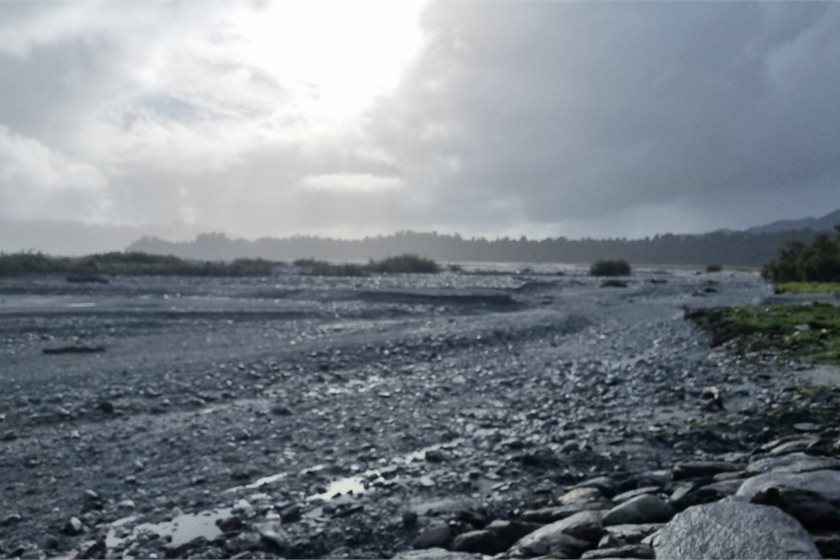
| The bed of the Waiho/Waiau River is a vast rock-strewn plain that grows higher by the year. PHOTO: Lois Williams / LDR |
By Lois Williams, Local Democracy Reporter
Franz Josef community leaders are urging the West Coast Regional Council to think twice before saddling them with a $4 million debt for flood protection.
The Government has offered the council $6 million to build stopbanks protecting farms and lifestyle blocks on the south banks of the Waiho River opposite the town, if ratepayers contribute the remaining $4m.
The sum would also cover extensions to a stopbank on the north bank protecting Franz Josef’s sewerage ponds.
The council is contacting property owners this week by mail with details of the loan offer and what they would be up for in special rates.
It has previously said a $400,000 property would pay an extra $1076 a year and an $800,000 one would pay $2152, over a ten-year loan period.
Just north of Franz Josef, Stony Creek resident Adam Haugh says he and his neighbours, who live out of the flood zone but still pay rates for stopbanks, are nervous about the deal.
“Maybe it will be acceptable to pay $500 a year to protect Franz Josef infrastructure that makes the village liveable. We all wait with great expectation to see if the council has come up with something sensible."
The most sensible thing in his view, would be to get rid of some stopbanks and let the river go to the south, away from Franz Josef.
That would mean sacrificing some south bank farms that are under repeated attack from the rampaging river, whose bed grows higher by the year as rocks tumble down from a retreating glacier.
But if nothing changes, Franz Josef’s sewerage ponds will have to be moved away from the river, costing an estimated $10 million dollars, Mr Haugh says.
“If we could release the river to the south, not only do we save the cost of a stop bank loan, we’d actually save the $10m cost of having to build a new sewerage plant.”
The Regional Council’s core business is building and maintaining stopbanks, Haugh says, and several councillors have experience in the associated industries.
“That’s their thing. They’re very good at it, but I wonder if they’d ever make a pitch to the government to actually get rid of a stopbank?”
With the government’s $6 million and the ratepayers’ $4 million, the lower Waiho farms could be bought up at valuation, and the river let go, ultimately saving money for the government and ratepayers, Mr Haugh says.
Figures provided by the Regional Council show a valuation of just over $13 million for 26 lower Waiho rateable properties.
But the Regional Council told Franz Josef ratepayers last month that the government grant and loan money cannot be used for that purpose.
Adam Haugh is not the only one urging a rethink.
Business man Logan Skinner, a north bank representative on the council’s Franz Josef Special Rating District’s joint committee, says the stop banks have a design life of just ten years.
Asking a small ratepayer base to take on a $4 million debt for a temporary solution to protect about 30 south bank properties makes little economic sense, he says.
“The stop banks might last longer – or they could be swept away or damaged sooner – and what do we do then? Go back to the government and say ‘Please sir can we have some more'?"
The original ten-year ‘hold the line’ approach was based on a buyout happening, but that had now been scrapped with no alternative long-term plan in place, Mr Skinner said.
Another Franz Josef ratepayer, Ian Hartshorne says north bank residents will be footing most of the bill for the south-side stopbanks.
The south and north banks previously had separate rating districts, but at the government’s insistence they were combined last year.
“Now we’re all back into a joint venture, the town’s going to pay for most of it – over 90 percent of the bill - because the properties on the south side are pretty worthless.”
Westland District mayor Helen Lash says the south bank properties are worth a lot more than $13-million including some very productive farms and cutting them loose would devastate the community.
“If you lose the south side, you lose about 40 residents from Franz Josef. You lose kids at the school, and some key players in the real community. On the north, it’s mainly the tourist businesses.
“We know the south side people bought there because the land was at risk and cheaper, but they’ve invested heavily in their properties and they’re the heart of the Franz Josef community."
One day the river will have its way and take out the Waiho flats, the mayor agrees.
"But as Minister Shane Jones has told us, there’s no money in world that could cover the cost of relocating the number of New Zealand townships that were built in volatile places.
“If they did it here, they’d have to do it everywhere. A buy-out is just not on the government’s table."
Meanwhile, the big conversation that should be happening about a long-term plan for Franz Josef has been once again kicked for touch, the mayor says.
“If we’re buying time by building stopbanks, what for? What are we going to do with that time to somehow secure a future for those south side residents?
“That is the plan we should be working on with the government and I think it’s clear our Westland district council will have to lead it.”
LDR is local body journalism co-funded by RNZ and NZ On Air.

print this story

Red Stag boss questions $60m cement support as timber ETS reforms stall
Thu 23 Jul 2026
By Oli Lewis | The Government has granted $60 million to an emissions-intensive industry while dragging its feet on a proposal to allow firms making harvested wood products to earn carbon credits in the Emissions Trading Scheme, an industry leader says.

Govt brushes off 'damning' assessment of stalled emissions reductions
Thu 23 Jul 2026
By Liz Kivi | The Government is downplaying the Climate Change Commission’s “damning” report on the country’s stalled emission reductions, while experts say policy changes since the Coalition Government came into power are squarely to blame.

Businesses told to plan ahead as energy risks mount
Thu 23 Jul 2026
By Shannon Morris-Williams | Switching to electricity and improving energy efficiency are becoming increasingly attractive investments in the face of rising costs – and companies can no longer afford a "business as usual" attitude to energy, according to a new report.
Only Genesis can invest in Huntly, Treasury told ministers
Thu 23 Jul 2026
Treasury backed Crown investment in Genesis Energy because only Genesis could invest in Huntly Power Station, but argued the company had no special claim on building more renewable generation.

Business leaders say climate report ‘wake-up call’ for NZ
Thu 23 Jul 2026
By Liz Kivi | CEO-led organisations representing 42% of GDP are calling the Climate Change Commission’s latest report “a significant wake-up call for New Zealand.”
West Coast council holds off on climate adaptation plan
Thu 23 Jul 2026
By Vihan Dalal, Local Democracy Reporter | The West Coast Regional Council is holding off on preparing a climate adaptation plan until a proposed law change advances further in Parliament.

Disappointment and shock as Govt strikes out iwi-council deals
Thu 23 Jul 2026
By Craig Ashworth, Local Democracy Reporter | The iwi that last week signed an environmental deal with Taranaki Regional Council is “deeply disappointed” the agreement won’t survive Government law changes.
NZ at risk of missing all its climate goals: Commission
Wed 22 Jul 2026
By Liz Kivi | Aotearoa New Zealand’s rate of emissions reduction needs to more than double, with progress stalling since 2024 after the Coalition Government took power, according to the latest report from the Climate Change Commission.

Resource management Bills 'not yet ready to be enacted', says Upton
Wed 22 Jul 2026
By Oli Lewis | The two Bills to replace the Resource Management Act are not ready to be enacted and there is no way of knowing how they will affect the environment, the Parliamentary Commissioner for the Environment says.

Green Party takes ‘electric election’ up a notch
Tue 21 Jul 2026
By Liz Kivi | The Green Party is promising to cut power bills and establish a publicly owned company, ‘Kiwipower,’ to deliver affordable renewable energy.
