
Govt 'not even pretending to try' to reduce transport emissions: former MOT chief science advisor
11 Jun 2024

 |
| Transport minister Simeon Brown. |
By Liz Kivi
The former chief science advisor for the Ministry of Transport says the current government isn’t even pretending to try to reduce carbon emissions from transport.
For the past six and a half years Simon Kingham, professor of Human Geography at Canterbury University’s School of Earth and Environment, was seconded two days a week to the Ministry of Transport as chief science advisor, to advise on the evidence base of government policy.
Kingham says the coalition government is taking a completely different approach to the former Labour-led government. “The previous government was working to reduce transport emissions. The current government is not even pretending to try.”
There is a long list of transport emissions reduction policies that the coalition government has binned. “They’ve cut back the Clean Car Discount, reduced the Road User Charges exemption for EVs, they’re winding back the Clean Car Standard, reducing funding for public transport, reducing incentives for walking and cycling, they’re building more roads which increases emissions, they’re encouraging density but also encouraging sprawl, which induces demand."
Kingham says his final months in the advisory role were challenging as his advice was sought much less under the coalition government. “The number of things I was asked to comment on has reduced drastically in the past six months.”
Last month climate change minister Simon Watts told Carbon News that he supported the current target of reducing transport emissions by 41% by 2035 but experts, including Kingham, are sceptical about how that target will be met under the new policy direction.
Focus on net emissions
The government seems to be focussing more on net emissions and offsetting, Kingham says. But that’s not a straightforward solution. “If the emissions reductions are not coming from transport or agriculture that puts a lot of pressure on tree planting.”
While the government issues carbon credits for tree planting, we don’t know if that sequestration is necessarily durable, Kingham says. “Do they get to keep the carbon credits if the forests burn down? As well as tree planting there’s talk of biofuels. That all adds up to a lot of land that’s going to be used and I don’t know if anyone has thought through the implications of that.”
While relying on the Emissions Trading Scheme might work to decarbonise other sectors, Kingham says it won’t work for transport. “The ETS is not going to deliver reductions in transport because the price it would have to go to is politically unpalatable. You’d have to add a dollar to the price of petrol and no-one is going to want to do that.”
Kingham is concerned that, as well as increasing vehicle emissions, the government’s transport policy means New Zealanders will miss out on the multiple co-benefits of reducing vehicle travel and having lower speed limits.
“If you’re walking and cycling you get physical activity as well as community and social benefits. You get to meet people and get to know your neighbours. If you use public transport it’s also much cheaper to provide infrastructure than if people are forced to live further away. The costs comes down a lot.”
Policy not based on good science
Kingham says he doesn’t know where transport minister Simeon Brown is getting his advice. “I don’t know anyone in the research community who thinks what he’s doing is a good idea. It would be interesting to know if there was someone.”
However the minister is within his rights to set policy as he sees fit. “The minister was elected democratically and he has every right to implement policy how he chooses. He doesn’t have to make it based on good science.”
While the government has promised to increase the availability of EV chargers, Kingham questions whether that will do enough to increase EV uptake.
“The government would say that now more Chinese EVs are appearing at reduced prices, so the government might argue that the Clean Car Discount is not needed. But at the moment EVs are substantially more expensive than they were and some big polluting vehicles are about $6000 cheaper than six months ago.”
EV sales down
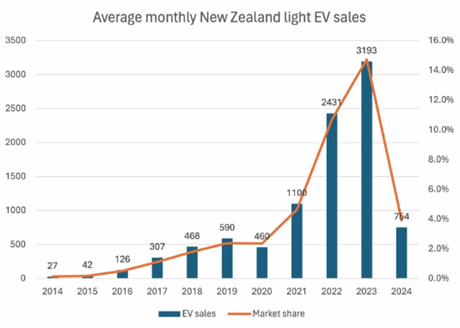
After a bumper year of electric vehicle sales last year, the EV market is now eerily quiet. Following the government scrapping the Clean Car Discount and instigating Road User Charges for EVs, there were just 793 sales in May and a total 3,771 for the year-to-date.
 |
| IMAGE: Robert McLachlan |
The Ministry of Transport had forecast 24,000 EV sales for 2024 - but this looks increasingly out of reach.
Robert McLachlan, distinguished professor in Applied Mathematics at Massey University, says that while the overall market for vehicle sales is down 11% on 2023’s numbers, EV sales have reduced far more, and are down 76%. “The longer this goes on, the more emissions savings have to be found elsewhere.”
The government is also set to pass the Land Transport (Clean Vehicle Standard) Amendment Bill, which experts say is set to further increase emissions from transport.
The Government had hoped to quietly pass the Bill last week under urgency, but didn't get through all the post-Budget business in time. It allows the government to charge car importers a Clean Vehicle fee but it also, controversially, gives Cabinet the power to alter the imported vehicle emissions targets for future years - currently written into law - without consultation.
“When these were set there was extensive consultation and modelling done,” McLachlan says. “Here my concern is that the new Bill would allow the targets to be changed without consultation.”
McLachlan expects the government will significantly weaken the emissions targets. “Currently the targets for 2026 and 2027 are strict enough to allow us to catch up with the EU by the early 2030s.”
CO2 import standards gone?
Christina Hood, head of Compass Climate, is also concerned that the legislation about to be pushed through parliament under urgency doesn't just lay the groundwork for weakening the targets, but will completely delete the existing CO2 standards that are in legislation.
“On passage of this Bill, we will have no CO2 vehicle standards for 2025 onwards. The Minister may set new ones, but is not required to. The current law has backstop values that would apply if future Ministers don't follow through with regulation-making, but this amendment would delete that backstop. If the Minister fails to make the regulations, there will be no CO2 import standards.”
Hood says climate change minister Simon Watts “ought to be concerned” about the implications of the Bill.
print this story
Story copyright © Carbon News 2024

New legislation to bar climate torts proves polarising for submitters
Fri 17 Jul 2026
By Liz Kivi | Opponents of legislation to block climate lawsuits say it could seriously damage investor confidence, while supporters of the same legislation argue that not passing it could be “devastating” for the New Zealand economy.

Climate adaptation plans welcomed, but funding remains the missing piece
Fri 17 Jul 2026
By Oli Lewis | Experts are welcoming a proposal to make climate adaptation planning mandatory, but warn the plans may be ineffective without clarity around who will pay to implement them.

Conservation bill could put development ahead of protection, commissioner warns
Fri 17 Jul 2026
By Shannon Morris-Williams | Parliamentary Commissioner for the Environment Simon Upton says the proposed law changes could give economic development greater weight than conservation, undermining the purpose of the Conservation Act.

Government running out of time to lock in LNG import terminal deal before election
Thu 16 Jul 2026
By Oli Lewis | Procurement for a floating LNG import terminal in Taranaki is well advanced, the Government says, but the clock is ticking to sign contracts before the election.

Climate law introduced requiring adaptation plans and reducing Commission's role
Wed 15 Jul 2026
By Oli Lewis | The Government has introduced legislation to amend the Climate Change Response Act (CCRA), which includes stripping the Climate Change Commission of one of its core roles, adds a new requirement for councils to produce adaptation plans for higher-risk areas, and updates ETS settings.

Climate remains top priority for Pacific leaders
Tue 14 Jul 2026
By Shannon Morris-Williams | Major regional events in Vanuatu and Fiji this month have underscored the Pacific's continued focus on climate action, with locally led innovation and sustainable farming highlighted as critical tools for tackling the region's environmental challenges.

EMA pushes for steady hand on energy and regulation
Mon 13 Jul 2026
By Shannon Morris-Williams | The Employers and Manufacturers Association wants the next government to commit to a long-term energy plan and allow faster investment in renewable generation, at the same time as slowing the pace of policy change and providing businesses with greater certainty.

Who should pay for adaptation? Local Govt NZ calls for clarity
Mon 13 Jul 2026
By Liz Kivi | Local Government New Zealand wants more clarity from central government on the vexed issue of ‘who pays’ for climate adaptation, with the organisation hitting back at comments from the Climate Change Minister that local councils are spending too much on climate resilience.

'Electric election': Labour promises $160m SolarSaver scheme funded by gas investment cuts
8 Jul 2026
By Oli Lewis | Labour is promising to reprioritise $160 million from the Gas Security Fund to pay for its new SolarSaver policy, designed to accelerate the roll-out of household solar.

Energy Minister completes overhaul of EECA board
8 Jul 2026
By Oli Lewis | The board of the Energy Efficiency & Conservation Authority (EECA) has been completely overhauled since the last election, with Energy Minister Simeon Brown responsible for all six appointments.
