
Paving over polarisation
25 Mar 2024


By Troy Baisden
OPINION: In a sequel to Paving Over Paradise – can we choose RMA reform and a wider political landscape that gives us smooth pavement and stunning outlooks over craters and chaos?
The new Government finished its first 100 days with a record run of repeals, surprises and fast-moves that range from disappointing to ‘dangerous’. Let me explain what ‘dangerous’ means, in terms of holding our nation back and turning us against one another.
The key word ‘dangerous’ stood out of my quote like a tall poppy as it closed off Rebekah White’s exploration of the Resource Management Act (RMA) Fast-Track legislation in New Zealand Geographic. Yet, my message expands on my comments in Paving over Paradise: even Chris Bishop and Shane Jones will probably do better to find common ground to moderate the Fast-Track legislation.
Many submitters and the big NGOs like Forest & Bird as well as the Environmental Defense Society (EDS) will come out hard against it. And they should. Yet if they do so without the Parliamentary Select Committee submissions process as a chance to design and argue for stable RMA reform, then they’re falling for a well-set trap that becomes a lose-lose proposition – the opposite of a win-win. In fact, it looks like a loss three times over.
Loss #1
The Government has the numbers to pass the Fast-Tracking Bill. Massive numbers of submissions opposing the Bill will only be of value if they bolster a case to moderate it and make it more durable.
Helen Clark has promoted Simon Upton’s vision of an RMA that did not need new legislation but could have been made to work better. That’s significant because they fought from opposite sides of politics for over a decade. Upton’s Newsroom Opinion article is well worth a careful read.
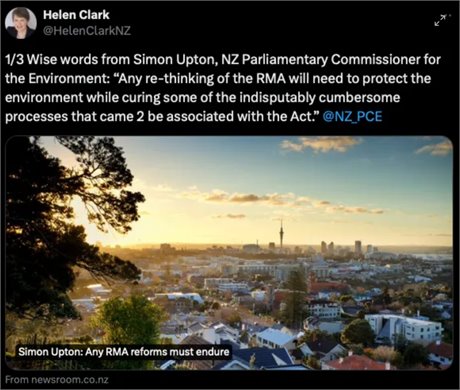
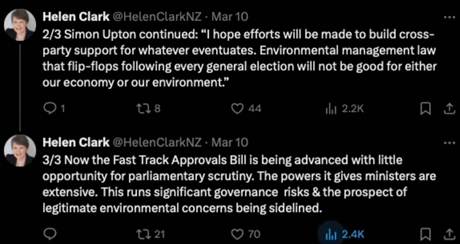
Read the Parliamentary Commissioner for the Environment’s (Hon Simon Upton) Op-Ed on Newsroom. It was published in January; the fast-track debate makes it truer and more urgent today.
Some progress and partial progress on needed frameworks is worth digging into further, including more uniform limits and targets as an alternative to bespoke processes to consider every attribute, plan change or consent. These could become a consistent, useable and community accessible way to acknowledge environmental limits that have become the norms of legislation in other nations and globally, on issues from acid rain to climate change. Limits, once established, can speed and ease decisions, offering sanity, transparency and a process that is not dangerous to our constitutional framework and norms of good governance.
A better process seems worth designing and fighting for.
"It's got to be asked what the national catastrophe is that justifies empowering ministers to this extent in today's environment." –Constitutional Law Expert Prof Andrew Geddis
Loss #2
You might ask why Labour’s replacement bills for the RMA weren’t simpler and better? In most countries, NGOs and think tanks focus more on designing legislation from both partisan and non-partisan motivations. We’re different because our NGOs like Forest & Bird and EDS, as well as the upstart Environmental Legal Initiative know their real successes com from court challenges, including conservation orders. One good example was the death knell of Ruataniwha Dam and Irrigation Scheme. That scheme could be resurrected by fast-tracking, returned environmental protection to the paradigm of the past when “every victory was temporary and every loss was permanent.”
Fast-tracking makes subsequent court challenges disappear. It may even make standing before the expert panel or Ministerial decisions difficult to achieve.
The NGOs and the environment they protect would lose their pathway to success.
Loss #3
The biggest loss could be the enduring polarisation of our society, with what could be wild swings of legislation and regulation between elections. We should be wary that enabling this polarisation – a desperate fight or flight instinct on both sides of politics during as economic trouble also escalates.
The possibility that environmental NGOs once again become pitted against a Muldoonian development programme is dire. But perhaps it understates the problem.
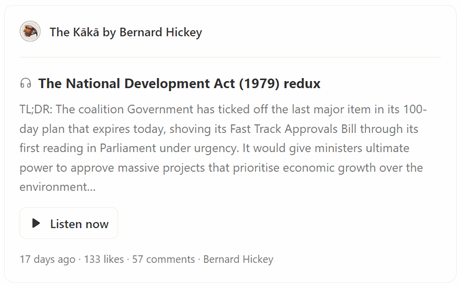
Muldoon’s ‘Think Big’ policies and 1979 National Development Act were pro-development in a way that unquestionably lacked balance, but they were also contained within the state or in state-owned enterprises, effectively socialising any gains. Hear me out when I say that the current direction is more worrying – it resembles the 1970s actions of Pinochet in Chile or the other Junta regimes that decimated the economies of Argentina, Brazil and Uruguay with mixtures of cuts and ‘free market reforms.’
The driving philosophy of the policies imposed across South America became known as neo-liberalism. This may sound familiar enough, particularly if you read Chapter 3 of Naomi Klein’s Shock Doctrine, or already use this term to describe the legacy of the 1990s in New Zealand. Klein’s book, published back in 2007, feels slightly dated when we consider how much the Shock Doctrine approach evolved. Even by 2007 it became somewhat friendlier and hid its ‘shock and awe’ better than the football stadium massacres that caused Pinochet’s Chile to suffer crippling international ire and boycotts.
But how have they evolved? I reminded myself and quickly realised I couldn’t find a single gap between the policy goals Klein warns of us in the Shock Doctrine, and the known policy goals of the Atlas Network that has multiple shadowy links into the coalition government. These links were most notably traced through the surprise repeal of anti-smoking smoking legislation, which is worrying due to the links between tactics of the smoking lobbyists and strategies such as climate change denial.
These steps take us way beyond Klein’s narratives about the rapid privatisation of public schools and housing in New Orleans in the recovery from Hurricane Katrina.
Evidence of a kinder, more democratic Shock Doctrine is all around us
That’s no smoking gun, but the evidence of a kinder, friendlier and more democratic Shock Doctrine is all around us in Aotearoa New Zealand.
-
The Fast-Track Bill
-
Massive Civil Service Cuts with hundreds of redundancies in each major ministry
-
De facto cuts to benefits and social programmes
-
A 100-day legislative programme with unprecedented use of urgency
And with large cuts to our research institutions, and ongoing financial crises in our universities which serve as ‘critic and conscience’ of society, you might wonder who will still be willing to pop their head up above the parapet to express concern. The obvious answer would be the media, except for the cuts to our major TV newsrooms and ‘papers’. In fact, most of the 100 Day agenda was carried out while the in-depth current affairs shows like Q&A, which less than 52 weeks of funding, were on summer break from November through February.
From Katrina to Gabrielle: collective forgetfulness?
We may have recovered from the pandemic, but not the onward shocks to supply chains, inflation and recessions it has induced. To listen to the talk of Labour running up big deficits, we could forget both the pandemic and massive scale of damage from Cyclone Gabrielle, which hit only a little over a year ago. I’m unsure what to make of the forgetfulness.
We might consider that with our massive infrastructure deficit and climate change on the way, we’re vulnerable. When we have systems as confusing as the notion that new consents and plans should account for very unlikely sea level rise scenarios, we appear to be developing systems across our society which may benefit rich and powerful.
The list of those likely to benefit include, foreign investment, their foreign lobbyists and the consulting firms that design and advise our government on adjusting the rules. These patterns are hallmarks of small government approaches, and according to Mariana Mazzucato’s latest book explain many of the problems we face. It is the opposite of the just and equitable transitions we need, at a time when so much is possible to address challenges in our housing, infrastructure and environment along with reducing our emissions and adapting to climate change.
We just don’t have to go to extremes. In fact, there’s every reason to believe that it helps National and probably their coalition partners steer toward the middle ground. In that middle ground, we can all follow Helen Clark and Simon Upton’s advice – and build stable systems that make a better New Zealand.
Ultimately, the Shock Doctrine approach is easier to see for what it is and fight, than it is to ponder what drives it. We need to resist the urge to fight first or flee – instead finding ways to innovate together. An important first step is testing the the opportunity to make the fast-track legislation sensible and transparent as well as a path to better and more durable resource management legislation.
____________________________________________________________
Troy Baisden is Co-President – New Zealand Association of Scientists, member of MBIE's Te Ara Paerangi Future Pathways Reference Group, and Principal Investigator – Te Pūnaha Matatini Centre of Research Excellence.
Originally published on the Environmental Integrity Project.
print this story

Extreme weather in Wellington ‘a different beast’
Today 12:30pm
By Liz Kivi | Climate scientist Luke Harrington says the small-scale but intense floods which have slammed the capital in recent days are the kind that intensify most rapidly in a warming climate – and are the hardest to predict.

Going concern status flags depth of Methanex NZ's gas crisis
Today 12:30pm
Methanex's New Zealand operation is relying on financial support from its Canadian parent to remain a going concern after a second consecutive year of asset impairments left the business with negative equity.

Green Party calls for national electrification plan
Mon 20 Apr 2026
By Liz Kivi | The Green Party is calling for a national plan to electrify homes, transport and industry using renewable energy, to reduce fossil fuel dependence in response to the Middle East crisis.

Diesel crunch exposes fuel vulnerability
Mon 20 Apr 2026
By Shannon Morris-Williams | Rising diesel prices and tightening supply are exposing New Zealand’s heavy reliance on fossil fuels, with experts warning the squeeze on farming and forestry is likely to ripple through the economy while strengthening the case for lower-emissions energy alternatives.

Climate pollution static but NZ still on track for first emissions budget, says MfE
Fri 17 Apr 2026
By Liz Kivi | New Zealand is still on track to meet its first emissions budget, according to the Ministry for the Environment, despite the pace of emissions reductions slowing to a standstill.

Fresh complaint targets hidden LNG modelling
Fri 17 Apr 2026
By Shannon Morris-Williams | Lawyers for Climate Action and New Zealand Climate Foundation have complained to the Ombudsman about redactions in documents released by the Ministry of Business, Innovation and Employment, challenging its refusal to disclose key conclusions from modelling underpinning the Government’s $2.7 billion LNG import facility proposal.

Media round-up
Fri 17 Apr 2026
In our round-up of climate coverage in local media: The fuel crisis is a chance for government to reduce greenhouse gas emissions, what would it take to tap into New Zealand's oceans energy, and which political parties would subsidise your rooftop solar panels?

Wilding conifers continue to plague Southland
Fri 17 Apr 2026
By Matthew Rosenberg, Local Democracy Reporter | Fast-spreading conifer trees are causing headaches in Southland as inconsistent funding continues to hinder control efforts.
Latest emissions inventory: ‘Something has gone very wrong’
Thu 16 Apr 2026
By Liz Kivi | New Zealand’s greenhouse gas emissions in 2024 decreased by just 0.1% compared to 2023, in what an expert says is a “terrible result”, compared to faster progress in previous years.

How much is climate misinformation shaping NZ Govt policy?
Thu 16 Apr 2026
COMMENT: While an inquiry into climate misinformation is sounding alarm bells about fossil fuel propaganda and its threat to the very foundations of society across the Tasman, we’re even more vulnerable to misinformation and unseen influence here in Aotearoa, writes Matt Halliday.
