
ACT’s proposed climate bill ‘concerning’ - expert
25 Jan 2024

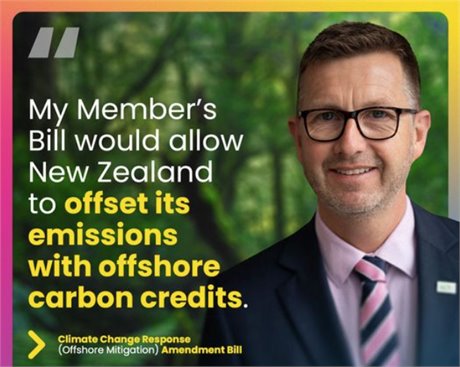 |
| ACT campaign material on Facebook features MP Simon Court |
A private member's bill from the ACT Party could delay gross emissions reductions and ultimately threaten New Zealand’s climate targets, according to an expert.
The ACT Party’s Climate Change spokesperson Simon Court has lodged a member's Bill to amend the Climate Change Response Act, which he says will make it easier for New Zealanders to access cheaper international carbon credits.
Court is hoping other parties will support the bill if it is drawn from the biscuit tin, as he says it would provide a way for New Zealand to meet its climate obligations without “unfairly punishing” local industry.
“New Zealand has a duty and responsibility to account for our carbon emissions, which are part of a global problem, so it makes sense to allow New Zealand businesses and consumers to access high quality and certified international carbon credits to mitigate our emissions. The Climate Change Response (Offshore Mitigation) Amendment Bill will help us ensure this happens.”
The Climate Change Response Act already allows offshore mitigation, although current regulations assume that there won't be any approved overseas units until the end of 2027, and amendments made by the previous Government prioritise domestic emissions reductions.
In contrast, ACT’s proposed approach requires the Climate Change Minister “to be neutral” about whether emissions budgets are met through domestic emissions reductions and domestic removals, or offshore mitigation. It also deletes a reference to the Climate Change Commission being able to recommend limits on offshore mitigation.
But carbon credits expert Ann Smith says the policy takes an overly simplistic view that businesses will be able to easily access offshore carbon units, when in fact it involves highly complex issues which have not yet been settled in international negotiations.
Since the Paris Agreement came into force in 2020, there are few, if any, examples of individuals or companies being able to purchase offshore carbon units for compliance purposes. “There is no indication in the proposed policy on how New Zealanders will be able to access offshore carbon units that meet the proposed standards that do not yet exist. There is no information on whether there will be sufficient offshore carbon units available that meet these proposed standards.”
Buying overseas carbon units is not the same as meeting emissions reduction targets, Smith says. “The use of carbon units allows companies to compensate for continued emission of greenhouse gases. This might not result in a reduction in emissions in the national greenhouse gas inventory.”
Using cheaper offshore carbon units would allow companies with obligations under the Emissions Trading Scheme to afford to buy more units and delay gross emission reductions. “If gross emissions reductions are delayed, this increases New Zealand’s future liability as the cost of carbon units will rise over time.”
Allowing companies to buy offshore carbon units also means that money currently paid to purchase NZUs, issued through the NZ ETS, would go offshore. “How does this loss of revenue to New Zealand achieve “least cost” overall for the business sector?”
Smith says the policy might have unintended consequences for forest owners, who could lose ETS revenue and reduce future planting.
“Assuming that offshore carbon units that meet the proposed quality standard are able to be accessed and are cheaper than NZUs that meet the same quality standard, what happens to the income of entities in the forestry sector that currently earn NZUs and sell them to emitters with ETS obligations?”
According to Smith, any legitimate offshore carbon units - if they are available at all - are unlikely to be as cheap as Court hopes, considering that the EU ETS carbon price was as high as €105.73 in 2023. “Where will this cheaper ‘offshore mitigation’ be sourced?”
New Zealand is already planning to meet its international obligations under the Paris Agreement by buying overseas units in country-to-country transactions, at a pricetag Treasury estimates will be upwards of $4 billion to 2030.
“These units will only be valid under the Paris Agreement if the other country makes a corresponding adjustment to its carbon accounts,” Smith says.
Climate Change Minister Simon Watts would not say whether or not he would support the bill. “This Private Members Bill has yet to be drawn and placed on the Order Paper; it is not a government bill,” he told Carbon News. “The government’s priority for the ETS is ensuring stability and certainty in the market so it can continue to reduce emissions.”
ETS expert Christina Hood, head of Climate Compass, told BusinessDesk she didn’t think the bill would get far if it was drawn. “What's actually being proposed here is essentially a weakening of our emissions budgets and [the] ETS. That would be a pretty big step backwards and one, in all honesty, I don't think other political parties would sign up to."
print this story
Story copyright © Carbon News 2024

New Zealanders losing ambition on climate change: Ipsos
Wed 20 May 2026
By Pattrick Smellie | New Zealanders’ belief that their government has a plan to combat climate change has taken another serious hit in the latest poll of 31 countries by global research firm Ipsos.

Pacific voice on climate at the UN
Wed 20 May 2026
A New Zealand-based researcher has told a United Nations forum that rising sea levels are already reshaping life across the Pacific and climate change is causing irreversible impacts on water supplies, food security and cultural identity.

NZTA rejects covering $145m of Wellington public transport projects
Wed 20 May 2026
By Justin Wong, Local Democracy Reporter | More than $145 million of Wellington public transport projects - including new bus spines along the harbour quays and the redevelopment of ageing Waterloo station - never made it into the Government’s $32.9 billion national land transport plan.

NZ Govt’s move to halt climate litigation under international scrutiny
Tue 19 May 2026
By Liz Kivi | Local and international NGOs have signed an open letter calling on the Government to reconsider its decision to shield major emitters from legal liability for climate-related harm.

Hipkins pans LNG plan as ‘massive step backwards’
Tue 19 May 2026
By Liz Kivi | Labour leader Chris Hipkins has told a Queenstown audience that a Government he leads would not proceed with a planned LNG import terminal, if elected at November’s election.

Competition weak in key energy sectors says Commerce Commission
Tue 19 May 2026
The Commerce Commission says competition remains weak in New Zealand's electricity and gas sectors despite modest improvement across the wider economy, highlighting how difficult it is for new entrants to challenge established infrastructure players.

Biomass sector asks: where did the love go?
Mon 18 May 2026
By Pattrick Smellie | New Zealand has sufficient biomass in its plantation forests to replace natural gas for industrial process heat at lower costs than electrification, but is failing to get the attention it deserves, sector leaders say.

Urgent need to rethink tourism says expert
Mon 18 May 2026
By Shannon Morris-Williams | The post-pandemic recovery has created an urgent need to rethink how tourism operates, who benefits from it, and how it impacts the social and environmental systems it depends on, according to new research.

Green building council calls for clean energy policies
Mon 18 May 2026
The New Zealand Green Building Council has released its 2026 election manifesto calling for policies to reduce energy waste in buildings, lower household and business energy costs, and improve New Zealand’s energy security.

Future big droughts may be worse than we think – NZ’s past shows why
Mon 18 May 2026
By Adam Brown, University of Waikato; Dave Frame, University of Canterbury, and Luke Harrington, University of Waikato | For an agricultural nation like New Zealand, severe drought is one of the most ominous consequences of a warming planet.
